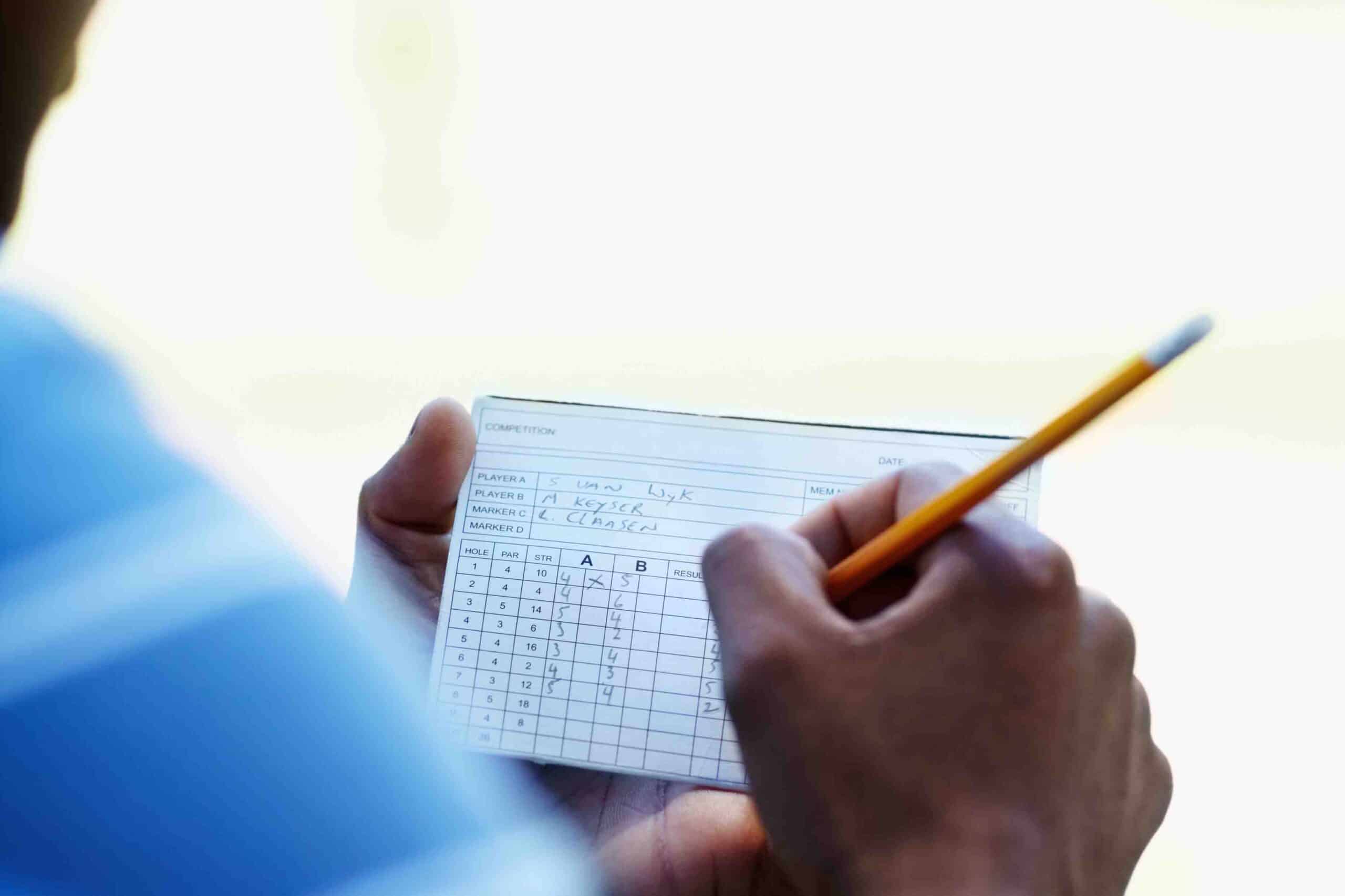



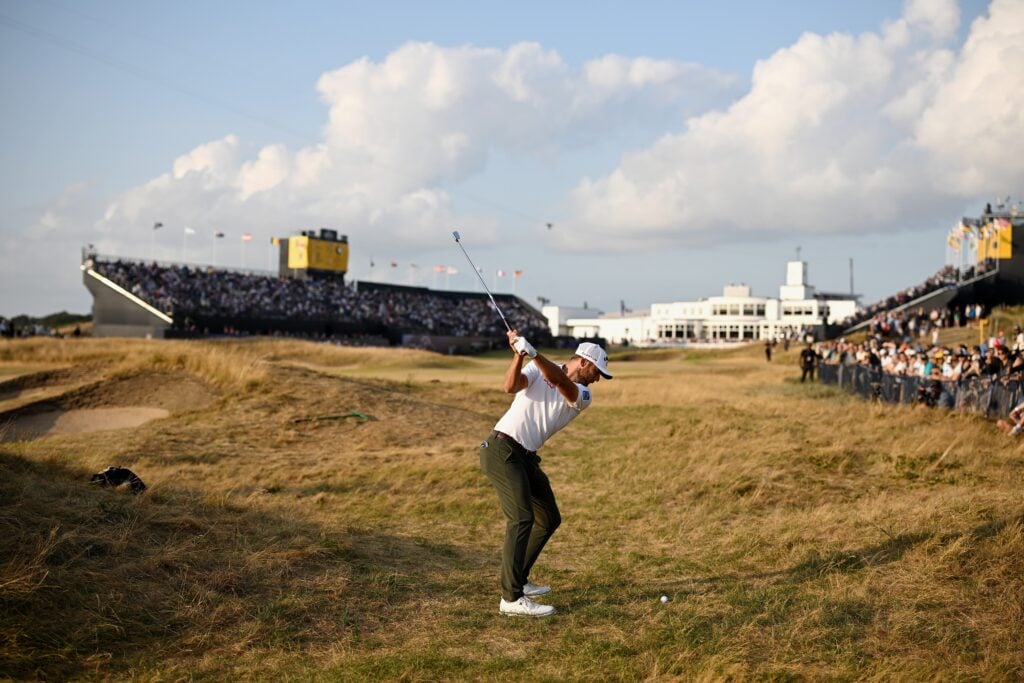
They say that many of the best rounds start with a bogey. Well, Lucas Herbert’s record-equalling 62 at Royal Birkdale in the second round of the Open ended with one, but by then he had already recorded nine birdies, with the 18th his sole blemish.
It seems that Birkdale has always been conducive to low scoring: Herbert equalled Denis Durnian’s all-time 9-hole Open scoring record of 28, also set on the Southport links’ front nine.
It was here in 2017 that Branden Grace finally shattered the glass ceiling- or should that be floor – to post the first score lower than 63 in major history.
And on the second day of the 154th Open, Herbert equalled his score of 62 and would have bettered it had he managed to hole a five-footer for par on the final green.
Within a couple of hours, Sam Burns had added a 62 of his own, while eventual champion Ryan Fox posted the same score on Saturday morning.
But we are going to concentrate here on Herbert’s round. It was intriguing to learn that the Australian knew exactly what was at stake, having admitted that breaking records first entered his mind after making his third birdie in as many holes at the beginning of his round.
“I’m a golf nerd, so I know all the numbers, all the records, everything like that,” Herbert said. “When you get an opportunity to get off to a hot start on a golf course that’s a par 70 – not that I wanted the thoughts to come into my head, but that was honestly when it came in.”
Let us start with the bare numbers. Herbert made nine birdies, eight pars and a bogey. Eight of those birdies came in the first 12 holes, which he covered in a scarcely credible 37 blows.
Not until the 14th did he record a five on his card, but he did close his round with two more.
Advertisement
Herbert played the quartet of short holes in -2, the 12 par 4s in -6 and – curiously – the pair of par 5s in level par.
It must be said that conditions were benign – warm and close to still. Add to the equation burned-out rough, firm fairways and greens both receptive enough to give the players control over well-struck approach shots and smooth enough to increase the chances of rolling putts in. Scoring was significantly higher each afternoon at Birkdale as the greens became firmer, slightly bumpier and the breeze increased.
ALSO: How golf course rankings have evolved over the last two decades
ALSO: Why Royal Birkdale is the perfect Open Championship venue – and why the R&A can’t get enough
Nevertheless, a look at Herbert’s clubbing is instructive.
Let us start with the par 3s, reconfigured for the championship to play in four distinct directions and all at different lengths. The idea was surely not that a player would hit a pair of 6-irons (to the 4th and 15th), a gap wedge (at the 7th) and a pitching wedge (at the 12th).
As for the par 4s, Herbert used one of his wedges on six of them for his second shot. He hit a 6-iron into the 13th and a 7-iron into the 6th. The rest were 8 and 9-irons.
It is also worth noting that the only par 4 where Herbert used his driver from the tee was on the 18th. Elsewhere it was 3-woods and long-irons.
There is a school of thought that this shows Herbert did not overpower the course with raw power but rather with skill.
That is fair enough, but another interpretation is that he barely even needed to reach for his driver to bring Birkdale to its knees.
It is not the case that Herbert achieved golfing perfection either: he hit only half of the fairways (seven out of 14), and 14 of the greens, requiring just 24 putts.
Then again, hitting every fairway on a links course as fast-running as this is practically impossible. It hardly seems fair to count balls trickling into the lightest of semi-rough as missed fairways.
What it does show is how difficult it is to force the elite male player to use much more than a short iron into any par 4. All the more so in conditions like these.
The architect has more control over par 3s where the length of the approach shot can be dictated. Whereas on a par 4, a drive in excess of 300 yards can only leave a mid-iron at the most, unless conditions are adverse.
It is much the same story on the par 5s, where even holes of 600 yards or more can be covered comfortably in two shots.
When you think that Fox’s winning score was only -10, and that these 62s represented rounds of -8, you can see them as the exceptional rounds that they were.
When it came to course set-up, the R&A had several levers to pull during the championship to increase the challenge.
To cite just one of them: on the final day, for the only time over the week, the back tee was used at the new par-3 15th hole. This tee is also further to the left. That was coupled with a back-left flag.
Architect Tom Mackenzie designed this hole with the prevailing wind helping, envisaging players landing their shots short and chasing them on to the green.
But here we had a left-to-right wind. Put simply, the hole would have been unplayable for just about every golfer on the planet. It tested the best male players in the world to the limit – but some were able to find a shot that carried the bunker at the front of the green, held its line in the crosswind and then landed softly enough to hold the green and not run away from the flag.
Advertisement
One of the reasons that the winning score was 270 (which is still -18 if the par is 72, let’s remember) is that Royal Birkdale has just been recalibrated for the purpose of hosting an Open. While the headline changes are well-documented, some of Mackenzie’s best and most important work came in tweaking the positioning of the fairway bunkering to reflect where he thought the modern tour player would be driving.
The same happens to Augusta pretty much every year between one Masters and the next.
But if you don’t have that luxury, and the means and inclination to move hazards around, it is an increasingly futile task to protect a course against the power of the modern elite player.
None of which is to take anything away from Herbert – or Burns or Fox for that matter. These were exceptional rounds at an exceptional golf course in the heat of a major championship.
NOW READ: Why Rory McIlroy driving greens at Royal Birkdale represents a massive problem for golf
NOW READ: Should Scottie Scheffler’s controversial drop at The Open spark a rule change?
What do you make of this column about Birkdale and the golf ball distance debate? Tell us on Facebook!
Advertisement