


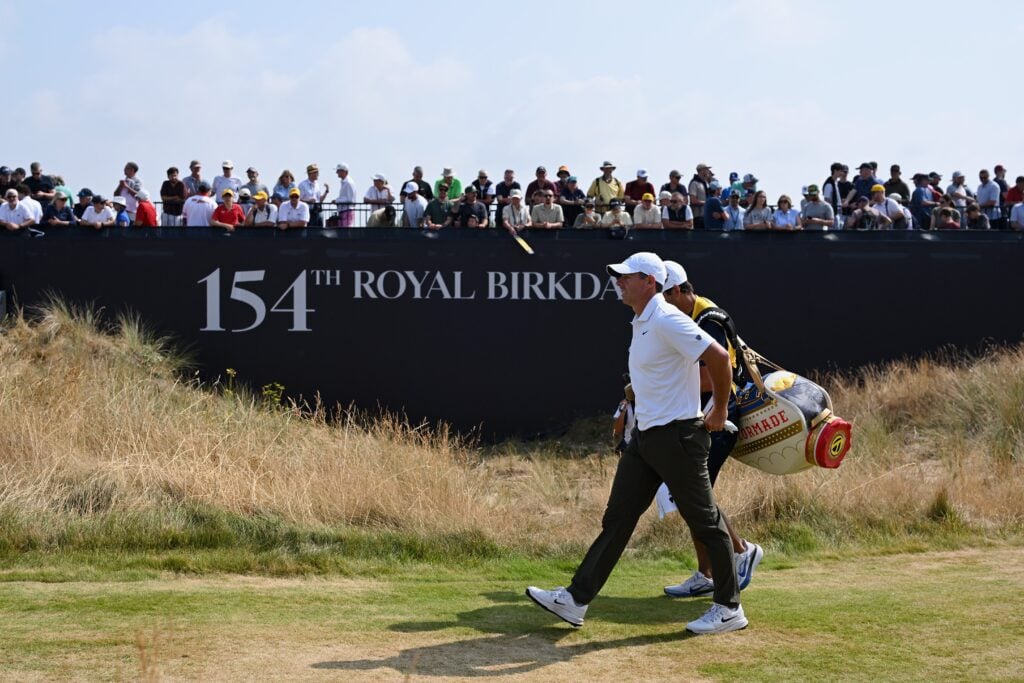
Rory McIlroy seemed to remember he was Rory McIlroy on the same hole of the first two rounds of The Open at Birkdale.
He hadn’t made a birdie before reaching the 9th tee on Thursday, and was in better shape reaching the last hole on the front nine on Friday.
The six-time major winner didn’t take one look at the fairway, nor the rest of the clubs in his bag. He ripped his driver over everything – the dead grass, the dip and hundreds of spectators milling around the corner of the dogleg – and his ball arrived on the green on both occasions.
He made birdie both times, sadly not an eagle. But that came on Saturday, as he hit his tee shot just short of the green and chipped in. As awestruck as we all were, these monstrous tee shots represent a growing concern in golf that the game’s governing bodies are trying to address. To this point, they still have work to do.
“It’s a massive problem,” said NCG Top 100s chairman Dan Murphy on the NCG Golf Podcast in Open week from Birkdale.
“Because we stood on that dune at the back of the 11th today (day one of the tournament) and we were looking across the entire links and I was looking at the tee on the 8th. I was saying, ‘Look where that tee is – it’s so far back’, and then I noticed it was on the boundary of the property.
“So on an enormous championship links course, where they’ve pulled the tees back and back and back, and they’re now right on the limit of the property as they are on every single other Open venue, and now we’re having people knocking it on par 4s that are north of 400 yards long, and it’s not even exceptionally windy.
Advertisement
ALSO: What has happened to golf ball roll back and what does it mean for me?
“I think it’s a huge problem, and it worries me greatly that we’re seeing the best courses, certainly in this country, arguably in the whole world, reduced to being a different par in some cases. I don’t like it at all.
“It’s like they’re going through a secret passage. You take the 10th hole. I don’t know how many bunkers there are on the inside and outside of that dogleg, but let’s say there are six or seven, and they’re all hazards that you have to navigate your way skillfully through.
“But they’re not having to do that because they’re just ignoring them. This isn’t to take anything away from the modern tour player. It’s just to say that the equipment has unfortunately got out of hand, and you’re at a stage where these holes are no longer able to test the same skills as they were several years ago, and I don’t like to see it.”
This discussion on the NCG Golf Podcast comes amid the distance debate in golf. Back in June, plans to limit how far the ball travels in the professional game were put on hold by the R&A and USGA, and other options are being considered to try to solve the game’s distance problem. The object of reducing distance is to maintain the integrity of skill in the sport, and for sustainability reasons with regard to golf couses and land acquisition.
There was meant to be a phased implementation of golf ball roll back. In 2028, the conditions under which balls were tested were meant to change, producing balls that don’t travel as far at the elite level. 2030 was meant to be the year of enforcement for recreational golfers.
Now, any change in the elite game will not occur before 2030, and there will be no phased introduction of new regulations.
Different parts of the golf industry want different things. Manufacturers, a lot of players, and the PGA Tour are not supportive of roll back, whereas figures like McIlroy, Tiger Woods, and Augusta National, along with the R&A and USGA, believe something must be done to rein in the astronomical numbers that top players achieve off the tee.
“If you take the 8th hole as an example, I was stood there watching that tee shot, and I think there were people sat in the gallery who’d been there a lot of the day, and they couldn’t believe how far Rory was down. I hadn’t watched the TV all day, so I can’t tell you what other people have been doing on that hole,” said Tom Irwin, host of the NCG Golf Podcast.
“But there was this marked difference between the strategy that Xander Schauffele adopted and the strategy that McIlroy adopted, and there was 120 yards between their approaches. That hole’s 460 yards long, and it is playing 37 over par.
“Are we doing the course and are we doing technology a disservice by talking about what DeChambeau and McIlroy are doing when that isn’t necessarily what the rest of the field are doing?”
At the 154th Open on the Merseyside coast, there have been contrasting strategies used by each player. The course has been largely dry and firm on championship days, especially in the afternoon of each round.
Some players, like McIlroy and Bryson DeChambeau, have opted for driver a lot of the time to advance up the hole as far as possible, with the hope of having a wedge from a short distance in a good lie. Some players haven’t hit driver everywhere, and have used the links and the contours to shape shots into the greens.
Advertisement
“I think the time when the genie was out of the bottle was really the time of the arrival of Titleist Pro V1, but I just want to be clear that I’m not in any way criticising Acushnet, who made the ball and quite the opposite – what a job they did,” Murphy continued.
“I don’t think that the equipment manufacturers are the bad guys here. I think they’re trying to make the very best equipment they can within a certain set of parameters.
ALSO: R&A backs the World Handicap System as criticisms continue
“But I think that ball really took everyone by surprise because you were able to hit it as far as any other ball, but also with all the control as well. And I think that without exaggerating, tour players were broadly 20 to 25 yards longer, but with retaining the same control.
“I think that particular quantum leap was the bit that probably made the difference and took us over the edge, and the rest of it is just incremental gains, isn’t it? It’s just science and evolution and players being fitter and stronger.
“If there’s one moment, I think that’s probably it.
“Golf is the only place where the size of the arena changes. That is a difference, isn’t it? The technology isn’t changing so much on the equipment in many other sports. F1 is one where they just do all sorts of things to try and pull the performance of the vehicles back, and that’s how they try to keep the skill in it, but it becomes very technical.
Advertisement
“But that’s how they do it. Golf works in a slightly different way. The tennis court doesn’t get bigger, the football pitch doesn’t get bigger. Of course, sports evolve, and if you compare a football match now to one from 50/60 years ago, it’s a very different thing.
“Lots of the progress is great, but I just think because there isn’t enough land for these golf courses, and there isn’t enough land anywhere, really. I think that’s terribly sad that you’re at a stage now where so many courses aren’t even on the map anymore in terms of championships, and it’s just so expensive, and it’s such a waste of resources. It just can’t be good.”
As we stand, golf balls won’t change until at least 2030, as it seems there is no group agreement between golf’s stakeholders, including the tours, players, manufacturers and governing bodies, who are determined not to stand still and watch the 400-yard drives keep passing them by.
Given what is at stake, and how many parties must buy in, is there a chance that roll back never happens?
“To make a wider point about distance, I just don’t understand how any sort of rollback can ever happen,” NCG’s Matt Chivers says.
“With the manufacturers not buying in, the PGA Tour not buying in. The only people that are for it are Augusta and the Old Course, and Woods and McIlroy, who transcend the game and are in a position where their opinions are worth more than anything.
“But I don’t understand how any sort of meaningful rollback can happen, and I think that is what we’re seeing with the delay to 2030. Because what I took from the most recent update to the roll back plans from the R&A and the USGA is that the 2030 date is not even guaranteed either.”
Advertisement
NOW READ: I’ve changed my mind on mobile phones – they shouldn’t be anywhere near the golf course
NOW READ: How much is a green fee at Royal Birkdale?
What do you make of this roll back-Royal Birkdale debate? Tell us on Facebook!