



I won a board competition. Yeah, yeah, good for me – I’m not writing that to show off, I’m doing so to reveal something I think needs attention in the World Handicap System.
My course is a Par 73, with a Course Rating of 73.2 and a Slope Rating of 132. It’s 6,800 yards off the white tees and the Playing Conditions Calculation was 0.
Off a WHS Index of 12.5 and a Course Handicap of 15, I shot a gross 80 in an individual medal. It was nett eight under. It translated to a score differential of 5.8. I won the competition by one shot.
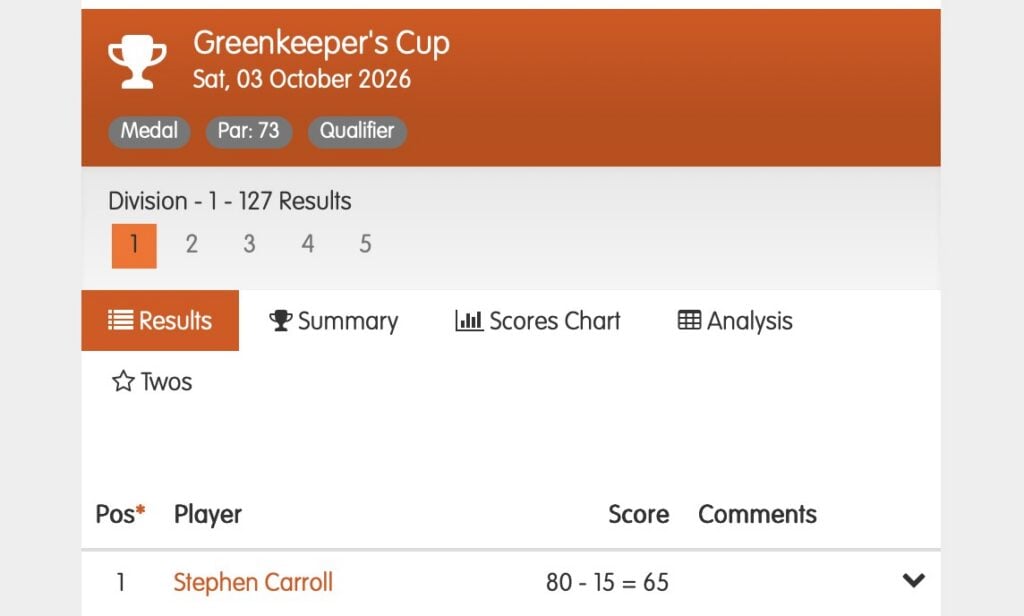
It was a triumph in an otherwise poor season that has seen my handicap jump from 10.0. For those of a mathematical mind, the rest of my counting differentials are 13.5, 10.3, 13.5, 11.8, 10.1, 12.7 and 13.5. Pretty ordinary stuff I’m sure you’ll agree.
In an averaging system, like WHS employs, one great round doesn’t necessarily change too much in the Index stakes. It’s why people go nuts when someone shoots nett 59 off a high handicap and doesn’t see their handicap cut in half.
If the other seven counting rounds are poor, it’s just not going to have the wrecking-ball effect you might expect.
The 0.3 strokes that make all the difference
But that’s where the Exceptional Score Reduction can come in. It’s meant to account for the occasions when a player posts a score that is significantly better than their current ability.
It applies when a single score differential is 7.0 or more strokes below a player’s WHS Index when the round was played. For differentials that are 7.0 to 9.9 strokes below their index, a -1.0 reduction is applied to the most recent 20 score differentials.
If the differential is 10.0 or more below the index, a -2.0 reduction will be applied to those 20 scores.
I was once a single figure handicapper. My index was as low as 7.3 in the summer of 2021, and I’m looking to return to the promised land ahead of my 50th birthday.
Advertisement
So given I’d just smashed my Course Handicap in this competition, I was looking forward to a healthy cut.
Then I clicked onto the WHS app the day after the event. Instead of the meaty chop I was expecting, I’d lost just 1.1 from my index.
My exceptional round hadn’t been quite exceptional enough. Here’s how short it fell. With an Index of 12.5 and a differential of 5.8, I was 6.7 strokes below my number.
Close but no cigar. By 0.3 to be precise.
The more I thought about this, and assuming my maths is up to scratch, the more I started to wonder about the way the Exceptional Score Reduction currently works.
The odd thing about a seven-stroke threshold is that 6.7 and 7.0 are treated every differently, despite being almost indistinguishable performances. For me, it probably came down to one putt – specifically the three footer I dragged left on the 16th.

How exceptional was my round?
USGA figures have put the odds of a 10.0 to 14.9 handicapper producing a nett score differential of -6 at 1 in 191.5, and -7 at 1 in 391.4. My -6.7 sits between the two, putting the odds of a round like mine at a rough 1 in 300.
That’s pretty exceptional, wouldn’t you agree? Then, scrolling through my own rounds, I can see I have never had such a low score differential during the WHS era.
In fact, to find a score with a differential lower than the one I posted on Saturday, I had to go back EIGHT years. Remarkable for me, but apparently not exceptional.
Isn’t that a nonsense? Perhaps in the upcoming review of the Rules of Handicapping in 2028, they could look again at where the bar for an exceptional score falls.
A recurring complaint about the WHS is the number of big scores that are winning competitions – particularly in Stableford events, and particularly from higher handicappers.
The odds of a player with an index between 25.0 and 29.9 shooting a nett score differential of -7 is 1 in 110.5. For a 39.9 index – which is as far as the USGA table goes – it’s a 1 in 48.8 chance.
WHS data released by the USGA and R&A revealed that 96.9% of golfers produced no exceptional scores last year.
So if we want to tackle high winning scores while also triggering reductions for better players who do something genuinely startling, is a different scale worth considering? How about one that slides depending on ability?
Higher handicappers have more shots to play with and clearly more scope to improve. Achieving a score several strokes better than their Index is statistically more achievable.
For better players, that same improvement represents a much rarer performance. But, right now, the system judges both by the same seven stroke yardstick.

What is exceptional? Is seven strokes the right threshold?
For simplicity’s sake, let’s move the bar. What about five, for example? I’m not saying this is the magic number, I’m trying to ask the question: how far below a player’s index does a differential need to be before we recognise something unusual has happened?
It would still be an incredible round in my case – more than a 1 in 90 shot, say the USGA – and would be achieved only one time in 40 by a player between the 25.0 and 29.9 index, and 1 in 23 by a 35.0 to 39.9 handicapper.
It would help increase the rate of descent for those players who have much more room to improve, while also recognising the long-shot ability of ‘better’ players to create something magical on the course.
Seven strokes may have made sense when the WHS was designed but could an example like mine suggest the bar is too high?
Advertisement
If a -6.7 differential can basically be a once-in-a-decade performance for me, but not enough to tip the scales, should we ask whether a fixed number is the best way to define what counts as exceptional?
Now have your say
WHS exceptional score reduction: What do you think? Should the ESR better reflect the way individuals scan score, or are my sums all wrong? Let me know in the comments, by email at s.carroll@nationalclubgolfer.com, or get in touch on X.
NOW READ: How does the Exceptional Score Reduction work?
Advertisement