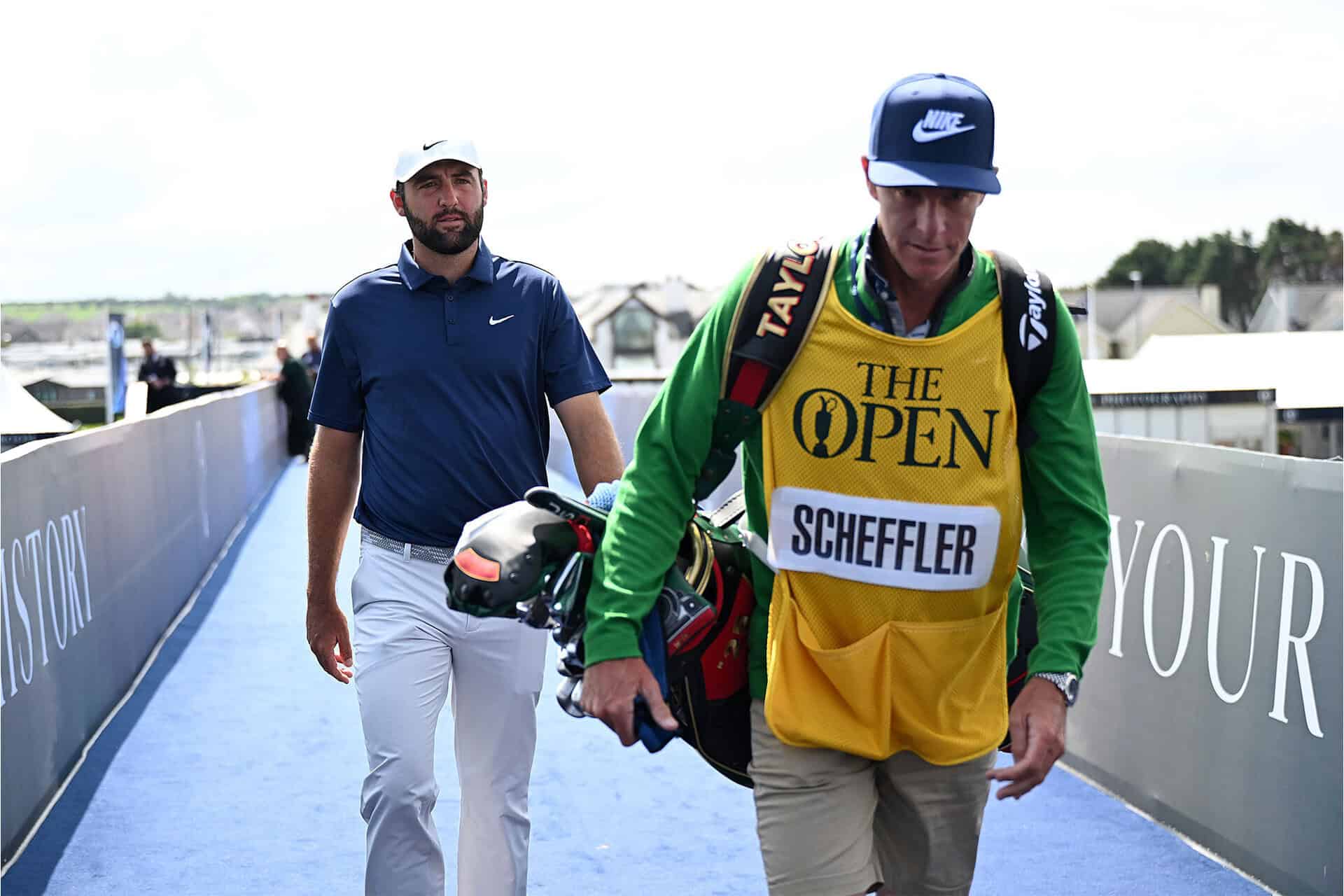



Bryson DeChambeau must’ve breathed a sigh of relief when he caught wind of the temporary immovable obstruction fiasco (TIO) that Scottie Scheffler was involved in at The Open on Sunday.
We’re all still talking about DeChambeau, of course, but you take my point.
On Birkdale’s par-5 17th hole and with the World No.1 needing to step on the gas to reach the top of the leaderboard in the final round, Scheffler wielded a wood and hit his ball way left when going for the green.
The ball landed in an area next to Clarets, a hospitality tent also known as a TIO. Where his ball finished was judged to be in the TIO. The ball was never seen again. A rules official told Scheffler that he didn’t need to find the ball to get relief, so Scheffler stopped searching and took a drop back in the rough, 90 yards from the flag.
Model Local Rule 23F says if the player’s ball has not been found but is known or virtually certain to have come to rest in a TIO, the player may take relief by using the estimated point where the ball last crossed the edge of the TIO. Scheffler went on to make a birdie, but also went on to come tied for fourth behind winner Ryan Fox.
While rules are rules and Scheffler used them perfectly well to his advantage to make a miraculous birdie, this caused some outrage online, and on the NCG Golf Podcast, with the main bones of contention being: should the rules of golf allow this level of relief to a lost ball concerning TIOs, and must The Open rethink where various forms of TIO should be positioned in championship week?
On the NCG Golf Podcast, Tom Irwin, Steve Carroll, Dan Murphy and Matt Chivers debated the topic. Here is a transcript of the debate:
Advertisement
Scottie Scheffler Open ruling debate
Tom: “I think something else needs to be done because you’re trying to create an equitable playing environment, and the presence of those hospitality pavilions and scoreboards, it means that missing in some spots is much more likely to yield a free drop than others.
“You then get in a position where you’ve got players who are obviously aware of this and are almost playing for those misses. I’m all for players having a good miss and understanding where the right miss is, but I don’t think playing for a drop from a hospitality pavilion is really what we want from the Open Championship.
“I don’t know what there is to do about it. But it feels like it needs some sort of alternate rules mechanism, or maybe there needs to be a penalty drop. It’s just not right how it is at the moment.”
Steve: “I don’t have a problem with it. I’m going to tell you from a rules perspective. Everyone gets themselves in a right tiz when the rules don’t work in someone’s favour, and then they get in a right tiz when the rules do work in someone’s favour; they’re just the rules.
“The only consideration from a rules point of view is: is this ball known or virtually certain to be in the temporary immovable obstruction? If it is, he can get relief. That’s it.”
Tom: “I don’t have any problem at all with what Scheffler did.
“Scheffler is just playing within the parameters that are provided; what I’m saying is, is the rule not wrong?
Steve: “I don’t think it is. There’s an argument about where temporary immovable obstructions are on the golf course. Where are we putting them? Should we be putting them in different places? Is the rise of the logistics of The Open so huge now that these things are everywhere, and as a result, that’s changing the nature of the TIO rule?
“But in terms of what was done, in terms of what happened – I don’t have an issue with it.
Dan: “As somebody who stumbled across the scene, I was absolutely baffled by how it played out, as someone who was there. Balls were raining over my head as I was walking up the 17th.
“It seems that something has gone wrong when a ball has disappeared. It went into an enormous bush on an enormous dune. It wasn’t in Clarets hospitality. It was the other side of Clarets hospitality.
“Let’s say it’s 40 yards left of the left edge of the fairway on 17. There are 10,000 people on that hole. Nobody’s got a clue where that ball is – it’s more lost than lost. The player’s got no idea; he didn’t see it as it came over a dune.
“Nobody’s got any idea where that ball is beyond the rough idea that it was left and going left. It just seems bizarre to me that that would result in a free drop. I’m then thinking, does he have to go back on the line of it, and this will be interesting because there’s just a load of dune wasteland.
“It seems incredible that that’s how it played out.”

ALSO: Ryan Fox’s Open win should embarrass slow golfers everywhere
Steve: “Normally, when you find your ball in or when it’s known or virtually certain that your ball is in a TIO, you get nearest point of relief from the obstruction, and you drop it in a one-club relief area. There is this thing that is called line of sight that comes into play, and line of sight, you actually see more TIO relief from line of sight than you do from anything else.
Advertisement
“What that essentially says is, if the obstructions on your line of sight to the hole are on a straight line, then you can get the green light for free relief as well. It’s hard to explain this, as the R&A and USGA’s document on temporary immovable obstructions is 22 pages long, so I mean it gives you a sense of how difficult it is.
“But what you have to do for line of sight relief is essentially, if a ball is within one club length, it’s measured on what’s called an equidistant arc from the hole to a spot where the obstruction would then be on the player’s direct line of sight.
“That’s what’s called the corridor, and then, so, if I remember the rule right, you get one club length, then you get one club length for the corridor, you essentially get two club lengths.
Tom: “I’m saying that because of those immovable obstructions, the golf course has played materially easier this week than it would do if they weren’t there.
Steve: “That’s not a rule problem: It isn’t a rule problem; they just don’t need to stick a big hospitality tent there.
Dan: “His ball wasn’t in somebody’s creme brulee. His ball is in an enormous thicket. It’s never going to be seen again. I’m trying to figure out what he’s going to make, and that he’s got to get up and down from somewhere very unpleasant with his provisional to save bogey. The next thing – I look on the app, and he’s made birdie.”
Advertisement
Tom: “There are two things in terms of potential solutions. One is the course setup. So that is a par 5 where people are going to be going for the green in two, so you have to have a penalty for missing the green. It can’t be a free drop, can it?
“And the World No.1 player has said my miss is left, so I knew if I missed it left, I was just going to get a free drop. So he basically took it on because of the presence of the hospitality tent. That’s what I’m saying is the problem. Don’t put the hospitality there. Put it short right, or put it further back on the left.
“Or, I don’t understand what’s happened to drop areas. If he’s hit his ball effectively pin high, but 100 yards left, and there’s a hospitality pavilion in the way, why isn’t there a drop area that is 100 yards left of the green that has at least afforded him the same kind of shot they would have done if he’d found his ball? Because where he actually dropped it bore no relation to where his ball was.”
Steve: “I wonder whether they contemplated the prospect of too many balls going in there. I wonder if you’ve got a Spieth on the 13th situation where, if my memory serves, no one ever thought that anyone would take line of sight relief going into the driving range. And if you notice this time, because the hospitality area was there, the spectator village was there, the right of the 13th was out of bounds this time.
Advertisement
“I just wonder whether they’ve not considered the possibility of someone going that far left that they put a drop zone in. But I was looking for drop zones around the grandstands this time because obviously, as media we like to do that. I didn’t see too many around Birkdale. Maybe that was my eyes not looking properly, or maybe it was just because the grandstands were a bit more set back from the greens, and a lot of the greens went up and down, and then there was this rough that there wasn’t much prospect of balls being stuck in and around the grandstands.
“I don’t disagree with you. Maybe that’s what they do. Maybe that’s how they look at it in the future; they say, if you hit it in this area, we’re going to have a mandatory drop zone that you have to put it into.
Matt: “We’re all saying we haven’t got an issue with the application of the rule because it’s written down, and obviously we haven’t got an issue with the referee that allowed Scheffler to take the relief, and we haven’t got an issue with Scheffler either.
“I thought I’d read out what Scheffler said afterwards:
‘If I find it, does that help me? Can I drop it? Since that would be about 50 yards closer to the hole. The referee said, ‘Yes, you can use that spot, but you might have to go to the other side of the TIO’, which I didn’t exactly know where that would be, and that’s not a great angle coming across there.
‘So I decided to stop the search and go back and drop it, doing point of entry TIO relief. Actually, I did that once this year during the Byron Nelson as well. Not something I’m proud of, but I was familiar with it’.
“I’ve got no issue with the rule application, but it is obvious why this is so unpalatable. He’s hit such a bad shot, and he’s lost his ball. I get the application of the rule, but it’s just a birdie with no integrity.
“That is so unpalatable for people like us. Especially with the Bryson ruling earlier in the week, you’ve got a few players thinking that the Bryson ruling is unfair, and then you’ve got this happening. There is an extent to which some of these players want it every way.

ALSO: Why Rory McIlroy driving greens at Royal Birkdale represents a massive problem for golf
Steve: You’re talking about two different things there. So in terms of the TIO, it’s if the ball is known or virtually certain in there. I found the “I’ll stop looking for the ball” thing quite interesting, actually. What I found more interesting was the way that other people reacted to it, which is, yes, I’ll stop looking for the ball now because this often comes up, and I’m going to say it again for the podcast listener audience: you can’t declare a ball lost. You can’t do it.
“The ball’s only lost after three minutes have elapsed in the search. So while Scheffler can ask people to stop searching, they could have kept searching, and the spectators who were in that area could have kept searching. So is that a fault of the rule, or is it a fault of the situation that people didn’t know the rule that allowed it?
“It could have made a material difference, actually, because if they’d found the ball, then that might have impacted where he found his nearest point of complete relief, if my memory is correct.
“Whereas obviously, because he doesn’t find the ball, then it’s the last estimated point that the ball is deemed to have entered the TIO or virtually certain to have entered the TIO.”
Tom: “I do think the two things are linked (DeChambeau and Scheffler’s ruling), because what you’re talking about really is integrity of the sport, aren’t you? I think Scheffler actually made this point himself in his press conference about Bryson, where he wanted to say I don’t think Bryson is a cheat, but the ruling is correct. And he actually said, I think we need to get back more to fastidiousness around this kind of thing, and he was meaning people tramping down stuff behind the ball and all the rest of it.
“But I do think the two things are linked because golf is a daft enough sport as it is. But if you’re watching that for the first time, which a lot of people would have been, and he could quite easily have won The Open yesterday by getting a very, very advantageous drop effectively out of someone’s glass of red wine. That is just ridiculous.
Matt: “There are handball rules in football where they look an absolute nonsense on television, and you’re sat there going, ‘That is an absolute nonsense. How is that a penalty?’
“You can’t just say rules are rules and expect us to sit there and say, ‘Fair enough – I have to just accept that’. This is the same thing. He has hit such a bad shot, and I understand that rules are rules, and it’s no one’s fault.
“But it’s the fact that he has never seen his ball again because he’s hit it 40 yards left, and no matter what you think, no matter what the rule is, it is objectively baffling that he’s just made a birdie out of that.”
Steve: “You would be happy to accept this if it worked in your favour. You’re only unhappy because you don’t like the result, and you’re unhappy because you feel that the result’s egregious.
“If I give you a very brief club golf example of this, because it seems to be the problem is he hit his ball so far off target that he shouldn’t get relief.
“If it’s autumn and you hit a shot 40 yards wide and it goes into a load of leaves in the rough and those leaves are piled, you know that your ball’s gone in there, you get relief from it.
“The rule allows you, when you want it, to have relief.”
Tom: “That’s not a good example because I’m not aiming for the leaves. He said he knew he’d get free relief.
Dan: “The bit of it that doesn’t seem right is it’s the 71st hole of The Open Championship, and the best player in the world is in contention to win. There are thousands of people on that hole. The cameras of every major sporting broadcaster are watching Scheffler.
“He hits a shot that I’m not sure anybody knows where it’s gone. The player definitely doesn’t. The fans who were near where it might have landed, we definitely didn’t.
“There are however many officials within the group, and I don’t believe they knew where it was going. There are people in the kitchen at Clarets who are poking their heads around the door. They don’t know where it’s gone. Nobody knows where his ball has gone, and then a couple of minutes later, with the ball having never been found, he gets a free drop.
“That seems like something’s gone wrong, doesn’t it?”
Steve: “Someone somewhere said it was known or virtually certain that that ball was within the temporary immovable obstruction. Known or virtually certain is: it’s in there, I’ve seen it go in there, other people have seen it go in there, all the evidence says that the ball is in there, and virtually certain is there is at least 95% likely that the event in question has happened.”
NOW READ: Ryan Fox wins The Open Championship for New Zealand and for the good guys
NOW READ: Rory McIlroy: I’m not fond of ‘performative’ Bryson DeChambeau
What do you make of the Scottie Scheffler Open ruling? Tell us on Facebook!