


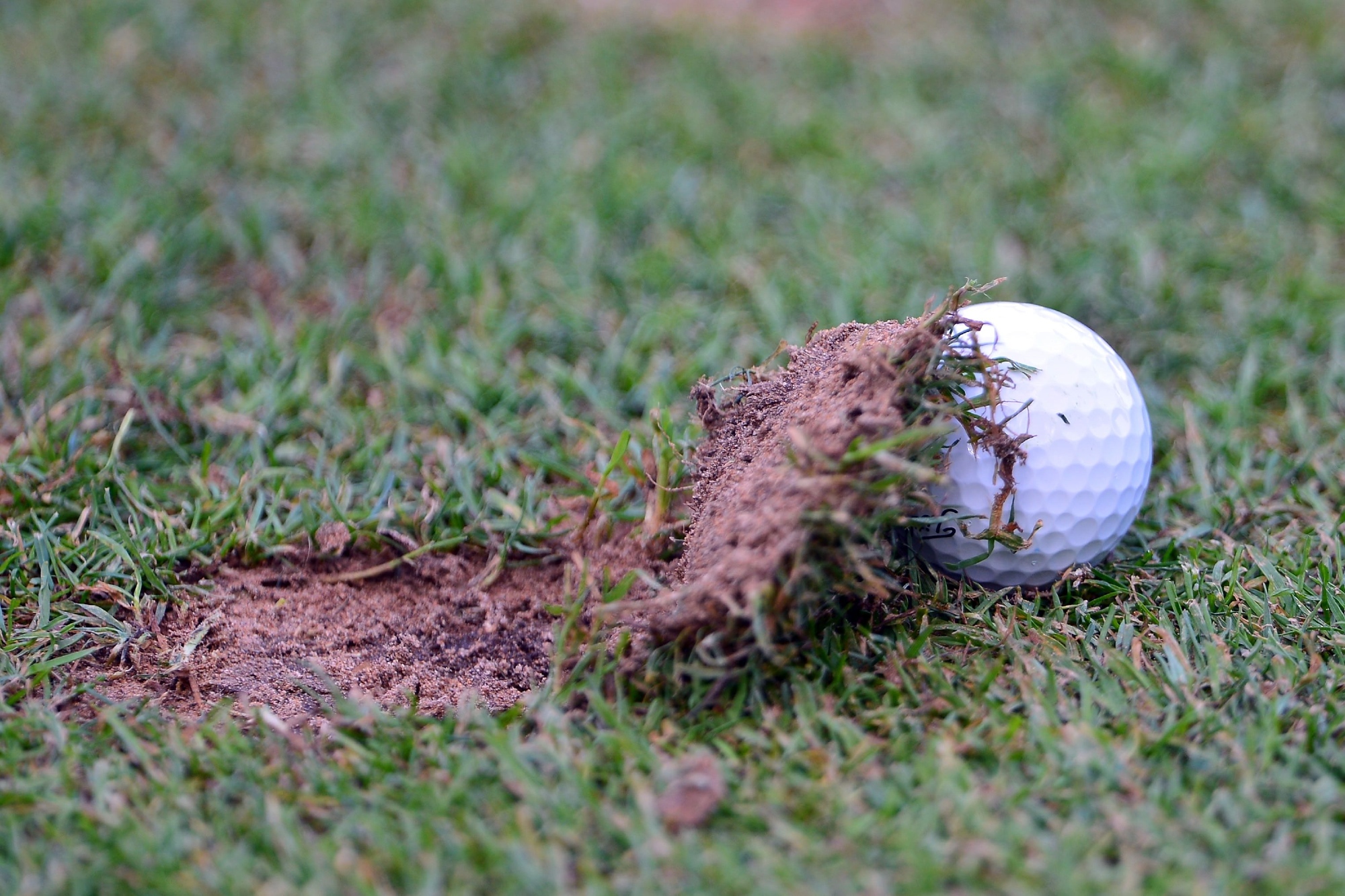
Don’t worry, this isn’t yet another article about balls lying in a divot. But getting unlucky after a good shot isn’t the only way you can be inconvenienced by a big wad of turf.
Some of you may have had this situation which arrived by email:
“A player took a shot and missed the ball but caught the ground causing a chunk of turf behind the ball. The turf was still attached. Can the player pat the turf down before their next shot?”
Well, that’s going to stop you getting a good strike, isn’t it? But are you stuck with it, or can you carry out an astute piece of gardening?

Can you flatten the grass behind your golf ball?
You all know there are some things just forbidden if they “improve the conditions affecting the stroke”.
I know I go on a lot about what they are, but they’re worth repeating. Those conditions involve the lie of the ball, the area of intended stance and swing, the line of play, and the relief area into which you might be dropping a ball.
Rule 8.1a (1) says you can’t move, bend or break any “growing or attached natural object” if it improves those conditions. Well, the turf is still attached.
And Rule 8.1a (3) says you can’t alter the surface of the ground by “creating or eliminating holes, indentations or uneven surfaces”.
The general penalty – two shots or loss of hole in match play – is the cost of getting it wrong. In the case of Rule 8.1a (3), you can’t even restore the original conditions if you messed about with them. The damage is done.
What if you were dealing with a divot? Also on the list of restricted actions covered in altering ground surfaces – again if they improve the conditions affecting the stroke – are “replacing divots in a divot hole” and “removing or pressing down divots that have already been replaced or other cut turf that is already in place”.
Advertisement
There’s a clarification that spells out what means. It considers when a “divot is replaced and must not be removed or pressed down” and it says pressing down, removing or repositioning a divot in a divot hole is “treated as part of the ground (and not as a loose impediment), even if it is not yet attached or growing”.
It adds a “divot has been replaced when most of it, with the roots down, is in a divot hole”. It doesn’t even have to be the same divot.
Got a question for our expert?
Despite the changes to the Rules of Golf in 2019 and 2023, there are still some that leave us scratching our heads. I’ll try to help by featuring the best of your queries in this column. Send me your questions by emailing me at s.carroll@nationalclubgolfer.com
What do you think about this rule? Can you flatten the grass behind your golf ball? You can also let me know by leaving a comment on X.