



Poke your head around the door of any clubhouse and it’s likely you’ll hear golfers chatting about bunkers. Only the greens are likely to shape more debate.
Whether it’s chuntering about ‘consistency’, or marvelling over renovated bunkers after a busy winter, we’re equally fascinated and fearful of the sand.
But what do you really know about bunkers? You might hear the pleas of a greenkeeping team urging you to rake them, but have you ever considered what it takes to maintain these hazards and keep them at the standards golf courses aspire towards?
What’s going to happen in the future? We know resources are getting scarcer and the cost-of-living crisis remains very real. Bunkers have been around since the dawn of the game, but can they remain a central part of the golfing experience in a world of rising inflation?
We put some these issues to esteemed golf course architect Jonathan Gaunt and started with the key question…

Are bunkers still an important part of golf course design?
Every single client says, when we’re talking about an assessment, that bunkers are among the top two or three priority elements on a golf course. Every single golf club I advise is a golf course with sand bunkers.
I’m currently advising The Club Company. They have got 18 golf courses and we’re onto our eighth project with them. Our brief at every single golf course has been to reduce sand areas down and reduce the number of bunkers.
Why? Because it’s an imbalance in terms of time spent and the cost associated with those features.
When you go to a golf course where the bunkers are in the right place, and they’re not too numerous, you can understand why they are there. But within our business, we are definitely recommending fewer bunkers per 18 holes than we ever did previously.
Advertisement
That’s been a big change over the last 15 years?
Size of sand areas is one of the drivers behind that. When I first started in this industry back in the 90s, it was a very different animal. I was only designing new golf courses. I didn’t do any bunker remodelling until I’d been in the industry for about 10 years.
In the early 2000s, bunker remodelling started to fill out our order books. The bunker areas were significantly bigger. That was because you didn’t put liners in them, so you didn’t have that additional cost, which could (now) be £50 a square metre on top. You weren’t paying £65 a tonne for bunker sand – you were probably paying less than £10. It was really affordable.
We built a course in Reading back in 1995 and some of the bunkers were 350 to 400 square metres – as big as a green.
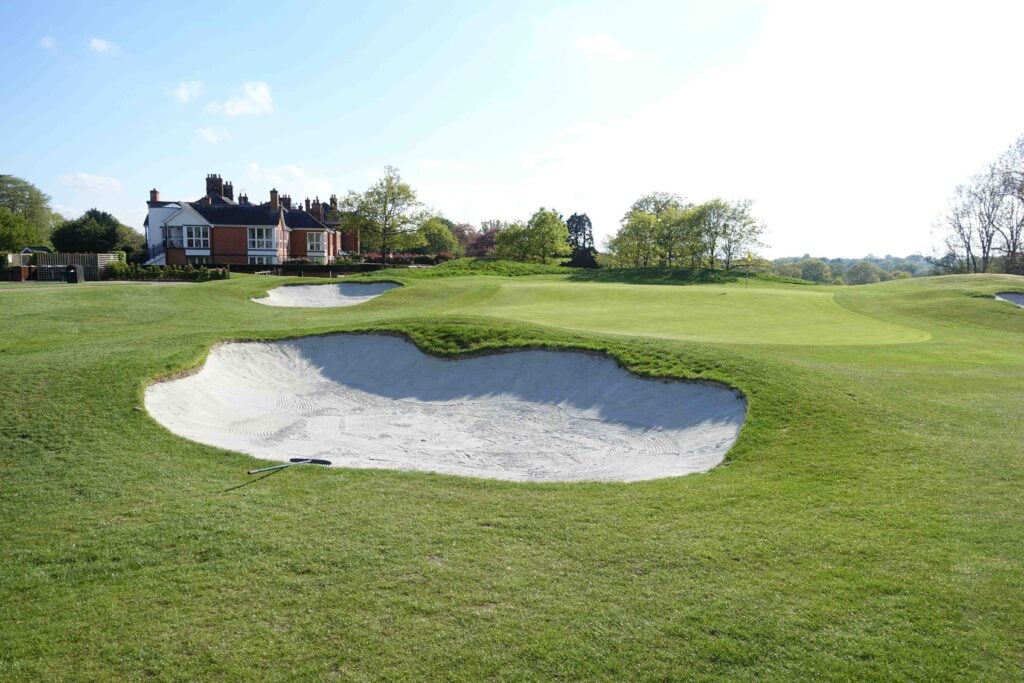
We’ve got a simple formula we use nowadays. Fairway bunkers are generally somewhere between 65 and 75 square metres. Approach bunkers are probably 40 to 55 and greenside bunkers are somewhere between 25 to 40.
As you get closer to the greens, the bunkers are getting smaller. There is a reason for that. The bigger the bunker, the longer the shot you can play from it. The smaller the bunker, the more you are being asked to play a wedge or a sand iron. So, as you get close to the green, you put pressure on the club choice.
Now we’re talking about smaller bunker areas, using less sand, and none of my clients today would ever contemplate having bunkers installed without a liner material. Nowadays, you’re looking at a big cost just to renovate one bunker and if you’ve got 40 bunkers you can spend £450,000 to £500,000 on a project like that. There’s not many golf clubs that can afford to do it.
Do you design with longevity in mind?
It’s really important and there has been talk about a rollback. The interesting thing about the positioning of bunkers now – especially fairway bunkers – is that in 2026 we’re using a measurement of 240 metres from the back tee to the landing/turning point on the fairway.
Back in 1990, when I first started, it was 210 metres. The difference is golfers, even though they’re older and less able, can still hit it about 260 yards.
If you go to York (Strensall), some of the bunkers we put in there five years ago were at 275 yards off the back tee. I would say five years from now, some of those bunkers will probably require a rethink. So when you spend £10,000 on a bunker, it has to be well positioned.
When you’re tasked with a bunker project, are you designing with greenkeepers in mind?
For every project, we work with the course manager. We state that our course assessments will be carried out with the course manager and greenkeepers present because we know when we make proposals it’s going to directly impact what they’re going to be doing in the future.
When we’ve got a masterplan agreed, we always get them to review our plans so they’ve got an idea of how it’s going to impact mowing regimes.
Once you’ve got a bunker in position, you’ve got to design the fairway to maximise the use of that bunker. I’m not a great believer in having big swathes of semi-rough around bunkers. I like fairways to run into bunkers. That has an impact upon the time the greenkeepers spend mowing fairways. It has an impact upon the time they spend mowing bunker banks and surrounds.
We propose slope angles around the bunker edges of about 25%. Inside the bunkers, slope angles are really important. When you see these disaster movies showing bunkers washed out after extreme rain events, it’s because the internal slope angle where the sand sits is just too steep.
Advertisement
If you’re using a lining material with a good quality sand, you need to make sure that slope angle is no more than 28 degrees.
That guarantees the sand should remain and will stay on the slope, even after biblical rainfall. When we’re working with shapers and contractors we always get the greenkeepers out there – and not just the course manager – to see what’s going on, so they’ve got the chance to say, ‘we’re not quite happy about this’.
Often the greenkeeping team will come in and finish off the project and that helps with affordability, because if you employ a contractor to do everything from start to finish it’s a substantial amount of money.
How is climate change affecting the work you do with bunkers?
It’s really important. With greenside and approach bunkers, we often end up adding sprinkler heads so we’re keeping the turf around the bunkers adequately irrigated.
We work a lot of golf clubs who don’t have approach sprinklers – just greenside – and some don’t even have sprinklers on their tees.
It’s astonishing to me so many golf clubs in this country have been so behind in updating their infrastructure to deal with climate change. Thankfully, more clubs nowadays are asking us to get involved in rainwater harvesting, irrigation storage lakes, collecting water, storing water, and trying to get off being committed to using mains water.
We’ve been taking quite a lot of greenside bunkers out of play [at clubs] and replacing them with runoffs and grassy hollows. These still need maintenance but if you can leave semi-rough in them that’s an area you wouldn’t necessarily need intensive irrigation.
Advertisement
Generally, we’ve also been asked to take about probably 70% of rear left, right, and rear bunkers so you just have bunkers front left or front right. That means you’re taking bunkers out of play, but you’re saving money in terms of maintenance. You’re not buying sand, and you’re maintaining those areas in a different way.
What we recommended with fairway bunkers is there’s a fairway hydrant within 25 to 30 metres of that bunker. Once it’s established, it should be able to look after itself.
What’s the future for bunkers?
The cost of living is going to hit much harder over the next few years. Golf clubs are going to continue to be challenged and have to compete more against non-traditional golfing facilities. We’re doing smaller facilities with driving ranges, short game areas, high-tech driving ranges. It’s entire family, cradle to grave, golf, par 3 golf, nine and 12-hole courses.
What can you do to reduce your costs? If you’ve got 80 bunkers on your golf course and that’s taking up 30% of your maintenance costs, you’ve got to start to think about reducing those bunkers down in number and size.

About Jonathan Gaunt
A Senior Member of the European Institute of Golf Course Architects, Jonathan has advised more than 220 courses across the world and built more than 40 throughout Europe, Africa and North America.
This article appears in Your Course, from the British and International Golf Greenkeepers Association. Your Course invites golfers to gain a deeper appreciation of what preparing and maintaining a golf course really involves. Head to www.bigga.org.uk to find out more.
Now have your say
What do you think? Do bunkers still play an important role on the golf course, or is their influence likely to dwindle because of cost, climate and time pressures on staff? Let me know by leaving a comment below, or get in touch on X.
Advertisement