


If I’m in a bar, and there are a set of arrows lying around and the dart board is free, I’ll try and hit a few trebles. In the unlikely event the pool table isn’t surrounded, I’ll flex my cue arm and remember my youth.
But I would never call myself a darts or pool player. Golf, on the other hand, has – shall we say – a looser relationship with its participants.
The view among many is ‘put a club in someone’s hands, they’re a golfer’. It doesn’t matter whether it’s 18 holes or crazy golf. Pick up a club and you’re in the family. End of.
Part of this almost certainly springs from the era we now know as BC. Before Covid. This was a time of stagnation. A time of decline. A time of worry.
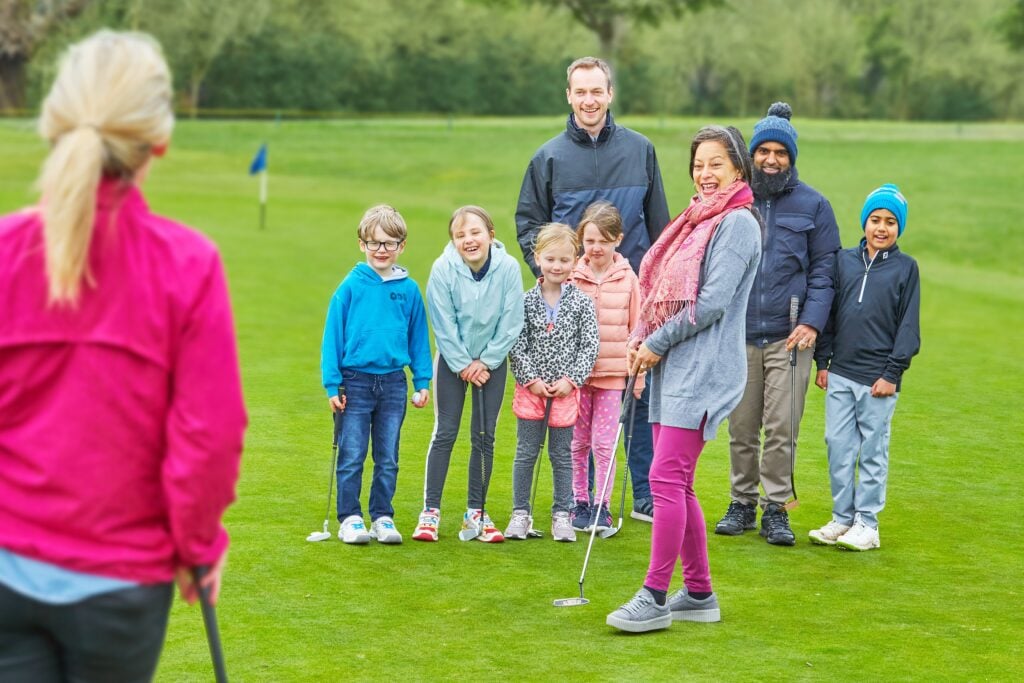
What do England Golf’s figures reveal about the numbers playing golf?
Membership was falling off a cliff. In the six years up to Covid, it fell in England to around 650,000. The future did not look bright.
Then the pandemic arrived, golf presented itself cannily as a sport where you could escape lockdown and still stay safe, and we have never looked back.
The latest participation numbers released by England Golf show how far we’ve come. They are quite remarkable. One in four adults – equating to 12.6 million people – played some form of golf in the country over the past 12 months.
More than seven million of those also did so on a 9 or 18-hole course. And they want to keep doing so too. 98% of recreational golfers and 96% of leisure golfers said they expected to keep playing.
Carly Telford, former England goalkeeper and England Golf Game Changer, said: “Golf is becoming more fun, more social and more accessible than ever.”
Matt Draper, the governing body’s development and membership director, added: “Our new data shows that millions of people are already engaging with golf in different ways, and junior membership is rising fast.”
Advertisement
Golf club membership is certainly in a far healthier place than it was in 2020 and the 750,071 who were fixtures at clubs across England in 2025 should be celebrated, as should the significant rise in junior membership (up 34% from 46,028 to 61,483).
But if my maths are right (never my strong suit) and you set that beside the overall participation numbers, club members, considered by so many to be the lifeblood of the sport, account for something like six per cent of the total number of ‘players’.
Golf’s has followed a traditional path for many years. You try the sport, you take lessons, you join a club, you get a handicap, maybe you play some competitions. But you’re part of the virtuous circle.
What England Golf’s stats show, along with earlier figures released by the PGA and R&A, is how many different entry points now exist. And though so many say they plan to continue playing the game, does that mean they will naturally move towards membership?
While that may be an aim, should we even expect them to? There is a huge difference between the golfer who plays two or three times a week, turns out in all the comps, and ploughs their hard-earned into the club, and the one who reaches for their sticks when Augusta National flashes up in all its verdant glory on the TV each April.
Is it right to think that the path to participation should ultimately culminate in players forking out an annual fee? Can they all just co-exist?

Should we expect more players to want to join golf clubs?
Going back to my opening analogy, if I want to join a darts team I can. If I want to play league pool, I can sign up to a club. But it’s not a given, it’s a choice. There is no expectation that one will necessarily follow the other.
Pathways can be very successful. iGolf has proved a very effective way of moving people into membership – with more than 30,000 having made the leap.
And clubs remain the place where much of the game’s culture survives. The recovery of the sport in clubhouses in the wake of the pandemic has not merely been a numbers game. It has been a genuine revival and is a story of friendships as much as one of economics.
But is the appeal of golf in the 2020s about the many ways you can play, rather than simply the narrow focus of the golf club gates? Perhaps this is the real success story of golf in the post-Covid revival – it is now a sport with multiple entry points without a single destination.
Today’s golfer may have no interest in competitions. Their involvement may be limited to hitting a bucket at the range and feeling the thrill of connecting with a good shot.
We used to worry people were deserting the game. But in today’s game, millions decide how they want to access the sport and they do so on their own terms. So instead of yearning for players to complete their journeys, maybe clubs are now just part of a much bigger ecosystem.
THE NUMBERS
- 12.6 million people played some form of golf in England in the last year
- 9.4 million enjoyed crazy or mini golf
- 7.3 million adults played on a 9- or 18-hole course
- 5.3 million played off-course formats such as driving ranges, adventure golf, simulators or Topgolf
- 98% of recreational golfers and 96% of leisure golfers expect to continue playing
- 59% of recreational players want to play more regularly
- Junior membership up by 34%
Pictures from England Golf

- This piece also appears in the GCMA’s monthly Insights newsletter that is packed with expert opinion on matters relating to golf club management. Sign up to Insights for FREE here.
Now have your say
Should club memberships be the ultimate pathway for golfers – or is it just part of the offering? Let us know by leaving a comment below, or get in touch on X.
Advertisement