




Imagine the ideal golf course. It’s not too easy, not too hard. Everything is perfect. It’s impossible to find such a layout, of course. But the idea of it forms a central part of how the Slope Rating works.
Why? Because that fictitious track has a rating that forms the base from which our handicap marks are calculated.
In the World Handicap System, your Course Handicap – the number of shots you receive in a round of golf – is determined with the help of the Slope Rating for the set of tees from which you play.
What is Slope Rating and how does it work?
Slope Ratings are described by the USGA as indicating the “measurement of the relative playing difficulty of a course for players who are not scratch golfers, compared to scratch golfers”.
Every course is assessed using a course rating system, which focuses on scratch and bogey golfers.
The course rating is produced by considering the number of strokes a scratch player would be expected to complete a round in under normal playing conditions.
Scratch, by the way, does not mean tour pro. It’s your average club zero-handicapper.
The bogey rating, similarly, is the number of strokes a bogey player would take in the same conditions.
A bogey golfer is classed as about a 20 handicapper for a man, and 24 for a woman.
The Slope Rating is created by taking the difference between those two ratings and multiplying it by a predetermined factor.
Every set of tees on every course has a Slope Rating and those numbers vary between 55 and 155.
The higher the Slope Rating, the greater the difference expected between the scores of those scratch and bogey golfers. A higher rating doesn’t necessarily mean that the course is more difficult than another.
Significant factors involved in working out Slope Rating include rough, water hazards, trees and, of course, length.
Advertisement
Understanding that bogey golfers tend to be wilder with their shot dispersion, and are likely to be penalised more by obstacles than a scratch player, means this will create a higher expected score. That results in a higher Slope Rating.
The old CONGU system worked on the basis that the relative difficulty of a course for all players was represented by the Scratch Rating (SSS) and meant a single handicap mark can be used on every course we play.
This changed under WHS. Using a Slope Rating recognises that relative difficulty affects golfers in different ways and that a number of factors are at work.
How good is the golfer who is playing the course? How long is the course? Where are the hazards found?
Slope rating golf: How does slope rating work?
A Slope Rating takes that relative difficulty of a course and the player’s WHS Handicap Index to calculate a Course Handicap for each course and each set of tees for every player.
Remember that ideal course we talked about at the beginning? As we said earlier, it forms the base or neutral Slope Rating – a number that indicates a course of standard playing difficulty.
That figure, for handicap purposes, is 113.
Your WHS index is worked out to one decimal place and that number is calculated against that neutral Slope Rating of 113.
That probably doesn’t sound like much to you, but using that neutral rating means you can compare your handicap index, and your potential, against any golfer in the world – regardless of whether they play at Pebble Beach or Powfoot.
Scores returned by players, from every course, are automatically standardised. That means it is calculated to that neutral base of 113.
Handicappers use the term ‘de-sloped’ for this and it is achieved using that number, the actual gross score – which has been adjusted for net double bogey – and the Slope Rating of the course on which that score was recorded.
Advertisement
So what does that mean?
Remember your WHS Handicap Index is not your playing handicap. Every time you go to the course, that mark will be adjusted for Slope for the course, or tees, being played.
That provides your Course Handicap for that round. That number could be adjusted again if you’re playing in a competition and certain allowances – such as 9/10 or 3/4 – need to be taken into account for the chosen format of play. This is known as the Playing Handicap.
But the great thing about Slope, and what makes it easier to follow than some of the things you’ve just read, is it works on a sliding scale.
So all golfers, whatever their handicap, can easily convert their Handicap Index to a specific Course handicap.
The computer software that clubs use to record entries for competitions can do that automatically once you punch your name into the touchscreen. You can also use your club or national governing body app to look up the course.
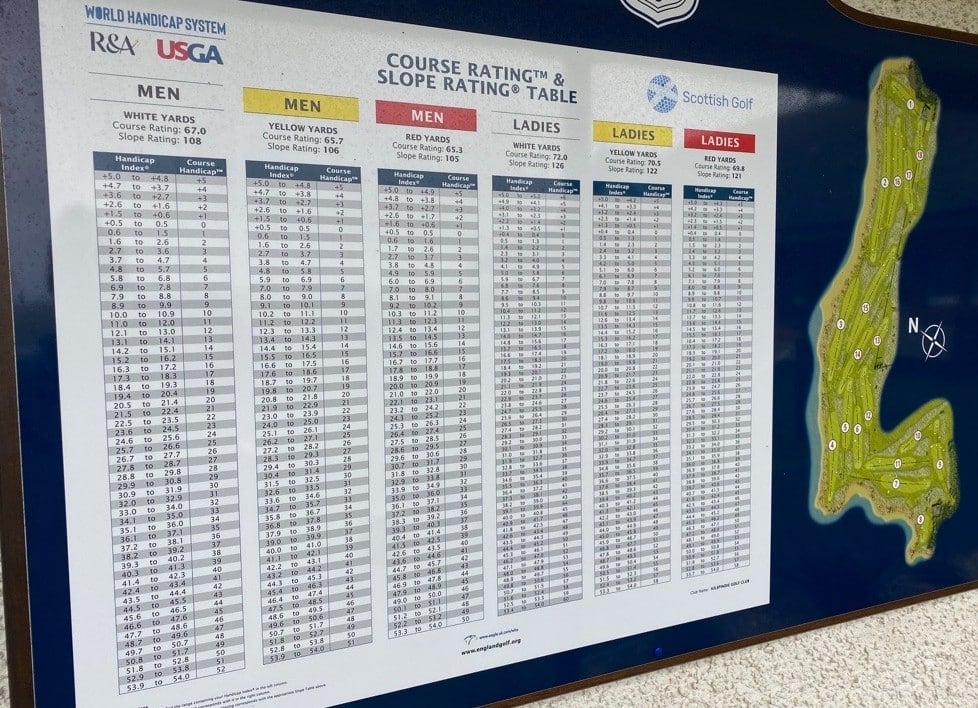
Or you also find a chart in the clubhouse that allows you to line up your handicap index against the tees to get the required number.
What has the impact been?
What establishes difficulty – course rating or slope? This has definitely confused golfers, some of whom – and even your correspondent at the beginning – believed it was the latter that was the chief determiner of how hard a course was for handicap players.
While the Course Rating tells you how hard it is for a scratch player, and the bogey rating does the same for a 20-handicapper for men and 24 for women, it’s the combination of those two that brings about the Slope Rating.
I’ve seen lots of players, and lots of clubs, mystified by their Slope Ratings – arguing it was not a fair indicator of the challenge. Most of those taking umbrage were claiming the figure was too low.
Advertisement
Even so, I reckon if you went out into a golf club today and asked 10 random members what slope was and how it worked you’d get a variable range of answers.
We asked on our Facebook channel if the Slope Rating had made a difference to handicaps, the comments were largely centred around disagreements with WHS as a whole.
Several years after the introduction of the system, we’ve still got a long way to go in convincing GB&I golfers that it can meet their needs.
Now have your say
Slope Rating explained: Has this made Slope Rating any easier to understand? Do you like this part of the World Handicap System? Let us know by leaving a comment on X.
Advertisement