But why do so few club golfers not follow suit and go for a combo iron set?
The truth, in my opinion, is that most manufactures design sets to be bought as sets. It does make life much easier for them.
In fairness, there is often progressive technology which makes the longer irons easier to hit. Leaving the shorter irons more workable.
And, sometimes there are loft issues between two different models. This could create gaps that are too big or too small.
But I still think that too many fitters fit players based on a 7-iron. And, then just give them the rest of the set to match.
The fitting process with tour players is obviously a lot more in depth and they work to get the right numbers and ball flight with each particular iron whether that’s using one, two, three or even four different models.
We caught up with Bill Price, Mizuno’s custom fit manager to find out how, why and when club golfers should be looking at going for a combo iron set…
How might the fitting process highlight where a golfer needs a combo iron set?
In the fitting process – you have your fundamentals in the same way you have your fundamentals in the golf – grip, stance, posture and alignment.
Advertisement
You have you four fundamentals of fitting as well – length, shaft, lie and grip.
What has come into the fray more now is model selection – do I need something more forgiving? Do I need something more playable? What do they look like?
Then the other element to fitting now is set make-up from the driver all the way down to the pitching wedge.
And what determines your set make-up is your clubhead speed. Because your clubhead speed dictates your loft.
There are a lot of misconceptions about that. If you have enough clubhead speed to handle 21 degrees then you can handle a hybrid that’s 21 degrees or a long iron that’s 21 degrees.
But if you don’t have that speed then you can’t handle that loft. So a fitter has to go through the process to really nail it down.”
Most tour players go for friendlier long irons it seems. We don’t see many bladed 3-irons do we?
There are less and less now. What determines the longest iron you play – whether it be bladed or not – is the loft.
You might not have enough clubhead speed to keep a 21 degrees 3-iron in the air.
But with the Fli-Hi clubs they are designed with a lower centre of gravity to get the ball up in the air with a little less spin so that’s why even the tour players might go towards a friendlier long iron.
How do Mizuno design their irons so they can be blended as a combo iron set?
Not a lot people focus on the aesthetics – which are a really important part of the fitting process.
Advertisement
If you put a club down and it doesn’t look right – it’s not going to breed confidence and you can talk yourself out of hitting a good shot.
In the past if you had an MP-4 but wanted a H5 in the longer irons. They benefited from the design of the H5 head but the blend from the 4 to a 3-iron wasn’t quite there.
It was a bit of a jump from an aesthetic point of view – you got the playability you wanted but maybe the top line was a bit too thick.
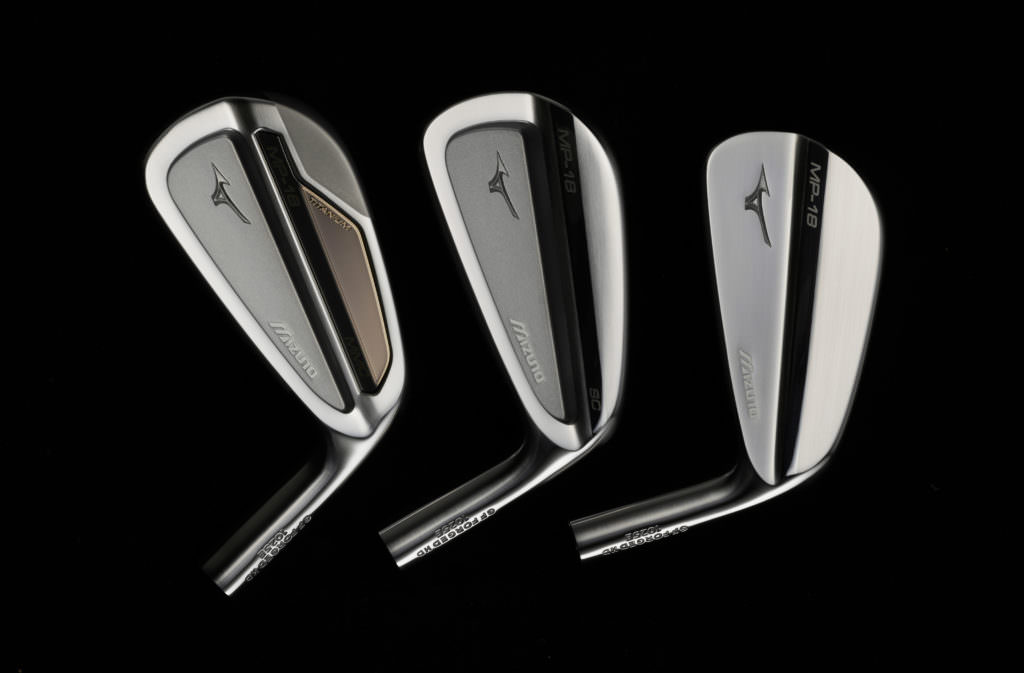
Now what we have done is tweak the offset so the muscleback and the SC have the same off-set. When you get into MMC, they are two degrees stronger.
Our traditional lofts – muscleback and SC – have a 30-degree 6-iron so the MMC and the Fli-Hi have 28 degrees of loft.
If a guy wants to play pitching wedge, 9, 8 in the muscleback, they want a bit for forgiveness in the 7 and 6 so go with the SC which have the exact same lofts and offsets. Then they want to go into an MMC in a 5- and a 4-iron. They may even want to go with an MMC Fli-Hi in the 3-iron.
Now the problem with that used to be you’d have two different lofts and two different off-sets.
But we’ve designed it now so you can weaken the lofts on the MMC so when you add loft to it you actually take away off-set and you add bounce.
So you can weaken the MMC Fli-Hi 3-iron to the same loft, bounce and offset at the muscleback 3-iron.
So the aesthetics and the blend of the set is so much more seamless.
Advertisement
Why do higher handicap players struggle with the longer irons?
If I was a fitter and someone came up to me, the first thing I would do would be to look in their bag.
If they have a lot of head covers in the bag the assumption might be that they are not a very accomplished player. They need help.
But the only assumption you can really make is that they have low clubhead speed. It doesn’t mean they are a bad player.
They need more loft to get the ball into the air – that’s why they have fairway woods and hybrids – when your clubhead speed goes up, head covers go away.
Is it confusing for the consumer when there are crossovers between models? JPX900 Tour and MP-18 MMC for example?
Well let’s look at the entire line from most forgiving to most workable.
We have the JPX900 Hot Metal as the most forgiving, then the JPX900 Forged – those golf clubs are designed with high COR (bounciness, trampoline effect) faces – they are distance golf clubs with stronger lofts and low centre of gravity to get the ball up in the air. They have thicker top lines and more offset.
The the JPX900 Tour really has the look of an MP but has JPX on it – it falls between the MP-18 MMC and SC – and it has the look and feel of a blade.
If anything it’s the MMC that’s the crossover club – it has the same forgiveness as the JPX900 Forged – but it has a thinner top line and less offset and is in a smaller package. And it’s not designed to be a distance golf club.
So maybe you like the look of the JPX900 Forged but you really don’t need all of that distance. If you want thin top line, less offset but still want that forgiveness, that’s where the MMC comes in.
Advertisement
Do you have a mixture of irons in your golf bag? Let us know on X.