


My first visit to this furthest extremity of Donegal was in the early 2000s. I did not know what to expect back then, beyond that the resort of Rosapenna was popular with Irish holidaymakers and there was lots and lots of golf in close proximity to the ocean. That was enough to entice me.
I have been lucky enough to return on a regular basis since and all I know is that I never want to leave.
Every time I come back, it seems the golfing offering has developed further, and it is fair to say that the Casey family who own the resort are spoilt for choice.
They now have three full-sized, 18-hole courses with the jewel in the crown the latest addition to the portfolio. St Patrick’s Links, which occupies dramatic and expansive prime linksland overlooking Sheephaven Bay, might just be the best new course to open in the British Isles in the last century.
The naming of the course is bold. For over 500 years Scotland has had its St Andrews. Since the late 19th century, England could call on Royal St George’s and Wales Royal St David’s. Now, at last, Ireland has St Patrick’s, which opened in 2021.
There is also the Old Tom Morris course, which in its current form also incorporates some work of James Braid, Harry Colt and Pat Ruddy.
The Sandy Hills course, designed by Ruddy in the 1990s, was until very recently Rosapenna’s pride and joy and a staple in the GB&I Top 100s lists ever since it opened. There is also an exceptionally entertaining pitch and putt.
Yet for all that, the course that has moved the needle for the resort is St Pat’s.
It has taken a while to get to this stage, but it has surely been worth the wait.
Advertisement
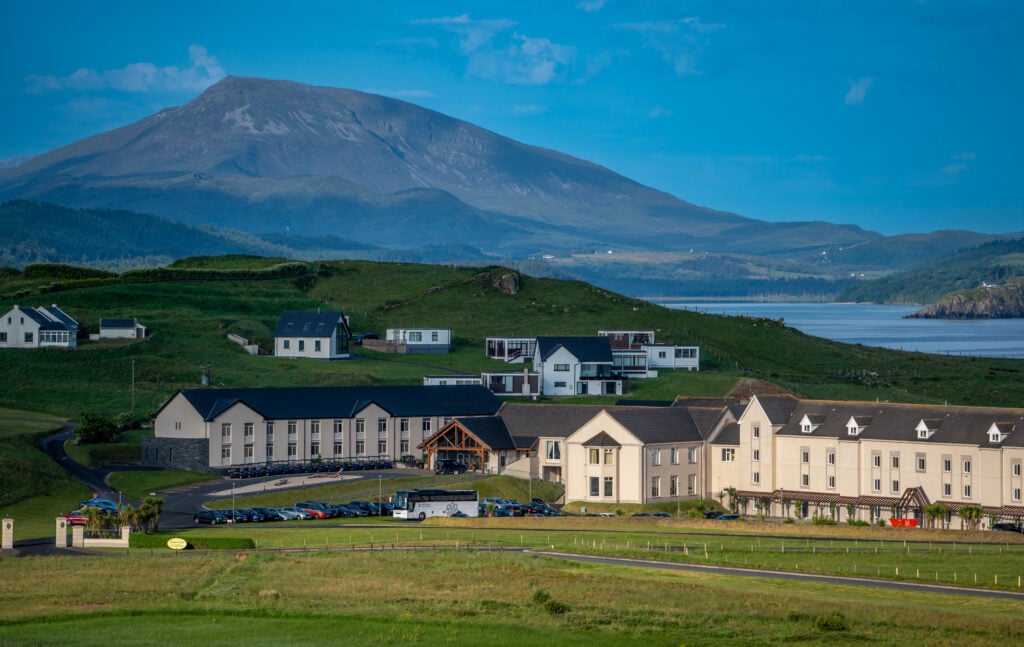
While the rest of the Rosapenna Resort, which is an hour or so north and west of Derry, is gathered around the main hotel, the 1st tee of St Pat’s is a couple of miles away. There is a good reason for this, but you need to understand a little bit of history first for context.
Rosapenna Resort: How Tom Doak transformed Rosapenna
The land St Pat’s graces was formerly owned by another local hotelier, who commissioned Eddie Hackett and Joanne O’Haire, assistant professional at Royal County Down, to design two courses. Then a Dublin developer stepped in, acquired the site and Nicklaus Design were appointed. They had just begun their work in 2008 when the repercussions of the financial crash saw the project abandoned with the land effectively transferred into government ownership.
It was not until 2012 that the Casey family, owners of Rosapenna, bought the land and commissioned Doak as the architect. They decided to build one course rather than two with construction beginning in 2018.
Clyde Johnson, one of Doak’s key on-site lieutenants, described it as “a once-in-a-lifetime opportunity” to work with a piece of linksland that might be the equal of anything else on earth, either developed or undeveloped.
First, there is the sheer scale, and the rarest of luxuries of being able to pick the best playing corridors on a site that, but for the concatenation of fate, could easily have 36 holes on it.
Next is the land itself and a rolling dunescape that heaves and pitches as far as the eye can see.
Then there is the unspoilt splendour of the Donegal setting – the romantic village of Downings with its white buildings dotted across the distant hill and the nostalgic twinge of childhood seaside holidays.
The final ingredient is the architect, unrestrained by the owners, and allowed to use this exceptional canvas as he saw fit.
The advantage of the land being somewhat removed from the resort means this is not a course built around existing infrastructure. Instead, the golf comes first, which may sound obvious but is much less common than you might think.
Doak conceived the routing and it was up to the Casey family to work out the rest.
The off-course facilities at St Patrick’s Links may be minimalist but for those of us who simply seek great golf, the lack of distraction is glorious.
It is a paradise of linksland, starting from the opening hole with its snaking fairway partially visible between mountainous dunes and the heaving topography.
At any number of links on Ireland’s west coast, the wild joy of the landscape is tempered by holes that can tend towards the extreme. We should not need to be reminded that the wind seldom fails to blow in these parts.
Here, Doak has created a course where the landing areas are highly generous, especially for those prepared – or compelled – to be less aggressive from the tee.
The routing takes the form of butterfly wings – there are two loops, the first of 11 holes and the second of the remaining seven. In both instances, you begin inland and then take a thrilling journey to the sea. The reveal on both loops is coruscating.
The first one comes after departing the green at the par-3 3rd and boarding the tee of the par 5 that follows.
The second is after the 13th, from where it feels like the whole of Donegal is within view on a clear day.
There are at least half a dozen moments that take the breath away on first sighting but it is the architectural sophistication that continues to offer deep pleasure thereafter.
Advertisement
Take the subtlety of the short 17th, a bunker-less par 3 and at first glance the simplest of holes. Yet the contours and angles of the green, which has a shelf on the back right, make for endless conundrums. The absence of any rough within 30 yards of the putting surface ensures that redemption is always possible – and yet so often elusive. It’s in my personal top 10 of all the par 3s I have played.
In a location such as this, playability should be right at the top of the agenda because there will be plenty of wild days to contend with. Throughout, there are half-par holes, whether in the form of short 4s or borderline 5s. As they play in all directions of the compass, on any given day the design will give with one hand while taking away with the other. Just the way it should be.
As with all the best courses, it is the way the holes interact with each other that creates the whole. St Patrick’s Links is playful one minute, offering you the chance of shaving 100 yards off a hole with a daring tee shot. Then the next it is all about subtlety, trying to manoeuvre your ball to an awkward corner of a green.
The visuals are breathtaking, with wild blow-out bunkers built into dunes and spiky marram grasses shimmering in the breeze.
Even if your driving is inaccurate, overly ambitious or both, you will much more often than not walk straight to your ball. And then you will most likely find yourself attempting an unwise recovery.
This will almost invariably be blind or at least partially obscured and result in you haring after your approach in the hope of gaining a view of it landing.
Most golfers find laying up difficult even when a swing is barely possible; here you are fooled into thinking you have not been punished for your sub-optimal drive.
Advertisement
The wisest will exercise discretion, even from a clean lie. Take the shot on but beware that Doak is not in the habit of making the game easy for you if you are playing from the wrong angle. Time and again, you reach the green to survey a chip of significant difficulty and realise that it would have been easier to play the shot from 100 yards away but with a preferential angle.
Doak saves a final flourish, and I like to think of him metaphorically thumbing his nose, for the last hole, which convention dictates should be a long and demanding par 4, but is actually drivable, or close to it, from all but the back tees.
In front of you is an impossibly wide fairway, which eventually topples into a deep hollow, with the green on the far side, nestling against a dune. The shot from this hollow, which is almost unmissable following a healthy clatter with driver from the tee, is not impossible but nor is it even remotely appealing.
The shot from the left of the lunar fairway, such a tempting bail-out from the tee, is a similar story, with the shoulder of the greenside dune exactly where you don’t want it, either consuming an under-hit approach or callously shoving a stronger one off the far side of the green or even back into the dreaded hollow. It is a hole of rich strategy and, I suspect, one where the tortoise may often fare better than the hare.
For a course just a couple of years old, it plays beautifully. Already, the fairways are running and the greens firm, encouraging running shots and imaginative use of the contours.
Advertisement
Perhaps the most exciting thing about St Patrick’s Links is that it will only get better – and it will evolve on its own terms.
I expected to return some four years after my initial playing of what was then a brand-new course to find a clubhouse next to the 1st tee. No – the cluster of small outbuildings remains and there are no immediate plans for that to change.
To me, that makes perfect sense as Rosapenna is not exactly short of facilities elsewhere around the hotel and golf pavilion. The latter is a huge structure and includes a substantial pro shop.
There is a driving range across the road as well as a short course that my children absolutely loved playing, the holes ranging from 50 to 150 yards with the tiny greens often situated in dells and sheltered by small dunes.
As for the hotel itself, it is a traditional Irish experience with the Vardon restaurant specialising in locally caught seafood as you watch the sun set over the ocean.
It offers full leisure facilities, including a pool, while the small resort of Downings is just a short walk across the beach away.
Be sure to make time for a visit to the legendary Harbour Bar, which does pretty much everything an Irish pub should do.
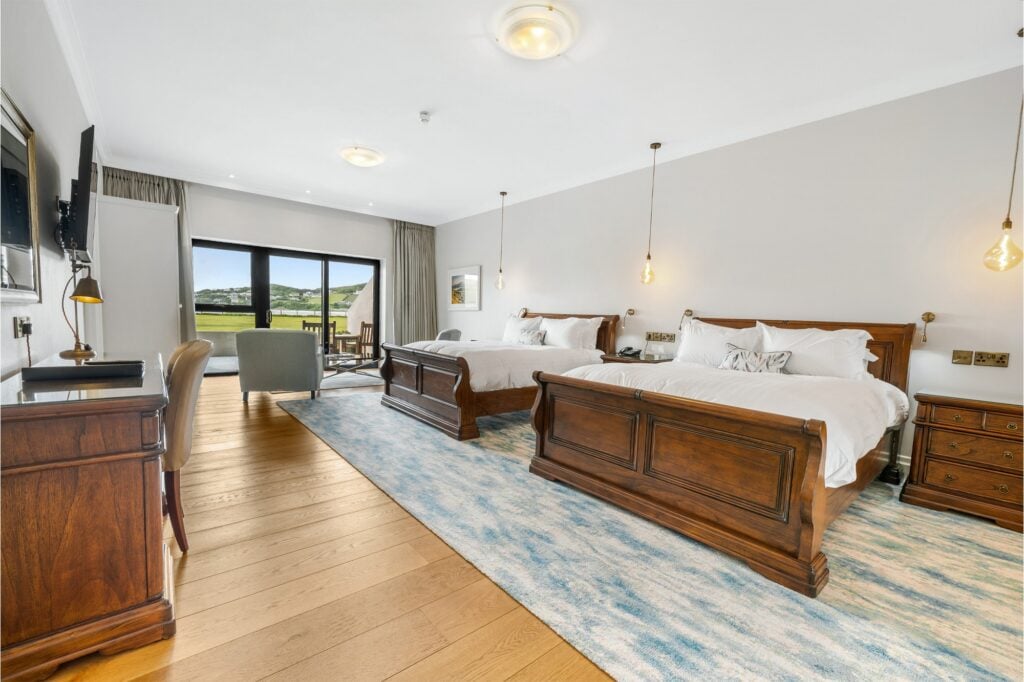
The rooms at Rosapenna are as spacious as the St Patrick’s fairways and will ensure you are well rested and ready for more golf the next day. With 54 holes of high-quality links golf, it is difficult to imagine what else a true golfer could need.
We have spent 2027 visiting the best courses in Ireland – we will be revealing the results and updating our list very soon both in NCG and online here.
NOW HAVE YOUR SAY
Have you played golf at Rosapenna Resort? If so, which course did you play? Where else in Ireland have you played golf? Let us know in the comments or by getting in touch with us on X!