


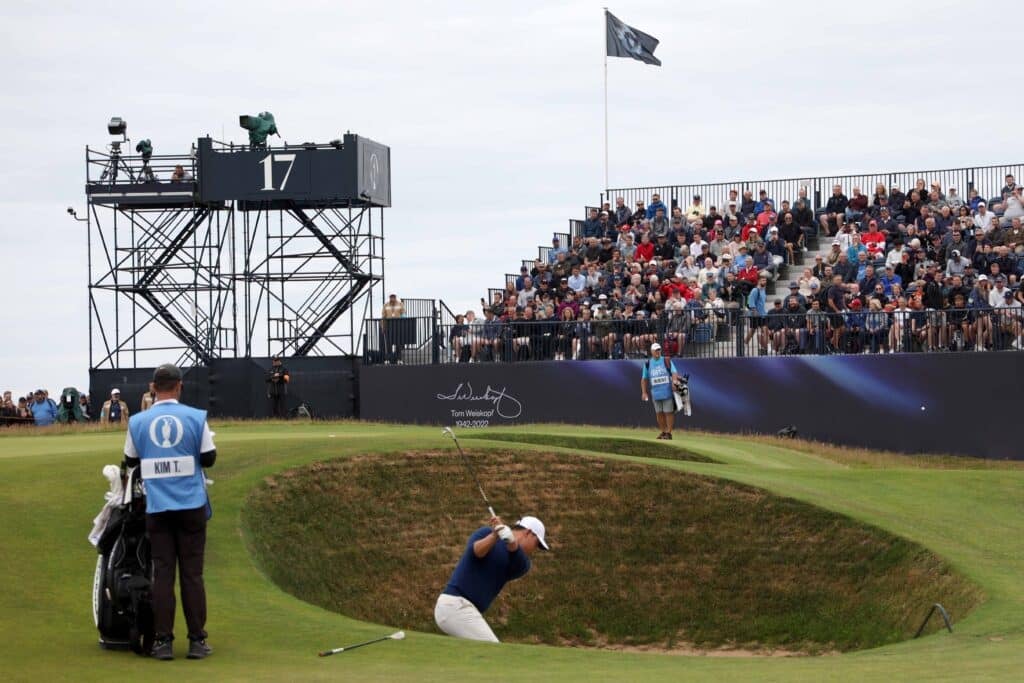
It lies in wait. Its deep mouth yawns open like a Venus Fly Trap in search of another tasty treat. And Maverick McNealy is its latest victim.
One foot perched, he swipes once and then again. Still the ball cannot escape its clutches. The home hole is ruined but, luckily for him, it’s not for real just yet.
You can come up with all kinds of adjectives to describe the Royal Troon bunkers. But brutal doesn’t seem aggressive enough.
“They’re hazards,” said R&A chief executive Martin Slumbers. “They’re deep. They’ve got big faces, and they’re designed to stay out of.”
“As you know,” he added. “Links golf is very simple. Stay out of the bunkers.”
But it was what he said in between that set my antenna twitching.
“We’ve been looking very carefully at the sand, and I think some of the players have commented how we’ve pushed them up a little bit to give them a slight chance to be able to get out.”
To understand the impact of that sentence, we must go back 12 months – to Royal Liverpool where the complaining was long and it was loud.
It was the first day. Justin Thomas had been punching his ball from bunker to bunker. Rory McIlroy failed to extricate himself from a revetted monster a few minutes later.
“Players felt they were too penal on day one,” reported Sky Sports’ Jamie Weir as he revealed the R&A had done something rather unusual.
They changed the way the bunkers were raked. They’d routinely be swept flat but they took the sand up one revet on the face. The aim was to stop balls flying at pace running into the edge of the face and planting right underneath it.
It did the trick. The moaning stopped and the tournament carried on. Now fast forward to Royal Troon and Scottie Scheffler in his press conference earlier this week.
Advertisement
Royal Troon bunkers: Softening them up “rather defeats the object”
He’d been big spending a “good amount” in the Ayrshire traps, he revealed, before adding: “One of the things I liked that the R&A changed this year from last year was the bunkering.
“Last year I thought it was a bit silly how they flattened out each bunker. The bunkers are still a penalty enough when the ball isn’t up against the lip.
“It was a bit of luck whether or not your ball would bury into the face because you have a flat bunker and a wall that’s going to go right into it.”
While Scheffler explained a bit of slope gave players the chance to escape the bunker, or to take on the lip if they were on the greens, I was trying not to spit my drink all over my desk.
Talk about spectacularly missing the point. Bunkers are a line of defence – and pretty much a links course’s only protection if it’s not blowing a hoolie. They’re meant to be random and unpredictable.
Royal Troon is flat and featureless to some of its critics. So it’s the sand, rather than meaty undulations, or big swirling sloping greens, that keeps the scores going too low.
They’re menacing and they’re designed to be that way. Softening them up in any sense rather defeats the object.
Players will dispute this, but luck is part of the puzzle, is it not? If your ball dives into a deep bunker, or a little pot, then you run the risk of coming a cropper.
No one forces a player to take them on, and surely finding them comes with a solid risk of punishment.
But it speaks to the mentality of the modern player who feels they have the automatic right to a shot should their ball strike the sand.
This comes from a place where bunkers are seen, at best, as minor inconveniences and, at worst, as somewhere from where they can actually gain an advantage.
How often do you hear commentators say the sand is a good miss? But put them in a major championship and we should be sloping the face to help them get out?
Do me a favour.
Maybe it’s in the best traditions of links golf, or maybe I just thrive on schadenfreude, but the element of danger – that you spin the wheel in a game of golfing Russian Roulette and risk blowing up your championship – adds to the thrill of the tournament.
Nullifying that in any way, essentially to pander to the whim of the pampered, may make the Royal Troon bunkers slightly easier to negotiate but isn’t in the best interests of the game.
Now have your say
What do you make of this Royal Troon bunker debate? Let me know by leaving me a comment on X.
Advertisement