


It’s wall chart time. It’s sweepstake time. It’s World Cup time.
This year’s festival of football in the USA, Mexico and Canada will feature 48 teams for the first time.
The resolve of the most deranged sickos that watch every match will be tested like never before, be it England vs Argentina or Curacao vs DR Congo.
The latter pair have genuinely qualified, with Curacao making their debut. Congo used to be Zaire and competed in 1974.
Cape Verde, Uzbekistan and Jordan will also be appearing in FIFA’s showpiece event beginning this month, among the many teams benefitting from a bloated tournament in which we will see teams play in Group L – a letter never previously included in the World Cup’s alphabetical batting order.
While not to resent the opportunity afforded to the minnows, the quality of the event might be diluted.
The final week of the World Cup coincides with another global sporting event showcasing talent from around the world. A couple of hours after the Champion Golfer is due to hoist the Claret Jug in Birkdale, the victorious team will lift the Jules Rimet trophy in New Jersey.
Different competitions played in different continents, but the ‘come one, come all’ nature is the same in both. Is this approach healthy for either?
Shaun Norris, Ryutaro Nagano and Ren Yonezawa qualified for golf’s oldest major at the Mizuno Open at JFE Setonaikai Golf Club in Japan last week, forging a path via The Open Qualifying Series (OQS), which places qualifying spots at a variety of international tournaments across the globe, in New Zealand, Hong Kong, Argentina, Singapore and Korea.
Last year, of the players who qualified from the OQS events, Jason Kokrak finished the highest in a tie for 40th. Admittedly, that is if you discount some players through my self-made mitigating circumstances, such as Rickie Fowler, Chris Gotterup, and Nicolai Hojgaard, who earned spots on the OQS at PGA Tour events.
Advertisement
Corey Conners also got in via the Arnold Palmer Invitational, but was eligible via his world ranking.
Gotterup won the Scottish Open the week before, and Fowler and Hojgaard are Ryder Cuppers. It isn’t because of these players that I ponder trimming the field, nor are they players for whom the Series was made in 2014.
Players who qualified for The Open through The Open Qualifying Series in the last five years
| Open Championship | No. of players qualified via OQS | Top 20 finishes | Missed cuts |
| 2025 at Royal Portrush | 24 | 4 | 14 |
| 2024 at Royal Troon | 28 | 5 | 10 |
| 2023 at Royal Liverpool | 33 | 0 | 24 |
| 2022 at St Andrews | 33 | 2 | 17 |
| 2021 at Royal St. George’s | 12 (Fewer events due to COVID-19) | 0 | 7 |
ALSO: At £190, has The Open Championship crossed the line and become too expensive?
In 2024, the Malaysian Open did throw up John Catlin, who came tied for 16th at Royal Troon. Ayrshire saw a good showing all around by OQS qualifiers. But generally, the OQS events spread across the world tend to offer spots to players who flatter to deceive. There are a lot of missed cuts in the table above. In four of the last five years, more than half of OQS qualifiers haven’t played at the weekend.
In 2023, Oliver Wilson was the highest performing player at Hoylake via the OQS, and he came tied for 33rd.
Sadom Kaewkanjana and Anthony Quayle gave a good account of themselves at the 150th Open at St Andrews, but they were the only players of the 33 OQS contenders that year to crack the top 20 at the Old Course.
The answer to the query posed isn’t easy. Take this year as an example. It should give us all great pleasure to see the national opens of New Zealand, Argentina, Hong Kong, South Africa, and Singapore recognised and respected by the R&A with Open spots. What I’d give to play and watch golf in these nations.
But then, what we see months later on the coasts of the UK, specifically Southport this year, is an almighty roster of players inevitably battling daylight to complete the first round, which is exactly what we saw in Northern Ireland last year. This is also not to allow golf’s chronic issue of slow play to hide behind field size, but it certainly doesn’t help.
The Masters has a very small field, compared to The Open. It has a list of criteria by which players qualify, but you could also interpret it as a guide for who the club chooses to invite. Augusta National can send envelopes to players whom they feel would strengthen the field, even if they didn’t qualify through formal means.
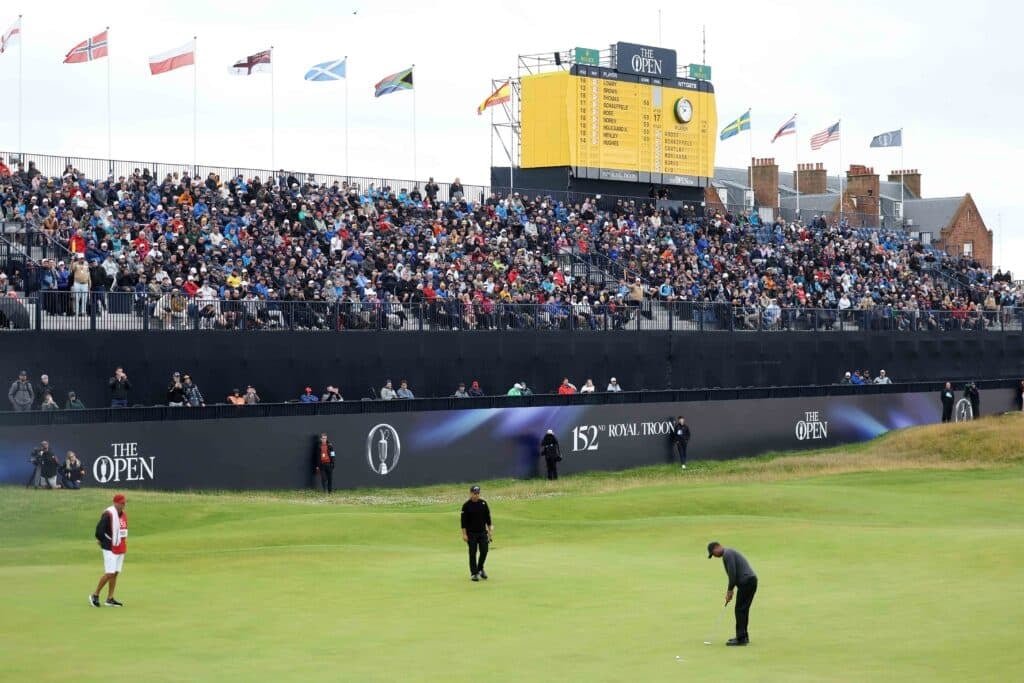
Calls to cut the opportunities to qualify for the UK’s major might be dashed and branded as miserable and unnecessary, especially when Final Qualifying, one of the tournament’s great traditions, also makes up about 15 spots each time, and not much success to speak of.
But we are talking about the peak of professional sport here. Surely, the idea is to have the best field, not the largest.
The OQS is a great thing for The Open CV to boast of its worldwide appeal and wide open doors, but are the beneficiaries of these pathways competing well enough to justify their spots and prove that the game’s best players exist beyond Europe and America?
To Shaun Norris, Ryutaro Nagano and Ren Yonezawa, and to Curacao and DR Congo, I wish them the very best.
But over-subscription with too many golden tickets might be doing more harm than good to these marquee occasions.
NOW READ: Where will The Open Championship be held in 2027, 2028 and 2029?
NOW READ: Record crowds and enhanced spectator experience for Birkdale Open
Advertisement
What do you make of this Open Championship-World Cup comparison? Is it an issue? Tell us on Facebook!
Advertisement