


It was one of the greatest comebacks in golf history – never mind in the 100-year history of the Walker Cup. Great Britain & Ireland recovered from a three-point deficit to dominate the final day singles in a famous victory.
It was dramatic, exhilarating, and captain Dean Robertson’s men stepped up when it was absolutely needed. But as much as that outcome was about incredible shots in the moment, it was also about the intense preparation – both before and during the matches.
“It was about creating the environment,” Robertson told us on The NCG Golf Podcast. “Creating the environment for these players to go ahead and play and anything that we could control, we tried to control.”
We’re used to phrases like ‘marginal gains’ and ‘controlling the controllables’. We’ve seen the lengths teams will go to in elite sport to find an edge, but how did masterminding a Walker Cup victory compare?
It might not have stretched to changing the bedding at Bethpage, as Luke Donald did last year to help his players sleep, but as Robertson reveals, almost no stone was left unturned in the bid to give GB&I a winning edge.
From sports psychologists and nutritionists, the miles travelled evaluating players, to an innovative app that helped team members drill potential shots they might play at Lahinch while thousands of miles away from the course, he outlines some of the measures that helped add up into a victory that will go down in history…
It was far more than a one-man band
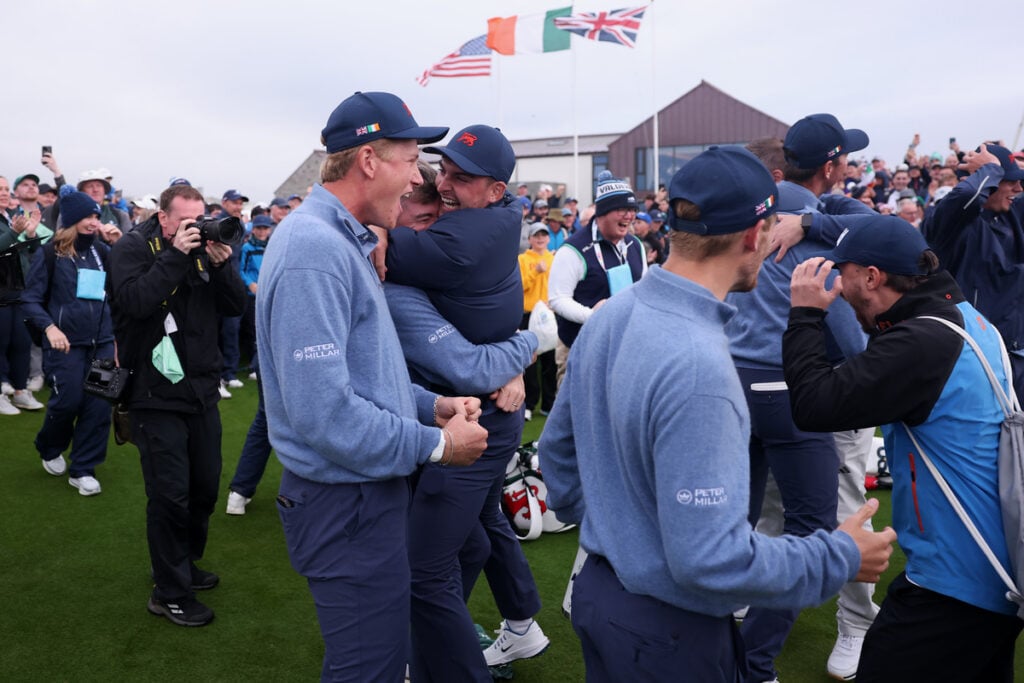
These players have belief in their own abilities but it’s not a one-man band. I might be captain of the team, but I’ve got an amazing support team around me.
On the ground for the tournament was Raymond Russell and Kath O’Connor, who are my lieutenants, and you’ve got my team manager Euan Mordaunt.
Advertisement
Behind that, we’ve got John Mathers, who I work with and has just retired from the University of Stirling. He’s a sports psychologist and he’s been man-marking Stuart Grehan for the last couple of years. Whether it’s been training camps at Dumbarnie, Hoylake or West Lancs, he’s played an integral part in some of the mental skills that have been played out. We have Matthew Campbell, who’s a sports data analyst, and we have got information on everything.
There were reports to myself and the backroom team every evening. They weren’t making decisions for us, but they were certainly informing us as to how everybody was performing and how the golf course was playing.
You might choose to relay something back in a manner that was able to draw out something from a player as to specific shots.
Amy O’Donnell, who left Lahinch to go straight to the Solheim Cup, is a performance nutritionist and she fuelled the players and had a massive job to play over the weekend – keeping the players’ energy levels up – whether it be in the morning when they get up and are getting protein shakes, or on the 9th or the back of the 10th tee.
She’s there and she’s feeding them the whole time round. They’ve got bags of homemade snacks that are all the good stuff.
LISTEN TO THE NCG GOLF PODCAST WITH DEAN ROBERTSON
ALSO AVAILABLE ON:
Apple Podcasts: Listen Now
Spotify: Listen Now
Amazon Music: Listen Now
How Dean Robertson Banked on success
Controlling ball flight was huge. Matthew developed an app called Bank Golf and that simulated some of the practices we were doing. In terms of dispersion on Trackman, linear and lateral dispersion, we were getting printouts of how the players were actually playing in practice. We were able then to simulate shots we would be playing in the golf tournament.
The app is only used by the University of Stirling and the Walker Cup team. From 90 to 140 yards, and from 140 yards to 190 yards, you would have 100 yards of currency in your bank, and then you would hit a matrix of shots going up a ladder and down and then at random.
Every shot that you hit, you would then input the dispersion, both linear and lateral, and your bank would reduce to zero. So it became gamified. It became a leaderboard, so the players could actually see how well they were practising in relation to one another. That was something that really informed us.
The leaderboard was topped by Tyler Weaver and that was in Tallahassee because the players were using this before they even got to Ballybunion [week before the Walker Cup] and before they got to Lahinch. [It was] the importance of being able to hit off-speed shots.
The classic example of this was Jack Whaley – why is a player who is so good, hasn’t yet established himself in links golf, yet is exceptional in the US?
They don’t have to hit those quiet off-speed shots that the craft and artistry [of] links golf would dictate you have.
Bank allowed us to do that. Even in practice, they were hitting two shots, two balls, two different clubs to a shot – whether it be the elevated approach at six, the elevated tee shot at 11. They were hitting a number of balls with different clubs to be able to off-spin, change the spin, yet control the distance and hit to the same finishing position. That was huge.
Before we got to Lahinch, we knew exactly what we needed to do.
The course
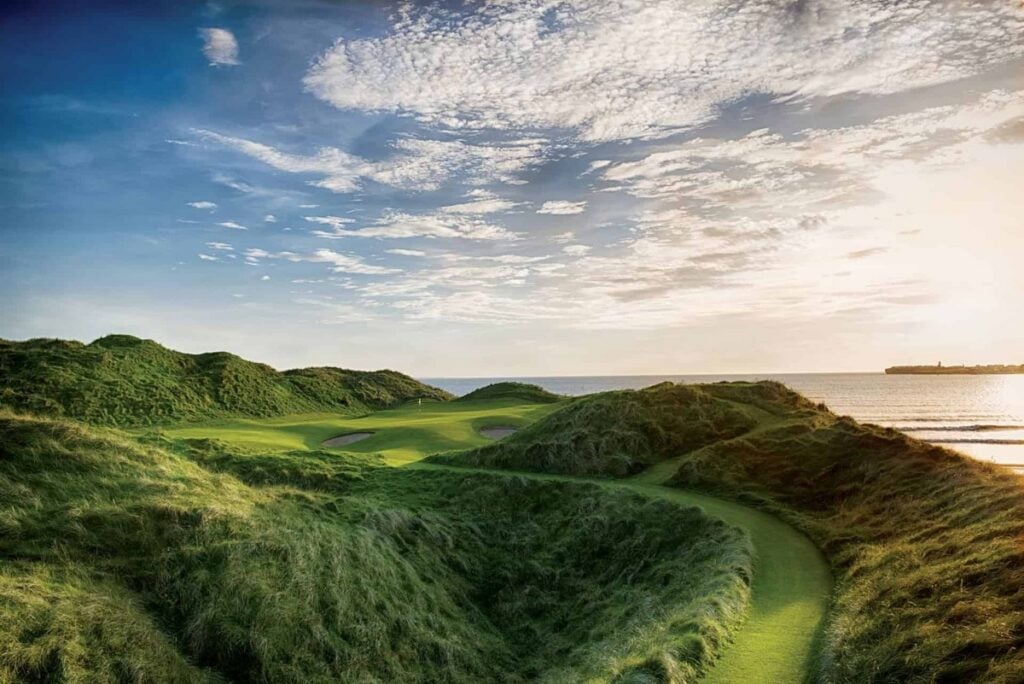
Lahinch has hosted the South of Ireland Championship every year since 1895. It’s their oldest provincial championship and it’s a 36-hole stroke play into a 64-man match play. Seven of the 10 players in the team were present at the South of Ireland training camp before that and then most of them played on into the event itself. There were a number of key factors in gaining course knowledge.
Advertisement
Lahinch is an incredible links course. It’s framed by the dunes and it’s not a course that you can necessarily overpower. But strategy plays a big part, and the players had to understand that. By and large, they sure did.
Rooms
Every player had their own room. At Cypress Point we twinned them up but, in terms of sleep nutrition, [we separated them at Lahinch]. We didn’t bring pillows, we didn’t bring mattresses, but there was a level of detail that went into us winning and the amount of data throughout the course of the year that I got from an exceptionally talented young sports data analyst, Matthew Campbell, was off the charts.
Establishing relationships
In the qualification process, I wouldn’t look at rankings at all. I can’t recall the number of steps but I would average between 25,000 and 30,000 steps a day going to the Lytham Trophy, the St Andrews Links Trophy, going to the Amateur Championship, or any of these events in the last couple of years – establishing a relationship, getting to know these players, understanding them as individuals, and seeing their games.
It’s about bringing a team together, and that’s about personalities and pairings. So many factors went into it.
Mindset – and being in the moment
The messaging on the walls in the team room – the players all played a part in that. They all had inspirational quotes there but, essentially, that’s only wallpaper unless you put it into play.
Advertisement
The one quote that was probably most used was from Niall (Shiels Donegan), and it was ‘Be where your feet are’. It’s quite a famous quote.
The simplicity of that – of being in the moment. You’re surrounded by this really, really excited crowd [that’s] being held back by a piece of rope and two people. You had to be so entrenched in the moment and the occasion.
The occasion was really special but the golf essentially remained the same. That was another key message and the final message was, ‘Do your job’.
This is why you’re here, because you’re a good player. We’ve talked extensively about strategy. Ultimately, they had to go and take ownership of that, be accountable, and do their job.
Prepare to win
On Monday, we played head-to-head singles and they had some money on the line. There was some purposeful disruption involved in that singles play.
They had the caddie draw and they got to meet their caddies for the first time. We took their mobile phones off them. They had to keep them in their locker. Didn’t like it. We took their lasers off them and their caddies. Didn’t like it.
We took the pin sheets off them. They didn’t like it. And we took the holes out of the greens. They hated that – absolutely hated it. So they were basically playing head-to-head match play for money with no pin sheets, no pins in the greens, no lasers, no phones, and they had to go out there and just work it out.
The messaging was simple. Use a book. You’ve got all the distances from the sprinklers and then work out, generally, the middle of the green.
There was value in the middle of the green, given the forecast was going to be really windy. You’re just trying to teach them golfing manners. We can get round this place, but there are places we just cannot miss. They got over that pretty quickly.
Advertisement
This interview was lightly edited for brevity and clarity from The NCG Golf Podcast.
Now have your say on Dean Robertson’s Walker Cup triumph
What did you make of GB&I’s famous victory at Lahinch? Were you aware of the preparation that goes into putting together a winning team? Let us know in the comments, or get in touch on X.
NOW READ: 5 things the Ryder Cup should learn from the Walker Cup
NOW READ: Dean Robertson wants another shot at Walker Cup glory