



Play it as it lies – it’s all anyone seems to go on about. But there are times when that’s just not an option. Perhaps you’ve drilled your ball into a gorse bush. Maybe you’ve become entangled in some cactus.
Or let’s say your golf ball is the rose between quite a lot of thorns. Yes, there is nothing to stop you having a go at it and trusting your fate to luck or your skill at the game. Sometimes, though, we must admit defeat.
This is catered for in the Rules of Golf with the unplayable ball rule. It allows you to extricate yourself from a tricky situation – at a price of course.
So what is it? How can you use it out on the course, and what are the pitfalls for the unwary golfer? Let’s get stuck in…
Everything you need to know about the unplayable ball rule
What is the unplayable ball rule?
It’s Rule 19 in the Rules of Golf and gives you a trio of relief options, all of which come with a penalty stroke, to get out of a tough situation on the golf course. You aren’t allowed to use unplayable ball relief in a penalty area.
Only you can decide whether your ball is unplayable or not. It is entirely at the discretion of the player.
What are my options?
It depends on what part of the course in which you’ve found yourself in trouble. In the general area, which is everywhere except the teeing area, bunkers, penalty area or putting green, you can take stroke-and-distance relief, back-on-the-line relief or lateral relief.
Stroke-and-distance means playing from where your previous stroke was made. With back-on-the-line, you keep the “spot of the original ball between the hole and the spot where the ball is dropped” and you can go back as far as you want. Drop the ball on the line and it needs to stay in a one-club relief area in any direction.
Advertisement
When taking lateral relief, you use the spot of the original ball and can drop in a two-club relief area. The rule says that “when the ball lies above the ground, such as in a tree, the reference point is the spot directly below the ball on the ground”.
In a bunker, the same three options apply. When taking back-on-the-line or lateral relief, the ball must be dropped in and must stay in the bunker. But there is another option, which allows you to take the ball out of the bunker altogether. It’s back-on-the-line relief once more, but this time it comes with a two-stroke penalty rather than just one.
What do I need to look out for?
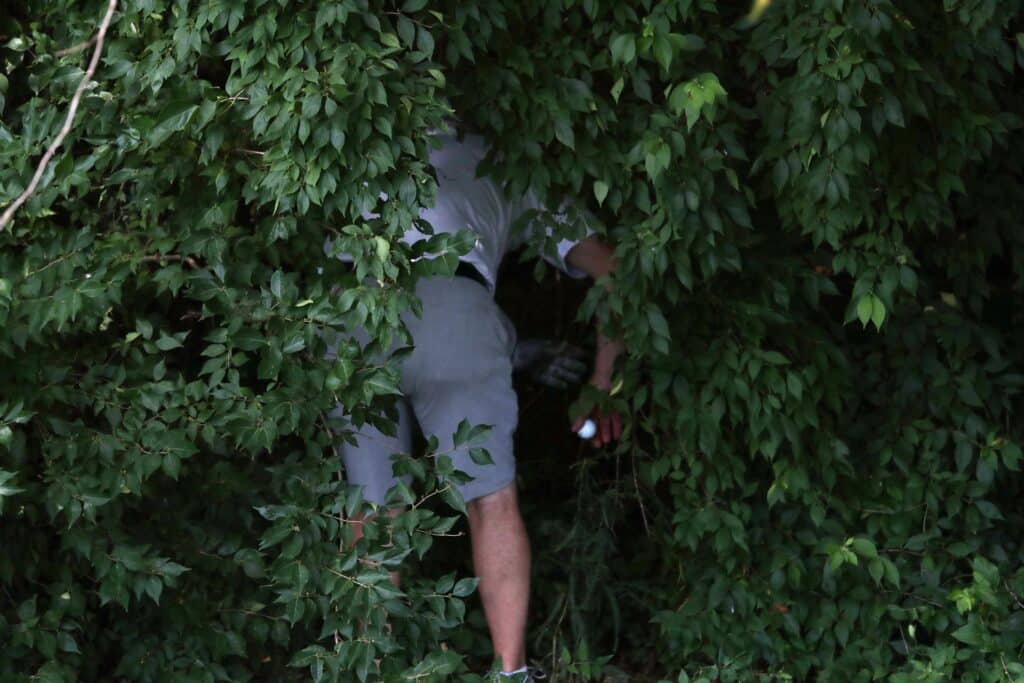
There are three big things club golfers get wrong all the time with unplayable ball rule. The first is misunderstanding where the two club relief area, when taking lateral relief, starts. I’ve seen many players whose ball is in a big bush or wooded area just take their ball clear of that hazard and then measure out their club lengths.
This is very wrong. The two-club relief area starts at the spot of the ball. And if that two club lengths isn’t enough to clear the predicament – and the ball has been lifted – then you’ll might be dropping back in the problem you thought you were trying to extricate yourself from.
As a clarification to the unplayable ball rule states, there is no guarantee a ball will be playable even after relief is taken.
If two clubs isn’t enough, you might have to take lateral relief again – at the cost of another penalty stroke. There is nothing to stop you taking lateral relief multiple times.
Each time a dropped ball comes to rest, “the player has a new situation” and you can take any option you wish under the unplayable ball rule.
The second concerns back-on-the-line relief. There was a small change to this rule in 2023 and it allows the ball to land on the line and then move in a one-club relief area in any direction. That means – and it only applies here – that the ball can bounce forward. As long as it stays in the relief area, it’s in play. Don’t pick it up thinking it’s closer to the hole and you have to drop again. You’ll inadvertently pick up another one-stroke penalty to the shot you’ve already added on for unplayable ball relief.
Finally, to use the back-on-the-line and lateral relief options in unplayable ball relief, you’ve got to know the ball is yours. That means you need to find it.
It’s no good hitting it into a bush and just saying ‘my ball is in there, I’ll take lateral relief’. Because the spot of the original ball is used for establishing a relief area, you must be able to find it and identify it.
This can become particularly challenging if your ball is in a tree. Some referees carry around binoculars, or players can use their rangefinders, to establish the identity of a ball that may be stuck in branches.
Now have your say
What do you think of the unplayable ball rule? Is there anything you would change about it? Let us know by leaving a comment on X.
Advertisement