

Bryson DeChambeau’s difficulties in some long grass at The Open certainly caught your attention.
The American got a two-shot penalty during his second round at Royal Birkdale after he was judged to have inadvertently improved the conditions around his area of intended swing from the rough on the 5th hole.
It’s got a few of you thinking about how it affects situations you’ve had on the golf course.
Hence this email: “While playing yesterday, I was searching for my ball in knee-high wispy grass. I only found it by treading directly on top of it (no penalty).
“However, I stumbled and half fell. Once I recovered, I could now see the ball as I had bent and broken some of the grass around it.
“Should that have been a two-shot penalty for improving my lie? It still required a hack with a sand wedge to get it about 15 yards and back into play.”
So what’s the answer to this one? And will you think I’ve got it right?
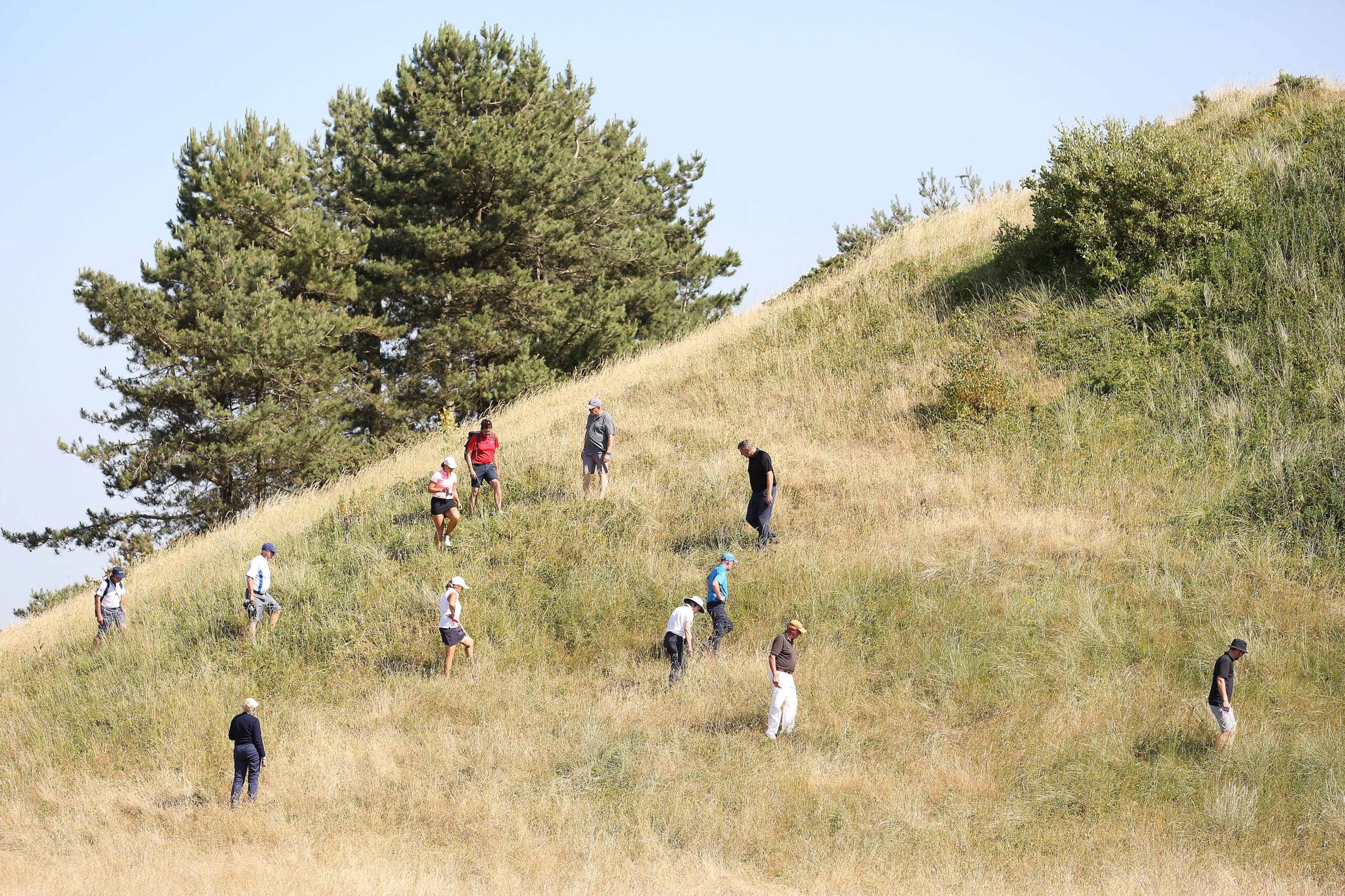
Can you bend or break grass while looking for a ball?
As our emailer rightly says, there is no penalty for accidentally standing on a golf ball while searching for it.
You’re also allowed to take reasonable actions to find and identify your ball and Rule 7.1a says that can mean moving or bending grass, bushes, tree branches and other “growing or attached natural objects” to do so.
You can even break such objects but only if it is “a result of other reasonable actions taken to find or identify the ball”.
Here’s what I’m thinking. It doesn’t matter whether the fall is accidental. The rules don’t actually require the improving of conditions affecting the stroke to be a deliberate act.
So I think this is the big question: Is moving the grass the result of reasonable actions taken to find or identify the ball?
Advertisement
I would argue it is. Our player stood on the ball while searching, lost balance as a consequence, and the fall was part of that same sequence.
I think that’s fine both under 7.1a and Rule 8.1b (1) as an action that’s allowed “even if doing so improves the conditions affecting the stroke”.
Just as a reminder, those are the lie of the ball at rest, area of intended swing and stance, line of play and the relief area where a ball will be dropped or placed.
So the key thing is not just that the improvement happened during the search, but that it was as a result of reasonable actions taken to find or identify the ball, rather than a separate action to improve conditions before the stroke.
As an aside, once you’ve trodden on it and, if the ball has moved, you replace the ball on its original spot – or estimate if you’re not exactly sure where that is.
If the original lie has been altered, something that’s also possible given you’ve stuck your big size 9s on top of the ball, Rule 14.2d (2) says you replace it “on the nearest spot with a lie most similar to the original lie”.
That needs to be within a club length of its original spot, in the same area of the course, and no nearer the hole.
So that’s where I am, but what do you think?
Got a question for our expert?
Despite the changes to the Rules of Golf in 2019 and 2023, there are still some that leave us scratching our heads. I’ll try to help by featuring the best of your queries in this column.
What do you think of this rule about standing on a golf ball? Let me know by leaving a comment below, email me at s.carroll@nationalclubgolfer.com or get in touch on X.
Advertisement