



Can you play your ball from a green when a temporary is in play? Do you get relief from a plugged ball in the rough?
There are loads of Rules of Golf that are specific just for winter and PGA professional Jack Backhouse and I have got you covered.
Whether it’s what to do when your ball is in leaves, or how to proceed if there is dew or frost in your line of play, we’ve gone through some of the decisions you’re likely to encounter on the course over the next few months.
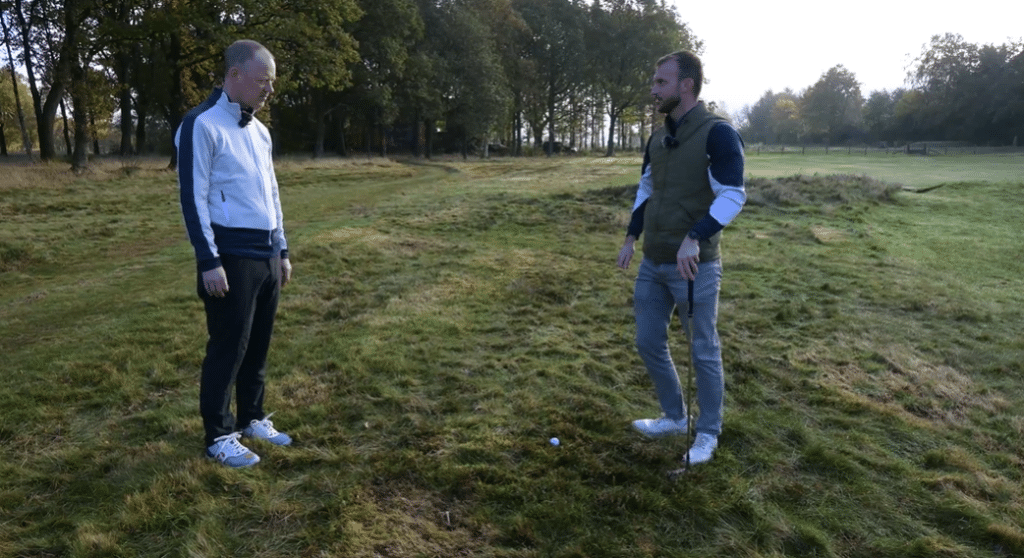
You can either watch us talking through some of these common winter golf rules in our video below or, alternatively, keep scrolling down as we go through them…
Winter golf rules: The six rules you MUST know
Winter rules of golf: What can you do if your ball is in leaves?
Autumn is here with a vengeance and there are leaves all over the course – and particularly in the rough. You might be able to get free relief here, but read carefully and don’t assume.
Leaves are loose impediments land Rule 15.1a says you that not only can you remove them, you can do so “in any way”.
You can shift them with your hand, a club, your foot – you can even use a leaf blower if you’ve got one to hand (and, yes, I’ve seen some people do that).
While you’re looking for the ball, you can take “reasonable actions” to find it, so there is no problem with improving conditions affecting the stroke if it’s part of a fair search.
If you move the ball while you were trying to find or identify it, don’t worry either. Just put it back where it was, or estimate if you don’t have the exact spot to hand.
You’ve got three minutes to search. If you don’t find it in this time, the ball is lost. You’ll have to take stroke-and-distance.
Advertisement
Once you do find it, be careful when shifting any of those leaves. Now, if you move the ball while doing so you’ll get a one-stroke penalty and you’ll have to put the ball back.
If there are leaves piled up all over the place, and your club are on the ball, they can use a Local Rule to treat piles of loose impediments as ground under repair.
If that’s the case, you can take free relief and you don’t even have to find it in the leaves as long as you know or are virtually certain your ball is in there.
Can you move your ball out of a divot?
It’s probably golf’s most controversial rule. It certainly causes plenty of arguments in our comments!
Plenty of golfers think you should get relief on the fairway from a ball that’s wedged into a divot. Normally, the response they get from rules chiefs is ‘tough luck and play it as it lies’.
But not in the winter. Your course will almost certainly have preferred lies in place for closely mown areas and that allows you to place the ball in a relief area. That’s usually six inches.
So if your ball is in the fairway, is in a divot, and preferred lies are in effect, you can extract it and give yourself a better lie. Hooray!

What if you don’t like your preferred lie? Can you do it again?
But even if with preferred lies, it can go wrong. Let’s say you place your ball and you don’t like where it’s ended up. I’ve seen plenty of golfers move to replace it again. Is that allowed?
It is not. The preferred lies Local Rule allows you to “take free relief once”. As soon as you’ve let go of that ball, with the intent for it to be in play, you can’t touch it anymore.
If you do touch it, or move it, after that point you’ll get a one shot penalty.
Golf winter rules: Ball embedded in the rough? Don’t worry about it!
You are allowed relief when your ball is embedded in the general area. I’m sure you all knew that. But did you know that the general area includes the rough?
So as long as part of the ball is embedded in its own pitch mark and is below the level of the ground, you qualify.
Find a reference point on the spot right behind where the ball is embedded and you get one club length from which to drop.

Winter rules for golf: Can you hit the ball off a putting green if a temporary green is in play?
You’ve overshot the temporary green and landed on what would be the usual putting surface. Can you just play it back up to the temporary flag?
Don’t do this. When a temporary green is the green in play, all other greens on the course – including the usual green for that hole – are wrong greens.
You are not allowed to play the ball from a wrong green. In fact, your feet can’t even touch it to make a stroke. You’ve got to take the nearest point of complete relief from the wrong green and you’ve then got a one-club relief area – no nearer the hole – in which to drop.
If you ignore this rule, you’ll be landed with a two-shot sanction for playing from the wrong place.

Winter rules in golf: Can I sweep water, dew, or frost off the line of my ball?
H2O – it’s absolutely essential for life but it can be a pain in the backside when it’s stopping our ball getting to the hole as we might like.
You know the scenario – it’s early in the morning, you’ve left one short, and you want to putt it. But the greenkeepers haven’t been out yet, or it’s been drizzling, and there’s liquid sitting on the top of the grass.
Advertisement
We’re not talking temporary water here, we’re talking about the normal stuff you might see if it’s an early morning or if it’s been raining.
You know it’s going to slow your ball down as it makes its way to the cup, but can you do anything about it? Can you just mop it up and smooth your passage to the hole?
Unfortunately, you cannot. Rule 8.1a specifically forbids it, saying removing dew, frost and water are “actions that are not allowed” when it comes to improving the conditions affecting the stroke.
That means you can’t do it on your lie, your area of intended stance or swing, your line of play, or the relief area where you will drop a ball.
A two-shot penalty will be forthcoming if you ignore this warning.
Got a question for our expert?
Despite the changes to the Rules of Golf in 2019 and 2023, there are still some that leave us scratching our heads. I’ll try to help by featuring the best of your queries in this column.
What do you think of these golf winter rules? Have any of them saved you shots during the coldest months? And which would you add? Let me know by leaving a comment on X.
Advertisement