


I don’t enter singles match play competitions. I’m a glass half-empty person about the format anyway, I think games are too much of a hassle to sort out and tough to fit in when so many other summer competitions are under way.
I am partial to a pairs, though, and I’m sometimes asked why I favour one over the other. On an episode of The NCG Golf Podcast, I told Tom Irwin why: handicaps.
Most competitions, whether they’re stroke play or match play, have an allowance. In stroke play, it’s 95% in singles and 85% in fourball.
In match play, though, it’s different. It’s 90% in fourball and 100% in singles. I think equity and field size can come into the equation in stroke play events, while in match play the allowances are designed to give each player the same chance of winning.
Do they? While the numbers might say one thing, I think the psychology says something very different.
I’m not in love with 90% as it happens. I’m much more of an Old Testament guy when it comes to match play. Give me the pre-World Handicap System era of three-quarters any day.
But those who know much more about the numbers than me were sure 75% tipped the scales too far in favour of the lower handicappers. So I live with it.
In singles, though, I think 100 per cent is too much. Here’s why.
LISTEN TO THE NCG GOLF PODCAST
ALSO AVAILABLE ON:
Apple Podcasts: Listen Now
Spotify: Listen Now
Amazon Music: Listen Now
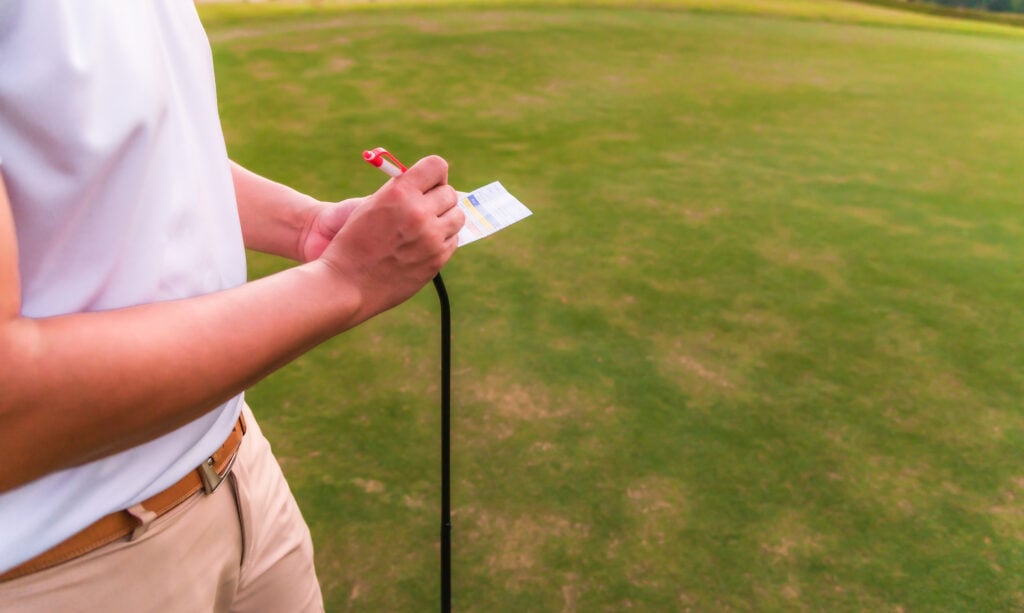
Do players get a boost when they can see their full handicap?
We’re forever having shots ‘taken off us’ every time we play a competition thanks to the Playing Handicap.
But in singles match play, the Course Handicap applies in full. For some players, it must feel like winning the golfing lottery.
Yes, everyone’s getting 100 per cent. Depending on the handicaps of the competitors, though, that can bring a decent swing compared with stroke play. I know who is probably feeling happier – the player seeing a couple more shots than usual.
Advertisement
The maths shouldn’t really change the expectations but can it be a mental boost? You play loads of golf losing shots – as far as the competition card is concerned at least – and then, suddenly, there they are in all their glory.
Does it give some players more confidence, and make make others feel like they’re up against it? Match play is as much a psychological battle as a technical one. Is it one-up straight away?
Handicaps change must faster now
Handicaps move far quicker than in the pre-WHS days. That’s not necessarily a bad thing, as it’s more reflective of form, but it’s also more reactive.
I don’t want to get into a cheat’s charter here, because we could go round in circles on that one, but back in the increasingly distant past you’d need 10 rounds to go up one full stroke under the old system. With no general play, that took time.
Now, depending on how much golf you play, your handicaps can shift significantly in a matter of weeks.
In a knockout running across the summer months, that can make big a difference with a full allowance. That might be fair in the broadest sense, but in a one off head-to-head it might not always feel like it.
Knockout competitions are volatile enough
The World Handicap System’s strength is in measuring scoring ability over time, but match play is different. It’s about winning holes in the moment.
Match play is a high variance event. Does a full allowance unintentionally amplify that randomness? There is always an element of lottery, but should the format dampen that for both sides?
Match play isn’t stroke play with different scoring, it’s a different game . If it’s already the most volatile format we have, is giving 100 per cent creating the fairness handicapping is designed to create?
Now have your say on singles match play
Could singles match play allowances do with a tweak in the World Handicap System, or are they just fine? Let us know in the comments below, or get in touch with us on X.
Main image: Golfers walking together on the course | Adobe Stock
Advertisement