

When the local headmaster of La Moye School, George Boomer, and his pals were refused admission to the Royal Jersey Golf Club in 1902, he decided to lay out some holes of his own on the dunes of La Moye, 250 metres above sea level.
It was once recorded that Royal Jersey members were ‘amused and surprised’ at the dress sense of members at La Moye – tradesmen who played in what they wore to work.
Among Boomer’s pupils were Harry Vardon and Ted Ray, who won seven Open Championships and two US Opens between them. Boomer’s son Aubrey, played in the first-ever Ryder Cup match in 1927 at Worcester, Massachusetts. He also came tied second at the 1927 Open Championship, six shots behind Bobby Jones.
Later, Boomer’s other son, Percy, published ‘On Learning Golf’ – one of the early instruction guides in the game. He became Head Professional of Sunningdale after World War Two. It’s said that Vardon and Ray sought his advice, as a winner of the Swiss, Dutch and Belgian Opens in the 1920s. This family held quite the presence and influence on a handful of the game’s greats around a century ago.
The Boomer family was very much part of the formation of the sport’s rich tapestry in the early 20th century, with the creation of La Moye Golf Club at the heart. In 1905, an extended, redesigned course was opened by Vardon, and its first clubhouse, too, in 1908.
I visited Jersey, and La Moye, on Liberation Weekend in early May. It was 81 years since Force 135 landed in St Helier to end the German occupation of the island. German occupying forces had destroyed much of the clubhouse and the golf course to improve sightlines for artillery use on St Ouen’s Bay.
ALSO: Why Wales offers some of the best value golf in Great Britain & Ireland
Advertisement
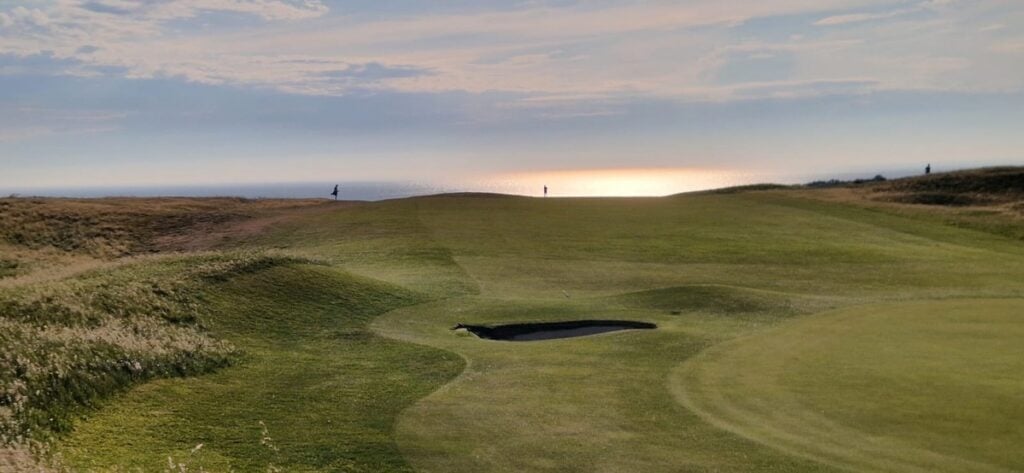
15 years after the war ended, a third iteration of the clubhouse was built, and since the course’s inception, some of golf’s greatest architectural minds have worked their magic on what is now a spectacular clifftop course.
James Braid redesigned it in 1935, and so did Henry Cotton in 1968. Braid was paid £20 for his work, and £7 15 shillings for an initial visit in July of the previous year. In 1993, Donald Steel provided a report suggesting modifications to the first three holes – a par 3, a par 5, and a par 3.
The front nine grabs your attention with this intriguing beginning – an opening par 3 that can play short and rope you into the prospect of a good start, followed by a par 5 that harshly doglegs to the right and is reachable on a firm day with the right wind.
The next par 3 shoots back in the opposite direction, and uphill, too. The raised green is unforgiving, requiring a precise tee shot; anything less is inevitably punished by the steep drop-offs on both sides and at the front and back.
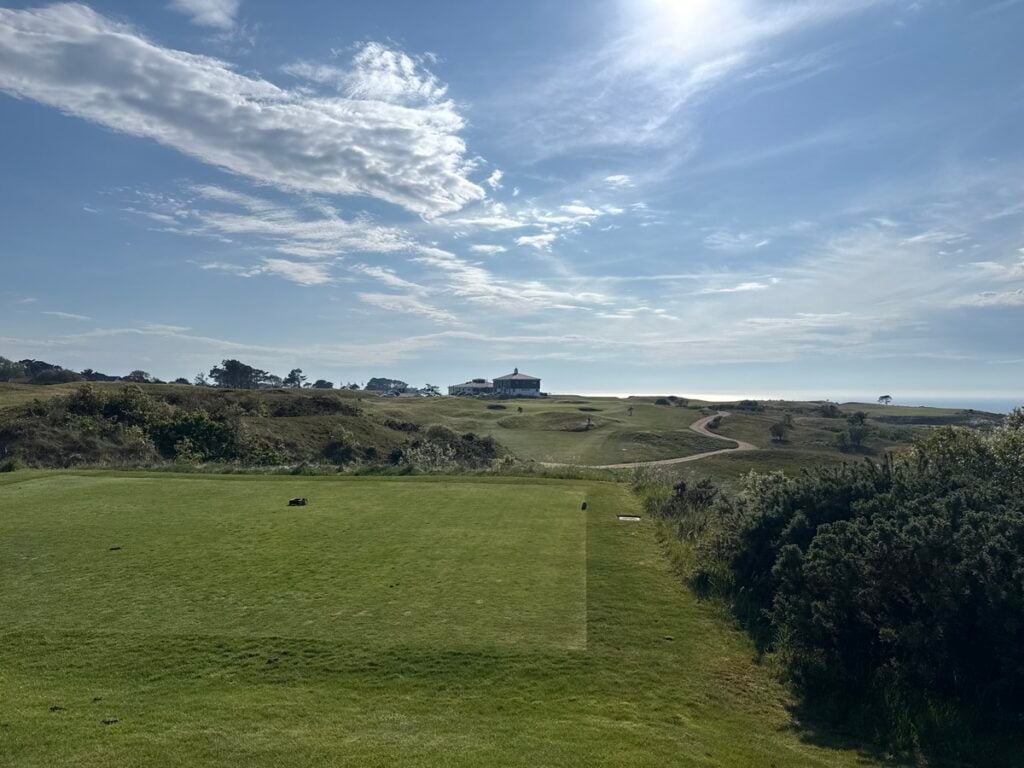
In 2012, holes 10, 11, and 12 were reopened after major redesign work of the greens and approaches by Martin Hawtree. This is a super stretch of the course that comes inland, and away from the clifftop and the clubhouse.
The tee shot on the 10th hole takes you downhill, as you look to fade your drive between bunkers. The approach comes back up to a raised green, with a steep run-off to the left, which is also where you’ll find more deep sand traps.
The 11th hole is a par 5. Two proper shots are required here to firstly find a fairway that initially snakes to the right, and secondly, to position yourself among the dunes and sand to find the putting surface with your third shot, aiming in the opposite direction. There are longer par 5s, but the shape of it demands a daring and exact second to find a testing putting surface, if you go for it.
ALSO: What we learned walking Augusta National’s second nine at the Masters
The 12th begins your journey back to the spectacular views across the beach at La Braye. This par 3 is guarded by several bunkers, and mirrors any short hole found on the coasts of England or Scotland.
In 2018, La Moye engaged renowned architects Mackenzie & Ebert to draw up plans to improve the course with emphasis on using land to the west of the 13th hole.
It was when we reached the apex of the fairway on 13, a delightful par 4 that then shoots downhill to a picturesque green site, when we looked over our right shoulders and caught a glimpse of the new holes soon to open at La Moye.
The new 13th and 14th holes take you right towards the sea, like one of those rollercoasters perched on pier ends. We were a couple of weeks early to experience them in active use and all their glory – that privilege is to come for members and visitors alike in the near future.
I was fortunate to experience this spectacular track on a scorching, windswept, late afternoon, when the very best of La Moye and its surrounding views showed themselves.
The closing four holes run parallel to each other, in a down-up-down-up loop. With the right wind, you can bounce a drive fairly close to the par-4 15th hole. You’re better off approaching the green from the right-hand side, if you can, as two greenside bunkers to the left will be glaring at you otherwise.
It’s on this putting surface where you are treated to the best vistas on the course, overlooking one of the many vast beaches on the island. This was a great hole. A gruelling par 5 takes you back to the clubhouse, then back down you go to another par 4 green at the top of a significant dip in this wide, inviting fairway.
Advertisement
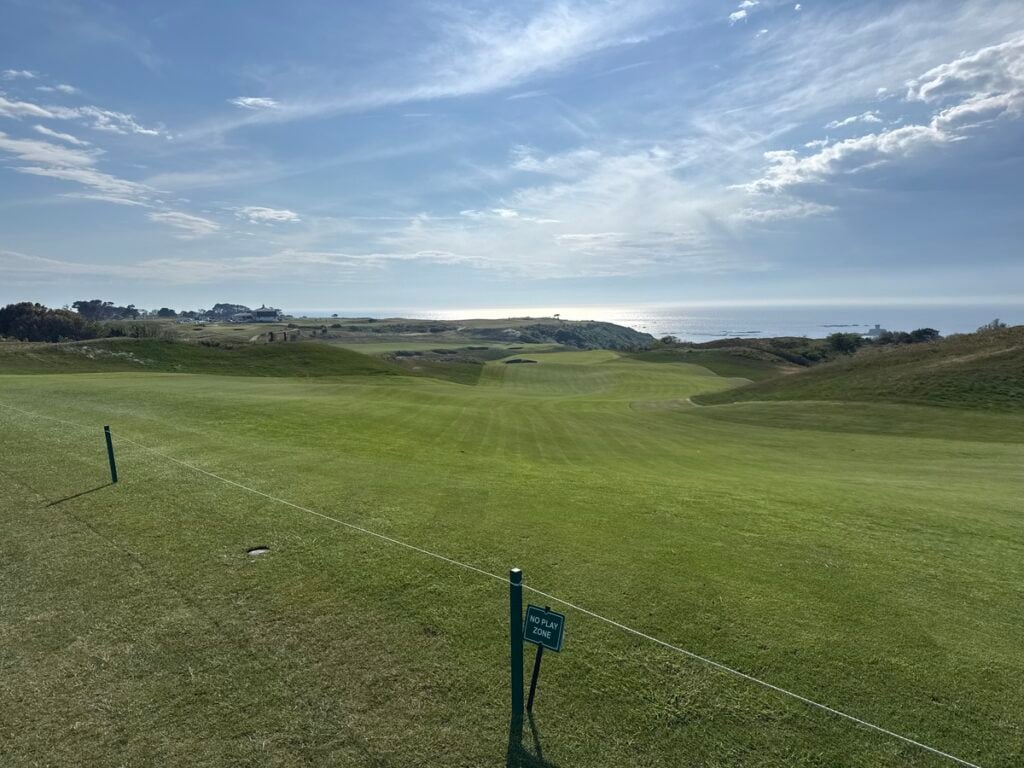
The dramatic drops and climbs at La Moye were once harsher, and levelled out to appease members when the course was tweaked in 1905.
The condition of La Moye is as impressive as the course itself. The par 3s test every club in your bag, the par 4s force you to rethink driver, and the par 5s require precision, as well as strength – especially when the wind blows as it did in early May.
La Moye was once host to the Jersey Open on the old European Tour. Sandy Lyle, Tony Jacklin, Bernard Gallacher, Ian Woosnam, Christy O’Connor, and Sam Torrance can boast appearances on the honours board.
And what an honours board to grace, and what a golf course to have left your mark on. My party and I were utterly dazzled and beaming when walking off the bowl green on 18, returning to the clubhouse terrace.
The turf was superb, and each hole, as if plucked from the most popular links and inland tracks of Great Britain and Ireland, provided enough challenge and variety to leave us all wanting more by the end.
NOW READ: Is this the best 36-hole venue in the UK?
NOW READ: Inside Royal Birkdale’s changes ahead of The Open’s return
Have you ever visited La Moye Golf Club? Tell us on Facebook!
Advertisement