

Match play doesn’t work in professional golf. Not really.
While we all love playing and watching it to some extent, the PGA Tour has dumped the format because it doesn’t work.
Players don’t know how long they’re sticking around for, nor do sponsors. If Rory McIlroy is beaten in the first round, loads of people will switch off, and once the final comes around, it’s an incredibly boring viewing experience, often complemented by a pointless third-place playoff in the group in front.
1916 was the year the PGA of America was established in New York City, shortly after department store owner Rodman Wanamaker brought leading golf pros together at the Wykagyl Country Club in New Rochelle to prepare the PGA’s agenda.
The PGA Championship began in the match play guise that year, and carried on until 1957.
Not that any of the above cynicism was shouted back then, but there is always clamour that the PGA of America should at least consider a return to maintain an identity.
So here we are again: the identity debate. The Masters is the Masters, the US Open is supposedly golf’s toughest test, and The Open Championship is played on UK links courses.
Once it was stripped of the ‘Glory’s Last Shot’ mantra with its move to May, the PGA was struggling for something it stood out for.
But, really, it wasn’t.
An army of club professionals has descended upon Aronimink this week, as they have always done. And while we all seem to be on a constant search to justify the PGA Championship’s existence, and tell it to go elsewhere to Australia or Asia, the event’s identity is under our noses.
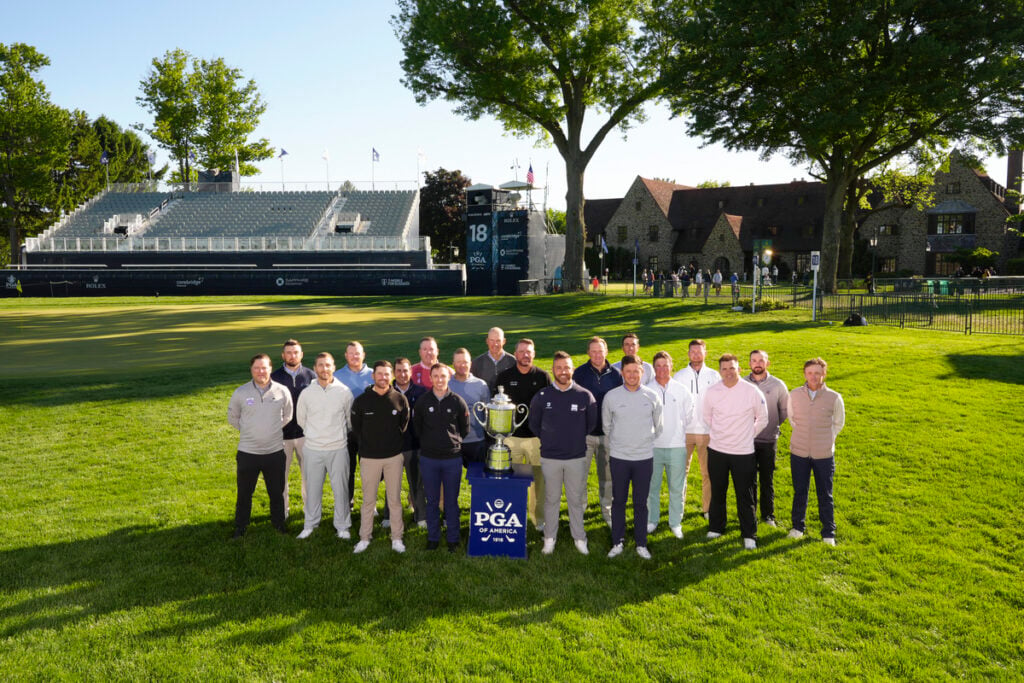
It is Michael Block. It is Mark Geddes, and Jesse Droemer, who won this year’s PGA Professional Championship at Bandon Dunes in Oregon. It is the club professionals who are honoured with places in the field.
Advertisement
Block made huge headlines in 2023, when not only did he make the cut and come tied for 15th, but he made an ace on Oak Hill’s 15th hole while playing with McIlroy in the final round.
ALSO: How to qualify for the PGA Championship at Aronimink in 2026
ALSO: Meet the PGA Professionals playing at the PGA Championship in 2026
We need PGA Professionals at the PGA Championship
He might have been a subject of derision since, which he now attributes to his own actions, but Block’s story has been more compelling than anything at this event for a while, aside from the World No.1 being arrested.
20 club professionals are scattered around the roster of the world’s best golfers this week, representing the lifeblood and grassroots of the sport.
The PGA Professional Championship is the platform where Block and his pals can qualify, and is essentially the equivalent of the regional and final qualifying we see at the US Open and The Open.
The PGA Professional Championship brings together a vast network of golfers looking to play in a major. It features a 312-player field from 41 PGA sections. It was born in 1968 and has provided a formal pathway for those who work at the community level to compete at the world level.
Are any of them going to win? No. Does anyone win The Open having got through regional qualifying? No, but no one questions why it is a thing.
“I hear it,” Block said in a chat with Alan Shipnuck, about the idea that PGA Pros shouldn’t be welcome.
“And that motivates me to want to play well. If the club pros always finished 136th-156th at the PGA, I would agree that the number should go down, that 20 spots is too many. But that never happens. Guys make the cut, guys finish well ahead of many of the best players in the world.
“But we have full-time jobs, we’re not used to a stage like that or course conditions like that, so of course some guys struggle. But I do think it remains an important way to showcase that club pros have game, too, and to maintain what has always been part of the history of the tournament.”
It is a great shame when the discussion is focused on shutting the door to PGA Professionals and closing down a concept that actually makes the PGA Championship unique, which is what we cry out for when the second week of this month rolls around.
While understanding that a major tournament might not be the appropriate platform to say come one, come all, their presence represents an intimate connection to where we all started at the beginner level.
That isn’t a feeling that exists at any of the other majors. Top amateurs and up-and-coming golf pros can battle through the various stages of qualification to play at Shinnecock Hills and Royal Birkdale, but this is a distinct pathway for those who teach the game, and run golf clubs to cater for those who want to be the next Scottie Scheffler.
“I’ll be approving payroll from the driving range at Aronimink,” Block added. “It’s pretty funny how much shop business I have done in the middle of the PGA Championship or at PGA Tour events.”
I imagine his peers will be doing the same.
In a game that has reached the peak of greed and gross evaluations of self-worth in recent years, the PGA Pros that tee it up in Newtown Square this week will bring a welcome departure from that, playing for the experience, the love and that distant hope of ‘You never know’.
Advertisement
NOW READ: Which LIV players are in the PGA Championship?
NOW READ: PGA Championship field 2026: Who is playing at Aronimink?
What do you make of the PGA Professionals-PGA Championship debate? Tell us on Facebook!
Advertisement