



Some of you don’t know what’s good for you. Me? If the mercury gets much below zero I want to be tucked up in the warmth and dreaming of spring.
But many of you like to get out no matter what Mother Nature’s throwing at us. Rain, hail, wind, snow – if it is open in the winter months, you’re on the golf course.
That can lead to some interesting rules questions. So let’s consider this one: Assuming the course is open, but there is some snow or ice stubbornly lying around, do the Rules of Golf help or harm?
What can you do if your lie is affected by a big ball or ice, or if it’s lying in the middle of someone’s melting snowman? What about if frost is going to slow your ball down all the way to the hole?
Next time you’re at the golf club and it looks like something from an Aled Jones fantasy, remember these snow golf rules and you might get relief, or you’ll certainly stay out of trouble.
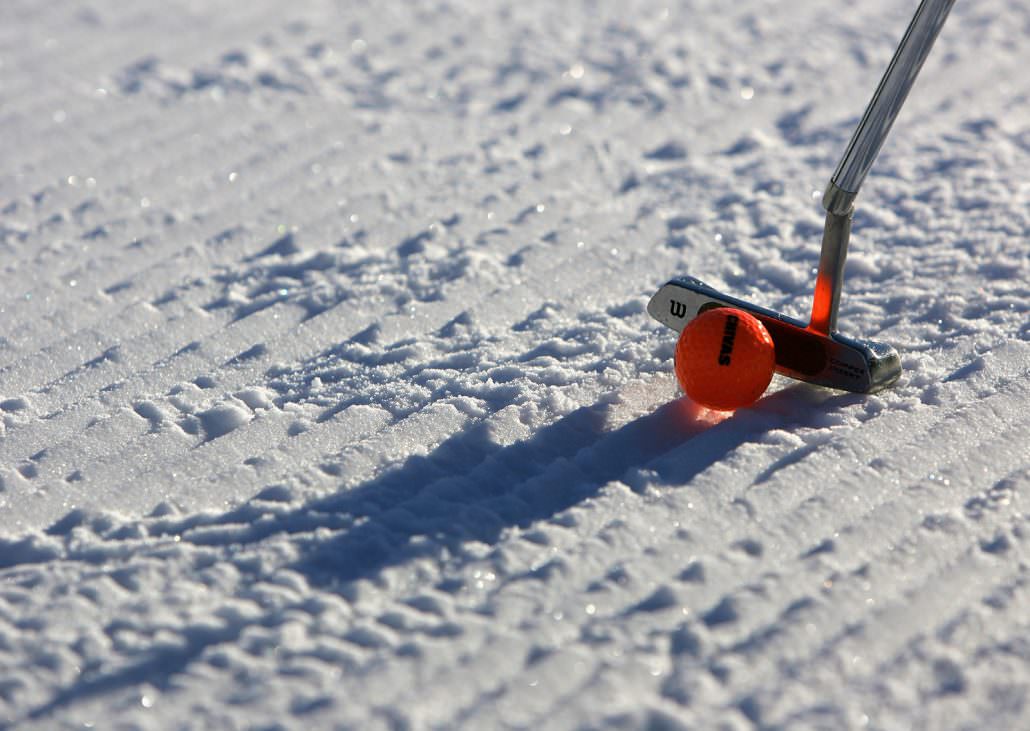
Snow golf rules: What am I allowed to do?
Let’s start with the simple stuff. Snow and natural ice, which would include hail, are loose impediments. If it’s affecting your stance, lie, area of intended swing, you can remove it. You can do that in any way – whether that’s by hand, foot, club. You can take out a big towel and swish it if you want.
But you can’t move the ball. If you do so, you’ll get a one stroke penalty and you’ll need to replace it. Forget to do that and your one-shot sanction will become two for hitting from the wrong place.
Snow and natural ice, when it’s on the ground, is also temporary water. And, as the player, you get to choose whether what you are faced with counts as loose impediments or temporary water.
Advertisement
If you plump for the latter, though, it must be seen before or after you take a stance and you can’t press down “excessively” with the feet to do it. The accumulation of snow or ice needs to be present.
Most of the time, if your ball is sitting on a stubborn patch of ice that the winter sun hasn’t yet tackled, it’ll be obvious it’s temporary water.
It’s fair enough too. For health and safety reasons if nothing else, you don’t want to be slip sliding away trying to hit a 7-iron.
Simply find the nearest point of complete relief that’s no nearer the hole and in the same part of the course – so if the ice, for example, is in the fairway then you’re taking relief in the general area – and drop in a one club length area.
Right, let’s move on to the trickier bits. Don’t get ice and frost mixed up. They are not the same. You can’t remove dew, frost or water from anywhere on the course except in the teeing area before making a stroke.
And while I’m sure you’ve seen all those funny social media videos with the snow bulldozed and leaving the perfect line on the putting green for the ball to get to the hole, this is also forbidden under the rules. It’s called creating a pathway to the hole.
You’ll get the general penalty – two shots or loss of hole – under Rule 13.1c.
Some of the sharper-eyed readers among you may have noticed I referred earlier to natural ice. That wasn’t a typo. Manufactured ice – the kind you might put in a drink – is treated differently in the Rules.
Advertisement
It’s an obstruction and an abnormal course condition. You can take relief if your ball is on it and, if you move your ball while shifting it, you won’t get a penalty.
Got a question for our expert?
Despite the changes to the Rules of Golf in 2019 and 2023, there are still some that leave us scratching our heads. I’ll try to help by featuring the best of your queries in this column.
What do you think of these snow golf rules? Do you play much when the snow and ice or on the ground on the course? Drop us a line on X.
Advertisement