


The Ryder Cup isn’t just a clash of continents. It’s a potential rules controversy waiting to explode.
In the rulebook are some quirks that could turn the matches upside down – from concessions to who can give advice.
With the battle at Bethpage Black fast approaching, here are some of the strange and easily misunderstood Ryder Cup rules you need to know…
Did you know these five Ryder Cup rules?
When is a conceded putt really a concession?
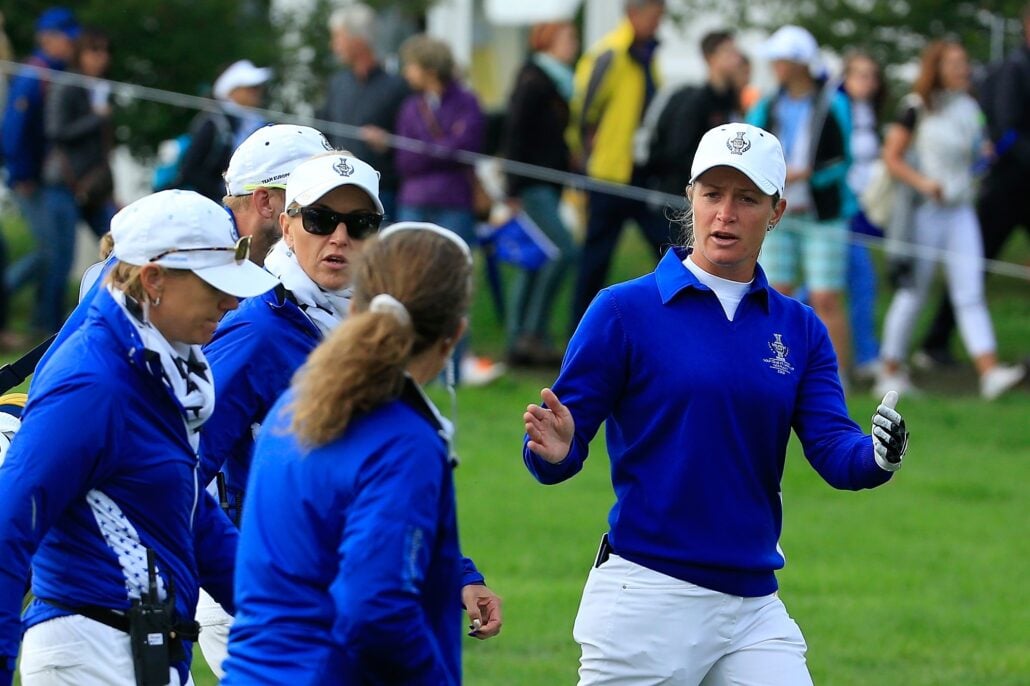
We’ve seen plenty of drama over concessions – from Solheim Cups to squabbles between Sergio Garcia and Matt Kuchar.
When a format allows ‘gimmes’, there is always a chance of a mishap and there’s not a bigger stage than the Ryder Cup.
You all know in match play that players don’t always have to hole out. An opponent can concede a putt, a hole, and even the match.
Rule 3.2b (2) says concessions only are only made if they are clearly communicated. That can be verbally or through a gesture that makes it obvious.
You can see how it can become confusing in the heat of battle.
But if an opponent mistakenly thinks a putt has been conceded and picks up their ball, there is a get out. If it was because of a “reasonable misunderstanding that the player’s statement or action was a concession” there is no penalty. The ball is replaced on its original spot.

Who can give advice?
Back when everyone just assumed Keegan Bradley was going to be a playing captain, there was plenty of talk about who would be able to give advice in a session.
It mattered because Ryder Cup teams usually agree only the skipper can dish out tips during play – not vice-captains and certainly not team members watching from the sidelines.
You’ve probably never used Rule 24 in club golf, but it allows each team to bring in a Local Rule naming one person an official “advice giver”.
Advertisement
It doesn’t always have to be the captain – it could be a coach or a team member. But they need to be identified. And if they’re playing, they can’t give advice at the same time.
Rule 24.4 is pretty strict: Partners can help each other, but “a player must not ask for advice from or give advice to a member of their team playing on the course.
“This applies whether the team member is playing in the same group as the player or in another group on the course.”
Late to the tee? It all depends on the format
No one will ever forget Rory McIlroy at Medinah in 2012. He mixed up US time zones and needed a police escort to make his singles tee time.
It could have ended the ‘Miracle’ before it really got going. Being up to five minutes late means loss of hole. Any longer and it’s disqualification. It’s unlikely forgetting the time zone would be considered an “exceptional circumstance” that could get a competition committee to waive a penalty.
Timings are tight in foursomes too. The player going first needs to be ready at the starting point and their partner needs to be either with them or where they’re expecting the ball to come to rest.
But in fourball it is different. “One or both partners may represent the side”. Both players don’t need to be present, or even play, on every hole. A match can even start with one-against-two.
If the absent player sprints down mid-hole, though, they’re not allowed to get into the action until the start of the next.

Will they ditch the one-ball rule again?
Two years ago in Rome, then US captain Zach Johnson revealed the teams had ditched the one-ball rule.
This Local Rule restricts players to using one brand and model of ball for the same round. In foursomes, this meant both partners would need to agree on a single ball before the match and stick with it.
You might argue it’s all part of the lore of the format in the Ryder Cup – with pairings resting on the success of getting the tactics right.
Matching players on whether they were ball buddies, or could cope with playing a different brand can be seen as part of that.
Instead, getting rid of the restrictions allowed players to switch balls hole-by-hole if they wanted. Will we see it again? It’s a fair bet we will.
Can benched players sneak in practice?
With only four matches per session over the first two days, it means four players from each team are left twiddling their 9-irons. Can they get in a few holes on the course while their teammates secure points?
We know it’s a no-go in stroke play. But Rule 5.2a says players can “practice on the course before a round or between rounds of a match-play competition”.
In Rome, Golf.com reported it was written into the Captain’s Agreement. Non-playing teammates could practice 40 minutes after matches teed off, as long as they stayed two holes behind the last game and kept away when holes were cut for the next session.
We should expect similar at Bethpage.
Now have your say
What do you think of these Ryder Cup rules? Are there any others you think could be an issue at Bethpage? Let us know by emailing me at s.carroll@nationalclubgolfer.com or leaving us a comment on X.
Advertisement