



This rule in a nutshell: If your ball is known or virtually certain to be lost in ground under repair, you can take free relief under Rule 16.1e. Find the estimated point where the ball last crossed the edge of the ground under repair and use that as the spot of the ball to determine the nearest point of complete relief.
The rough mower will soon be cutting a swathe through my golf course. This causes me to cheer greatly, as the ankle to waist high stuff I’ve been wading into from the tee for weeks will soon be no more. Let the golf truly begin.
That grass doesn’t go anywhere overnight. For a while, it sits on the edge of the fairway and it’s a magnet for my ball. Because it’s piled for removal, it’s ground under repair and we can take free relief.
But while getting to the ball can be one thing, finding it can be another. And that is at the heart of this column’s question…
“A player hits their ball into GUR and they and their playing partners are certain it is in the GUR. After a fruitless search for the ball, the player decides they would like to drop another ball at the closest point of relief.
“Although they and the others are certain the ball is lost in the GUR they are not certain where the closest point of relief is, only that it was somewhere around the middle.
“One side of the GUR is fringed with trees, while the other offers a clear shot to the green. What should the player do?”
So is it a shot through the gap, or a clear route to the putting surface?
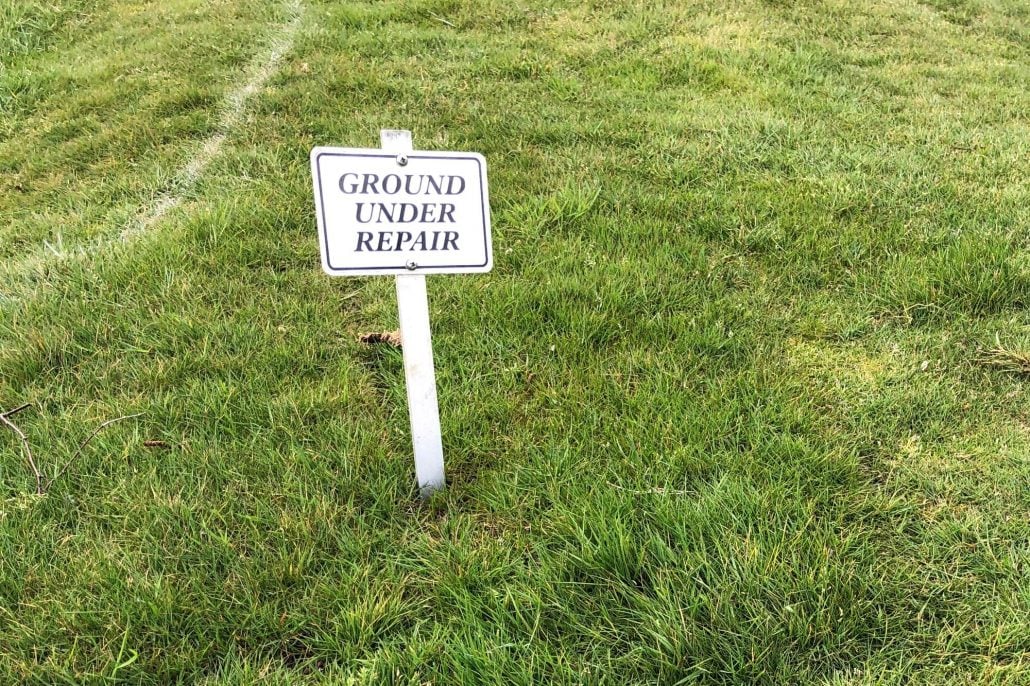
Ball lost in ground under repair: What the Rules say
This is one of those situations which can seem hard to fathom when you’re in the thick of it but is easier to understand when you take a minute to think about it.
Advertisement
As our questioner correctly asserts, if a ball is known or virtually certain to be lost in an abnormal course condition – in this case ground under repair – you can take free relief under Rule 16.1e.
So where do you take that relief? It’s not just a question of closest or, more accurately, nearest point of complete relief just yet.
You need to find the estimated point where the ball last crossed the edge of the ground under repair.
Estimated gets rid of the problem of not knowing exactly where it went in and you can do that by using reasonable judgement. Once you’ve found that estimated point, you use that as the spot of the ball to find the nearest point of complete relief.
You’ve then got a one-club length relief area in which to drop. Once you’ve put another ball into play, the original ball is “no longer in play and must not be played”. That’s the case even if you then find it before the end of the three-minute search time.
Got a question for our expert?
Despite the changes to the Rules of Golf in 2019 and 2023, there are still some that leave us scratching our heads. I’ll try to help by featuring the best of your queries in this column.
Have you had a ball lost in ground under repair? What do you think of this rule? Let me know by leaving a comment below, email me at s.carroll@nationalclubgolfer.com or get in touch on X.