


Storm season is on the horizon. Let’s keep the fingers crossed that everyone comes through safely but there will inevitably be debris, and golf courses have been a particular casualty of some of the extreme winds and rain that have battered us over the last few years.
So for those undaunted by the prospect of playing during the colder months, the following email might sound familiar:
“I played after some strong winds, which seems to be more common [and] had blown down a mountain ash.
“My ball came to rest under the branches of the fallen tree. The tree had completely snapped at the bottom so was not attached to the ground.
“It was too heavy to move so I had to move my ball before my next stroke. Should that have been taken as an unplayable or would I get free relief from abnormal conditions?”
So if you’re not fortunate to enough to have superhuman strength, what do you do when your path to glory is blocked by a fallen tree?
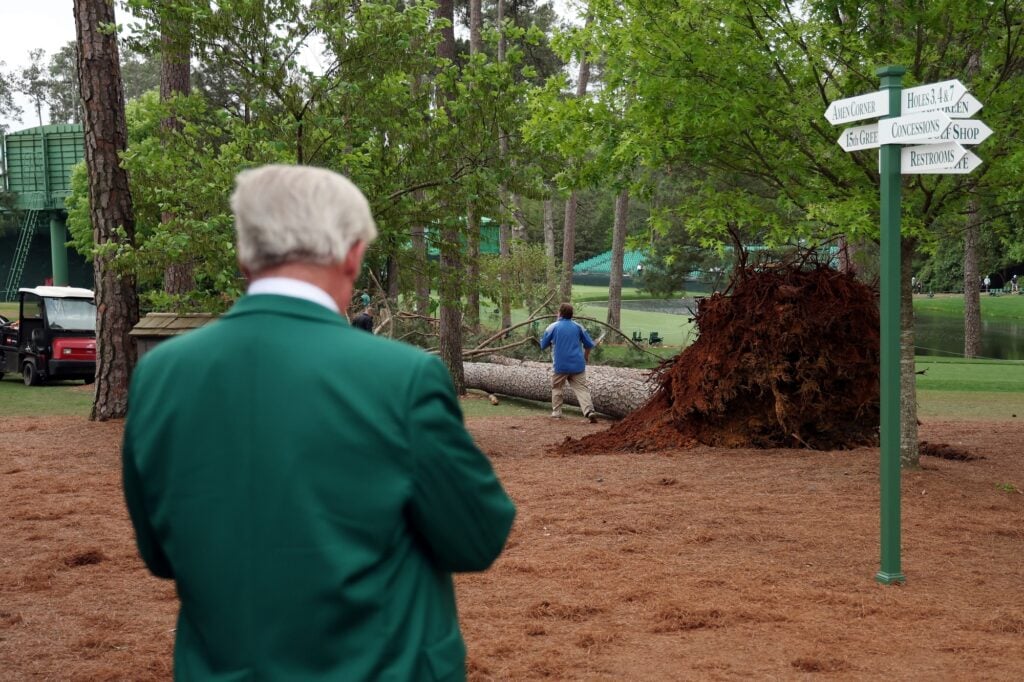
Fallen tree on golf course: What are the rules?
Trees are just 90 per cent air, aren’t they? I never seem to clear the branches, though, so I’ve got no chance of extricating my ball if Mother Nature has lent a hand and sent one crashing to the ground.
Loose leaves and branches are loose impediments. So if you can shift them, you’re within your rights to do so. Remember, if you move the ball when doing so you get a penalty stroke.
It’s a bit trickier, though, when you’re dealing with something so big it causes damage to people and property.
You might think this is automatically one of those situations where you’re dealing with an abnormal course condition. After all, trees are supposed to be upright.
But you might be wrong, and your club committee needs to be on the ball if you’re going to avoid a sticky situation in a competition.
Advertisement
That’s because a fallen tree, and a tree stump, is “not always ground under repair”, according to a clarification to the definition.
It says a “fallen tree or tree stump that the Committee intends to remove, but is not in the process of being removed, is not automatically ground under repair”.
But if it’s “in the process of being unearthed” or “cut up for later removal” then it is GUR. Are you all with me?
The clarification gives an example of a tree that’s fallen in the general area and is attached to the stump. This isn’t ground under repair but “a player could request relief from the committee and the committee would be justified in declaring the area covered by the fallen tree to be ground under repair.”
So the easiest thing is for your club committee to be aware of any damage that has happened on the course and, if they can’t quickly remove it, put out a Local Rule that establishes a fallen tree as ground under repair. Otherwise, you could be looking at trying to play it as it lies or taking unplayable ball relief.
If they’ve successfully done that, you will be able to take relief if the fallen tree interferes with your lie, area of intended swing or stance. But you won’t get relief for line of play.
Some of you might think the tree is an immovable obstruction. After all, it’s in the way and you can’t move it. But obstructions, as laid out in the rules, are artificial objects. I’m afraid a tree is as natural as they come.
Got a question for our expert?
Despite the changes to the Rules of Golf in 2019 and 2023, there are still some that leave us scratching our heads. I’ll try to help by featuring the best of your queries in this column. Send me your questions by emailing me at s.carroll@nationalclubgolfer.com
What do you think about this fallen tree on golf course rule? You can also let me know by leaving a comment on X.
Advertisement