



Imagine the ideal golf course. It’s not too easy, not too hard. Everything is perfect. It’s impossible to find such a layout, of course. But the idea of it forms a central part of how the Slope Rating works.
Why? Because that fictitious track has a rating that forms the base from which our handicap marks are calculated.
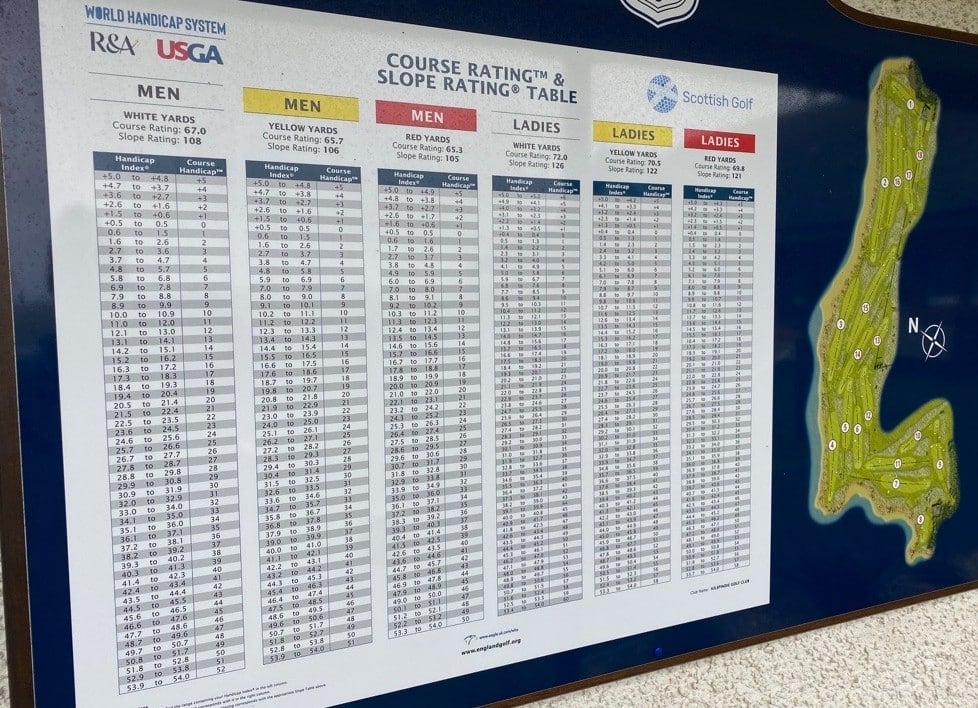
In the World Handicap System, your Course Handicap – the number of shots you receive in a round of golf – is determined with the help of the Slope Rating for the set of tees from which you play.
What is Slope Rating and how does it work?
Slope Ratings are described by the USGA as indicating the “measurement of the relative playing difficulty of a course for players who are not scratch golfers, compared to scratch golfers”.
Every course is assessed using a course rating system, which focuses on scratch and bogey golfers.
The course rating is produced by considering the number of strokes a scratch player would be expected to complete a round in under normal playing conditions.
Scratch, by the way, does not mean tour pro. It’s your average club zero-handicapper.
The bogey rating, similarly, is the number of strokes a bogey player would take in the same conditions.
A bogey golfer is classed as about a 20 handicapper for a man, and 24 for a woman.
The Slope Rating is created by taking the difference between those two ratings and multiplying it by a predetermined factor.
Every set of tees on every course has a Slope Rating and those numbers vary between 55 and 155.
The higher the Slope Rating, the greater the difference expected between the scores of those scratch and bogey golfers. A higher rating doesn’t necessarily mean that the course is more difficult than another.
Significant factors involved in working out Slope Rating include rough, water hazards, trees and, of course, length.