



For many of us, it’s part of our identity as a golfer. It’s often the first thing we’re asked when we meet other golfers. ‘What’s your handicap?’
It’s used to separate us in competitions – sometimes it determines whether we can even enter an event at all.
It’s also a measure of progress. A number that tells us where we are and how far we might still have to go to realise our ambitions. Ultimately, when converted into a Course Handicap, it determines the number of strokes we receive in any round of golf.
Under the World Handicap System, handicaps have a huge range. Absolute beginners can start at 54.0, while there is seemingly only our own physical limits that hold us back at the very top end.
When Jon Rahm enjoyed an incredible run of form in 2022 and 2023 – a period that saw him win three times and boast 10 top 10 finishes in 15 starts – it was calculated he’d boast a handicap index of +13.
We’ve all got a rough idea of what our number means for our ability, but where does that figure put us in the golfing pantheon?
Padraig Harrington once said he thought he could get every golfer in the world down to a single-figure handicap.
So how many of us boast a single digit? What is the average handicap? And where do you stand on the ability scale?
We’ve got some detailed numbers to show you, so let’s look at what a good golf handicap really is…
What is a good golf handicap?

What is a handicap?
Let’s start with the basics. When you’ve submitted 54-holes of scores – whether that is from three 18-holes rounds, six 9-hole rounds, or a combination of the two – you are given an initial World Handicap System index.
The USGA say it is a “portable number that represents your demonstrated golfing ability” and that first number is only just the start.
Advertisement
Once you’ve entered 20 scores, you’ve got what’s called a full record. From here, your best eight score differentials from that 20 are averaged.
How many golfers have handicap indexes?
The USGA issue up to date figures on the number of golfers with a handicap index and, in 2024, there were 3.4 million in the United States of America.
Of those, 2.78 million were men, and 610,000 were women. Those figures were substantially up on 2020 – when WHS was introduced – when 2.6 million players had a handicap.
A recent Troon International report on the playing, travel and spending habits of US golfers revealed 65 per cent of players had an official handicap through the GHIN system, while 11 per cent used an alternative method. The results, revealed in the Troon Golfer Survey, said 23 per cent of players did not officially maintain an index.
It’s hard to give precise numbers in Great Britain & Ireland, where WHS is managed by four separate home unions – England Golf, Scottish Golf, Wales Golf and Golf Ireland.
But in 2025, there were around 730,000 golf club members in England and over 785,000 golfers with a handicap when iGolf members are added.
What is the average handicap?
In the United States, the USGA reveal the average handicap index is 14.2 for male golfers and 28.7 for females. Among new players – those who got a handicap for the first time in 2024 – the average male handicap was 16.9 while it was 33.1 for women.
These figures put American golfers a bit ahead of their English counterparts – or the men, anyway. There, the average male WHS index is 17.38, with female players averaging 28.09. Combined, that means the average handicap index of a golf club member in England is 18.62.
That’s a touch higher than previously recorded when males were at 17.1 and females at 27.2.
The average iGolf handicap – for those English players who are not golf club members – was 20.07 (male 19.72, female 30.88).
How good or bad is my handicap compared to the average?
We can break those numbers down even further. The USGA figures show the biggest number of male players – 26.72% – have a handicap index of between 10.0 and 14.9.
Nearly 70 per cent of men and boys have a number between 5.0 and 19.9. For women, it’s a more even split from 15.0 onwards, but just under 20 per cent of players have a handicap index between 25.0 and 29.9.
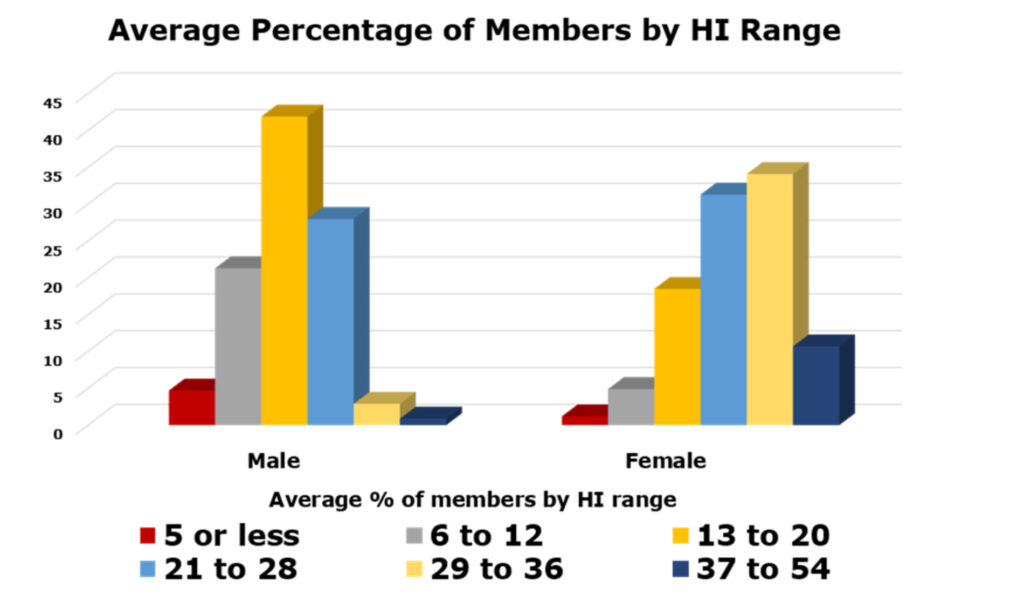
In the UK, as the above graph from England Golf shows, the majority of men are in the 13 to 28 handicap range (45% 13 to 20 and just over 30% from 21 to 28).
And despite the furore over 54 handicappers, especially in the UK, only tiny number of male players play off a mark that high. It’s a negligible number in both America and England. Players between 50.0 and 54 represent just 0.07 per cent of male golfers in the USA.
Back in 2022, only 2,250 players out of 737,000 affiliated members in England had a 54 handicap.
There are more female players with higher handicaps than males. Nearly 15 per cent of players in England are in the 37 to 54 handicap range. In the USA, around 43 per cent of females have a handicap index of 30.0 or higher.
How many scratch golfers are there?
There is an oft-quoted mantra that if you’re a single figure golfer you’re in the top 10 per cent of players on the planet. But if you’re 0.0 or better, it really seems like you’re soaring into the stratosphere.
Fewer than two per cent of male American golfers have a handicap that is scratch or plus – it’s 1.99% to be accurate – while 0.75% of female players can demonstrate the same ability.
It’s a similarly rarefied atmosphere for those from 0 to 4.9, with 1.38% of US-based women and girls holding that mark and just 8.55% of men managing the same.
In England, fewer than 5% of males have a handicap index in the five or less range, with a relative handful of women compared to the overall number of players.
Advertisement

So are you better than the average?
What is a good golf handicap? It’s difficult to say for everyone, as there will be plenty of people at your club that have no interest in competitions and may only play casually.
While a minority of courses, notably the Old Course at St Andrews, still require a handicap certificate to tee it up most are happy to take your green fees and membership subscriptions and never mention a handicap again.
Generally, though, a player who holds a World Handicap System index is likely to be more engaged in the game than one who doesn’t.
But even two with the same handicap can be players of different abilities. One might play three times a week, one might turn out once a month, but the cards they have submitted ‘label’ them in the same way.
So while the figures we’ve shown you can give you a good guide as to where you stand, it’s still a pretty individual number. Just make sure you try and keep on improving!
Now have your say
What is a good handicap? How does your handicap index rank with some of the numbers we’ve shown you here? How do you measure up against the average golf handicap? Are you better than expected when compared with your playing partners, or those in another country, or is there more work to do? Let us know by leaving a comment on X.
- NOW READ: High-handicap golfers are dominating club competitions – but not for the reasons you think
Advertisement