



Is there anything more misunderstood in the World Handicap System than Course Rating? Well, possibly Slope but the number that sits squarely as a measure of your course’s difficulty for a Scratch golfer causes all kinds of controversy.
Some clubs think their rating should be higher, some would like it lower. I’ve heard of clubs that have tried to engineer new obstacles into their courses – such as putting in new bunkers, shifting some, and making others deeper – to try and increase their Course Rating.
Little gets past the teams of volunteers that spend many hours learning how to properly rate courses and then spending time diligently carrying out the task for multiple sets of tees at clubs within their county area.
Enlightening golf coverage dispatched to your inbox
Sign up here for our daily newsletter and you’ll never slice a drive again. Promise.
Sign up (1)
You may know a little about landing areas, green speeds, and recoverability.
Recently, though, I had the chance to watch an Introduction to Course Rating – a 45-minute video seminar produced by England Golf for those interested in getting into the area.
While it doesn’t get into the depth required to get you out onto holes with a form and a Course Rating guide, there were several nuggets that might just give you a glimpse of what goes into the act.
So here are 5 things you probably didn’t know about Course Rating…
Here’s what you really need to know about Course Rating

Course raters carry LOADS of equipment
You might think they’re only armed with the Course Rating guide – along with a pencil and a form. But course raters have got a backpack full of stuff.
They use lasers to measure landing areas, distances between tees and bunkers, and the widths of greens. They carry plenty of batteries to keep their tech always working.
And they have a Stimpmeter on hand to evaluate green speeds and check out the slopes. A sleeve of balls serves the same purpose and several tees can help determine how firm a fairway might be.
Advertisement
A hole isn’t always as long as you think it is
It’s about the Effective Playing Length rather than the absolute yardage. The easiest way to visualise this is a sharp dogleg that might play to a distance on the scorecard, but completely another if a player cuts the corner.
There are five factors for effective length, which can make a hole play longer or shorter than its scorecard yardage.
These are roll, elevation, dogleg and forced lay-up, wind, and altitude. These can quite dramatically affect the playing length of a course, or an individual hole, and so can change the expected score of a scratch or bogey golfer. That could then alter the course and slope rating.

The size of the green is really important when assessing the difficulty of a hole
The line of play – so how you get to that green – is irrelevant in the calculation. Course raters measure the longest diameter of the green before measuring the crossing diameter perpendicular to the first measurement. To get the effective diameter of the green, raters just average the two measurements and convert it into yards or metres.
Hole positions, particularly where the pin location might be on the day the raters visit, is simply disregarded.
What is the ‘Psychological Factor’ in Course Rating?
Sounds like a prime time 80s quiz show, doesn’t it? But this little titbit blew my mind when I first started learning about Course Rating. What could it mean? Did that brutal out of bounds on the opening hole play a big role in the overall number? Did the tough par 3 finisher over water skew the figures?
The psychological factor is so much more and it’s actually determined automatically. It is simply based on adding up all the obstacles on a hole, the effect they could have on a player’s score, and working out their overall difficulty.
So when multiple obstacles, which are tough to negotiate, are found on one hole, it becomes much harder for players to escape intact.
Advertisement
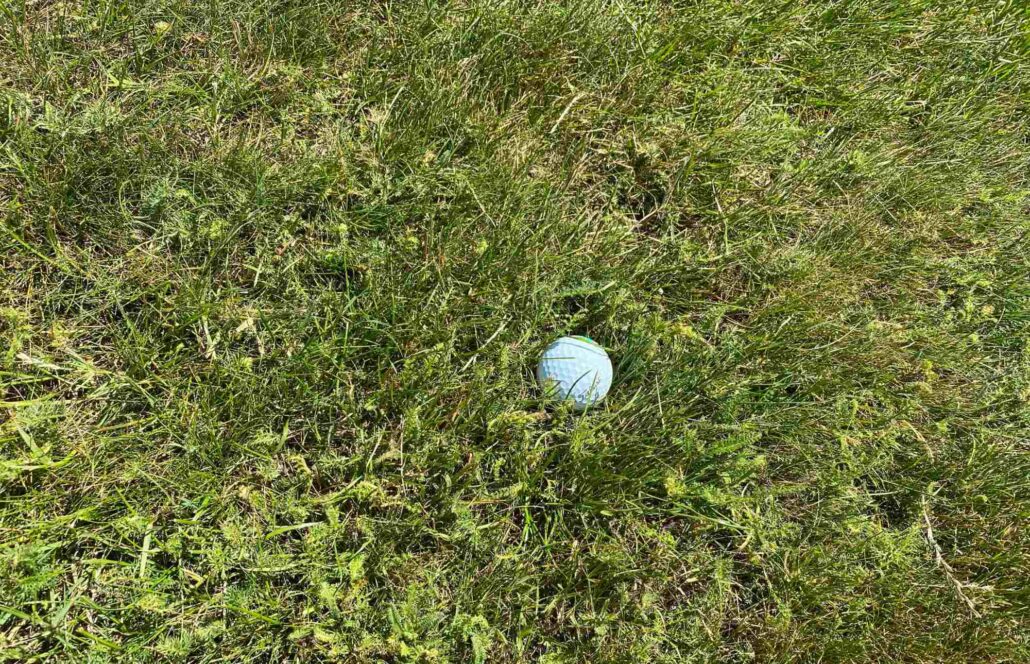
Rough heights are not recorded as exact numbers
Whether your course has got no rough, or looks like a prototype US Open contender, the depth of the rough is a really important part of working out how difficult a golf course might be.
Course raters don’t measure the rough length on every hole, as course managers usually keep it to a consistent length, and USGA chiefs recommend it is carried out once on each nine with a few spot checks along the way.
It’s important because the numbers are used to work out how hard it may be to recover when a player misses the fairway or green.
So they will take measurements from some specific areas of the hole and that will depend on where the bogey or scratch player’s shots will land.
They use a pencil, and a ruler that’s printed on the back of the Course Rating guide – placing the pencil in the grass and then work out the measurement.
But here’s the interesting thing. Since rough heights may differ, depending on whether you’re in a landing area, or close to the green, the raters try to come up with an average rough height for the hole.
Raters even try to find out how often the rough is cut and the height it would normally be at to help determine the final ratings.
Now have your say on Course Rating
What do you think about Course Rating? Do you understand it, and would you like to know more? Let me know by leaving a comment on X.
Advertisement