



The Castle Stuart Course, which opened in 2009, has enjoyed near-universal praise as a modern take on links golf that thrills and entertains while offering near-constant views across the Moray Firth.
In 2022, the property was acquired by Cabot with the intention of adding a second course as well as an array of accommodation options. Little over three years later and Old Petty, designed by Tom Doak, is set to open this spring.
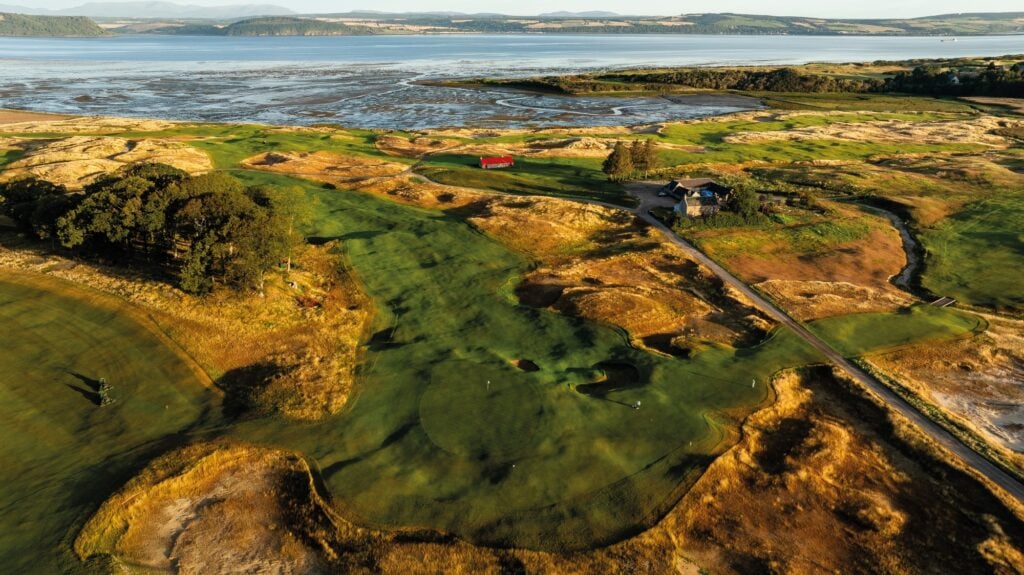
Using land to the west of Castle Stuart, that includes farmland, a castle, water features and even a copse of trees, this is a very different style of course to Mark Parsinen’s original design here.
Old Petty stretches to a shade over 7,000 yards from the tips but strikes you as being built for regular play rather than championship golf.
Stuart McColm, the long-time general manager at what was Castle Stuart, has overseen the project from the outset, while Clyde Johnson acted as Doak’s lead design associate and essentially looked after the creation of the course.
RELATED: How can you play the Old Petty Course at Cabot Highlands?
What was Tom Doak’s overarching brief and philosophy for Old Petty?
Stuart McColm (SM): It was to create a modern links in his minimalist style and to get the most out of the property using the many features of the 1625 Castle, the Petty Road (Road Hole-esque on #2), the two burns (Lonnie and Rough), the Bay, the mountains, the reeds, the copse of trees as well as being challenged to have the course start and finish at the current clubhouse location.
Clyde Johnson (CJ): It’s perhaps cliched, but our goal was to build a course that felt like it (had always) belonged to the site. The routing takes advantage of the existing landscape, with a road featuring behind the 2nd green, the 3rd playing alongside Castle Stuart, the 5th taking on the Lonnie Burn on its way to an old bothy, the 7th and 10th playing around a mature copse of beech trees, the 9th green tucked tight to a farm track, the 12th green nestled beneath a dry-stone wall and the short 17th playing across what feels like a relic quarry.
Advertisement
How has Doak balanced authenticity with modern playability in the design?
SM: The routing plays all around the compass (as Muirfield does) and the game is designed to be played on the ground in his design – classic rumpled contours with some semi-blind approaches (8 and 12) and lots of back stops and interesting deflecting contours that offer up shot variety according to your imagination.
CJ: The ground contour on approach, and blending into the greens, dictates playing strategy – there’s a grey scale of consequence to the angle of approach into the greens, depending on pin location, wind, firmness etc. A contour which deflects or hinders your approach one day, might be favourable on another. The fairways are comfortably wide, but not without interest, with a surprising amount of variety in angle, orientation and look from the tee. Though there are some larger, open sandy areas, especially along the coast, there are only a dozen or so, hopefully meaningful, pots, to complement the rumpled contour.
How similar or otherwise do you believe Old Petty is from Castle Stuart?
SM: Both their DNAs lie in fescue-dominated terrain interspersed with marram, gorse and heather. Both have a mix of rugged and revetted bunkers (though not overly used in defending the golf course) plus contoured greens where approach angles matter. Where they differ is in their routing – Castle Stuart’s holes are typically orientated on a SW or NE direction where Old Petty holes play all around the compass. Castle Stuart has returning nines to the Clubhouse where Old Petty is a more out-and-back routing. In short, they are more like brother and sister than identical twins but are still from the same family.
CJ: Old Petty presents an expansive journey across a site which really opens up, with many of the defining features being integral to the playing landscape. Castle Stuart offers a much more controlled expedition, with the holes carefully aligned to focus the golfer on the variety of views across the Moray Firth. With maturity of texture, both courses will feel as if they’ve been crafted from the same palette, while being complementary in their playing differences.
Talk us through how the routing incorporates historical landmarks like Old Petty Church and Castle Stuart
SM: The castle is seen in part or full on seven holes with the most dramatic views on 3 and 16. The walk from the 2nd to the 3rd is the ultimate reveal. As you leave the 2nd green, the trees behind the green shield you from the next view. Once through these on the way to the next tee, the 1625 castle reveals itself as do the ensuing 14 holes of Old Petty (the 3rd to the 16th). The church is seen from the 3rd green and the 16th tee as part of the hamlet of Old Petty including the Manse.
CJ: Old Petty sets off through the former driving range, crossing the 18th, so that the course finishes at the clubhouse, and to take advantage of the nestled opening green site. There are four holes in total on this upper section of property. A short-four, with a green inspired by the 16th at North Berwick, teases what is to come – a wonderful reveal above Castle Stuart and looking out west over the majority of the course. The 3rd and 16th transition down to and back up from sea-level – like many of our favourite links we valued the variety this less-linksy landscape brings. From the entrance gate to the castle, the 4th wraps around a marshy inlet, to a green which overlooks the seaside holes.
Advertisement
From the bothy, a short hole directs towards Alterlie, a hamlet which juts into the Moray. The course detours inland, relying on Castle Stuart to guide the approach to the short par-five 8th. By the 10th, you’ve wrapped back around the copse of beech trees, to a green which is set across the oft-snow-capped Ben Wyvis. A triangle of holes turns back again, tracking along the railway line, and then climaxing with a downhill, drivable four with its green sitting on the horizon of the water. From this perch, which is directed at Old Petty Church, a long-three and then par-five chase along the bay, before the 16th drive carries back over the marsh inlet.

Can you explain the concept of the “wrinkled ground” and why it was so important to recreate that links-style surface?
SM: Links golf is defined by firm and fast surfaces enabling the game to be played on the ground and thus under the wind. It was important to re-create these contours on fairways and into the greens to have the course feel authentic to this style and in the low sun, seeing the shadows on the rumpled terrain makes for classic links topography.
CJ: Even the most polished links courses of the Moray Firth (and Highlands) are abundant in micro-contour – the small, imperfect movements in the ground which give the course character. It was important to our process that we were able to recreate these, to give the course a timeless feeling.
Advertisement
Can you talk about the respective roles Clyde Johnson and Chris Haspell have played in shaping and agronomy?
SM: Clyde as lead designer to Tom was on site all the way through the shaping process and was able to lead Chris in the shaping requirements for both Tom and Clyde’s vision. All agronomy was lead under the expert eyes of Alistair Beggs (Open Championship lead Agronomist) and Gordon Howat, both from the R&A with input from our Course Manager James Hutchison, who was involved in the construction of the Castle Stuart Course back in 2007 through opening in 2009.
CJ: The design owes a lot to Chris Haspell, who was the primary shaper. Rory Paul and Vittorio Adabbo provided intern shaping help in the first season. Angela Moser and Brian Schneider each made visits to coincide with Tom’s visits. I was Tom’s lead design associate and took on the bulk of the shaping with Chris.
The land was historically farmed and relatively flat – what were the biggest challenges in creating the rumpled, natural-looking contours?
SM: The real challenge once we had stripped the topsoil off was ensure the shaping stayed above the high tide mark ensuring that water was able to be drained to the sea. Lonnie Farm was the lowest lying farmland in the North of Scotland.
CJ: It was important to the client to reveal the inherent sandy and gravelly soils beneath the centuries-old build-up of topsoil. Efficiently consolidating the material generated and shaping that into believable landforms was a big part of the project, as was generating the material to build back-up areas where the topsoil had been stripped from. There were lots of pieces of relic infrastructure to deal with, that made completing holes in one go a challenge. Our hope is that the untrained eye will find it difficult to decipher where we did and where we didn’t move dirt for the benefit of agronomy.
Advertisement
Is it accurate to say that underneath the surface of the farmland you found sand and genuine linksland?
SM: Absolutely! A large amount of the sands we uncovered here had percolation rates as high as the USGA spec for greens. This meant we could use these on greens and tees safe in the knowledge that we would remain open even under the most testing of weather events.
Do you expect Old Petty to play firm and fast as it matures?
SM: Undoubtedly. All areas are pure sand – roughs and all – and we will be managing the turf conditions to replicate the classic linksland look and feel of firm and fast surfaces.

How did the archaeological discoveries you made during construction impact the routing and timeline?
SM: Thankfully, the timeline wasn’t too drastically impacted and other than a few tweaks here and there to avoid some sensitive archaeo areas, the impact has been relatively insignificant.
CJ: In certain areas, it was more efficient to leave areas untouched, which influenced the evolution of some features. The discovery of the ancient chariot wheel to the left of the 7th, and the Bronze Age village between the 10th drive and 11th green, inspired us to create relic building-like landforms.
What makes Old Petty a true “walking-only” experience, and why was that decision made?
SM: In this day and age, walking is definitely seen more and more as a health benefit and walking 18 holes of golf regularly is proven to add years on to your life. In an effort to make OP walkable the routing was set in such a way that there were gentle climbs and nearly all turf walkways to ensure a manageable and enjoyable walking experience was created.
How do you see Old Petty complementing Castle Stuart in terms of guest experience and resort positioning?
SM: As two courses on the same property with different DNAs but similar shot values, the two walks are entirely different but both offer up a calm and pleasurable journey through differing terrains. They are equally majestic in their differing settings and their ability to ask serious questions of your golfing repertoire.
You have received approval from Highland Council for luxury lodges – can you share details on the scope and timeline?
SM: We should be in a position to start construction of our lodges in the early part of the New Year. Phase 1 sees five four-bed lodges therefore increasing our inventory of on-site rooms from 12 to 32 by the time we open for the 2027 golf season.
Phase 2 of the lodges should be underway in late 2026 and will likely be ready for the 2028 golfing season. This will see a further 36 bedrooms on site and with that we will likely expand the retail and F&B offerings.
With the ever-increasing demand for quality and facilities from a global market I believe Cabot Highlands and the Highlands as a whole will have the perfect blend of lifestyle, recreation, world class golf and amenities that will challenge any destination for golf.
As a Nairn member yourself, how do you think Castle Stuart and Old Petty complement and add to the collection of historic links courses in the Highlands?
SM: Not only as a Nairn member but also as a Board member of Highland Golf Links for 15 years, we have been working as a destination since Castle Stuart’s inception and have firmly believed in the collective to continue to attract a bigger market share. Now, with world class golf at Royal Dornoch (and their new world-class clubhouse facility), Nairn and ourselves along with our new lodges as well as the world-class hotels in the area (Kingsmills, Ness Walk, Culloden House and Links House Dornoch), there is no question that we all complement each other in giving a first-class golf destination experience.
Play the Old Petty Course at Cabot Highlands on the NCG Top 100s Tour

- Book your spot to play on the Old Petty Course at Cabot Highlands on the NCG Top 100s Tour on May 21st, 2026 here.
- You can also play on the Old Petty Course at Cabot Highlands as part of our Highlands Spring Swing, which also incorporates events at Nairn and Fortrose & Rosemarkie.
Now have your say
Have you been fortunate enough to take on the new Old Petty Course at Cabot Highlands yet? If so, what did you make of it? Let us know your thoughts with a post on X, formerly Twitter!