


We all think we know Augusta National. But, what does the world’s most famous golf course really look like when you’re walking the fairways rather than watching on TV?
Every year at the Masters, the world’s best players are tested by a course we feel we have learned inside out.
It is a venue that hosts one of the most watched events in sport, but understanding how it plays is another matter entirely.
The way the ball reacts, how the wind shifts, and the decisions players are forced into aren’t always obvious when watching from home.
That’s exactly what NCG Golf Podcast hosts Tom Irwin and Dan Murphy discovered when they walked the course ahead of the 90th Masters tournament.
So, here are 10 things that define what Augusta is really like…1. The bunkers are bigger than they look
The bunkers still look imposing on TV, but they can be even more sly in-person. As Irwin explains, they seem to influence decision-making before a shot is even hit and can immediately play tricks on your eyes.
“There aren’t many, but what you would say about the bunkers is that they are all absolutely massive and particularly the tee bunkers.
“It messes around with the depth perception. All of those bunkers appear closer than they are and some of them aren’t even reachable.”

“What that does is create uncertainty. So, even if you zapped it and even if you can’t reach it, you are still facing this white abyss.”
“They are also exclusively – I can’t think of an exception to this – in the fairway,” added Murphy. “They are not by the side of the fairway; it’s creating a decision to make.”
2. It’s not just a draw course off the tee
It is a bit of an Augusta cliché to say that it’s a course which suits players who shape the ball right-to-left. But, is that really the case?
Advertisement
“There are also fade tee shots,” said Irwin. “I would say the first is probably a fade to a degree, 11 and 18 (as well).
“What I think is true of all the tee shots is that there is a massive advantage to hitting it a long way through the air. There are quite a lot of uphill tee shots, and there are loads where there are ramps.”
“I have come away from it thinking that it is not so much a drawer’s golf course, but a course for somebody who has mastery over ball flight,” Murphy said.
3. The greens aren’t just big, they are widely different
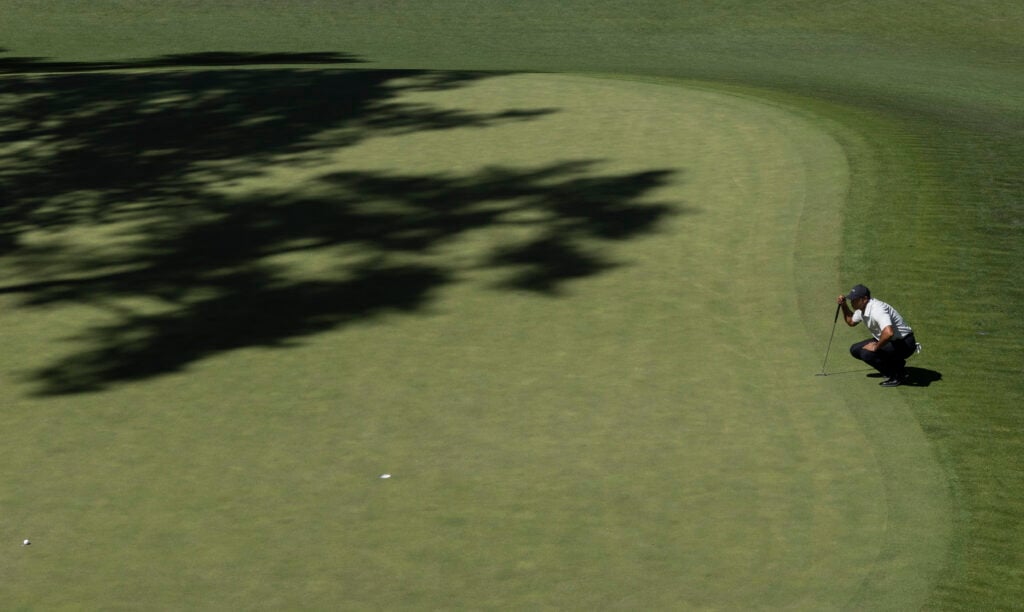
It’s not just the speed of the greens, but their variety in shape, size, and slope that players must overcome if they are to win a Green Jacket.
“The greens are fascinating,” Irwin noted. “The angles they are sat at to the hole – a few are what you call a tilted plane, across the angle of the hole – some are just absolutely enormous, and some are steep.”
“You think of them as all being massive, but some of them are really small. The 12th is the smallest at about 4,000 square feet. The biggest is the 14th, which is just under 10,000 square feet.”
4. It’s firm
Firmness brings two things that tour pros hate: uncertainty and having to play angled shots. It makes them think, improvise, and problem-solve. Three things golf is, and three things Augusta challenges even the world’s best with.
“There are any number of places where I was looking where the ball might land, and particularly if it had the wrong kind of spin on it, because of the undulating nature, and I was thinking that is quite terrifying,” Murphy explained.
“It feels like the ball might never stop, and not in a good way. It generally isn’t running towards the target.”
5. The course can’t keep getting much longer
Despite constantly evolving year-on-year, one thing that may no longer change is its length. The physical limitations of Augusta’s layout may mean it might have reached its full capacity.
Irwin pointed out that: “It is currently coming in at 7,565 yards. I think it is fair to say it can’t really get any longer with how the property is.
“Loads of holes are restricted by boundaries or proximity to other holes. That’s maybe the predominant reason for talk of a golf ball rollback.”
Murphy agreed, adding: “Let’s be honest, there are lots of holes where you are thinking you can’t go back any further without doing surgery to the golf course. We are at a stage now where there is exactly one par four that measures under 440 yards.”
6. The wind
One of the biggest surprises is how inconsistent the wind feels from hole to hole. When you think of the possible challenges of playing at Augusta, the wind isn’t one of the first things that would spring to mind.
Irwin explains how the wind is a different sort of challenge on the front nine compared to the second nine. “The front nine is predominantly played on top of the hill, and the back nine is predominantly played on the bottom of the hill.
“On the top of the hill, you have a much more exposed wind flowing through the stands of pines. You can feel the wind more regularly on those early holes and on the holes that are higher up.
“When you get down into Amen Corner, you can’t feel the wind at all.”
7. The routing can be a distraction

“It’s a routing that is kaleidoscopic, and you can see how, for a competitor, it must be unbelievably distracting,” said Irwin.
Even seasoned Masters viewers can be caught off guard by how the course fits together.
Advertisement
“The routing is absolutely remarkable. You almost never play more than one hole in the same direction. You’re constantly being spun around in a different direction, sometimes without realising it. That’s genius,” Murphy said.
8. The course protects itself
Augusta is known to be one of the trickiest golf courses on tour. Player’s struggles around Amen Corner are highly publicised, but the course defends itself in much more subtle ways as well.
One such way is that its fairways are mown towards the tees.
Irwin pointed out the challenges this brings up. “That is probably adding 20 yards to the relative playing length of each hole. It would also make the purity of iron strikes harder to achieve because the ball will be sat down in those relatively thick blades of grass.”
9. Strategic use of trees
The towering pines might look like a picturesque backdrop on TV, but in reality, they are carefully positioned to ask questions and manipulate play at every turn.
“There is definitely a strategic use of trees, but also tree branches,” Irwin noted after walking the course. “They might not be a stop sign, but they are something to think about.
“This strategic use of trees is an Alister MacKenzie thing. He says trees are fine as long as they are used strategically, and I think you see that all over the show here.”

10. It looks playable… until you get around the greens
As faint as it may be, many of us have a dream to play Augusta. But what score would you actually shoot if you got the chance?
“It feels to me like a golf course where an 80 or 85 is achievable, if you play for that score,” Irwin said. “I think if you set out to aim to shoot 85, you could probably do it because you’re not going to lose a golf ball for a start.”
Advertisement
Murphy wasn’t so sure and pointed out how it can appear manageable on the surface, but once you reach the greens it can be a different story altogether.
“The one thing I thought that would ruin a lot of golfers would be the chipping around Augusta. The lies are tight.
“The greens, especially when you aren’t coming in from the right angle, and let’s face it, as club golfers, we’re not coming from the right angle often, I think you would make a fool of yourself.”
- NOW READ: If anyone can Master the sensory overload of being defending champion at Augusta it is Rory McIlroy
- NOW READ: The Masters is missing Tiger Woods, but what Tiger Woods is missing is far more troubling
- NOW READ: Is this the golf club that could decide the winner of the Masters?
LISTEN TO THE NCG GOLF PODCAST
Advertisement