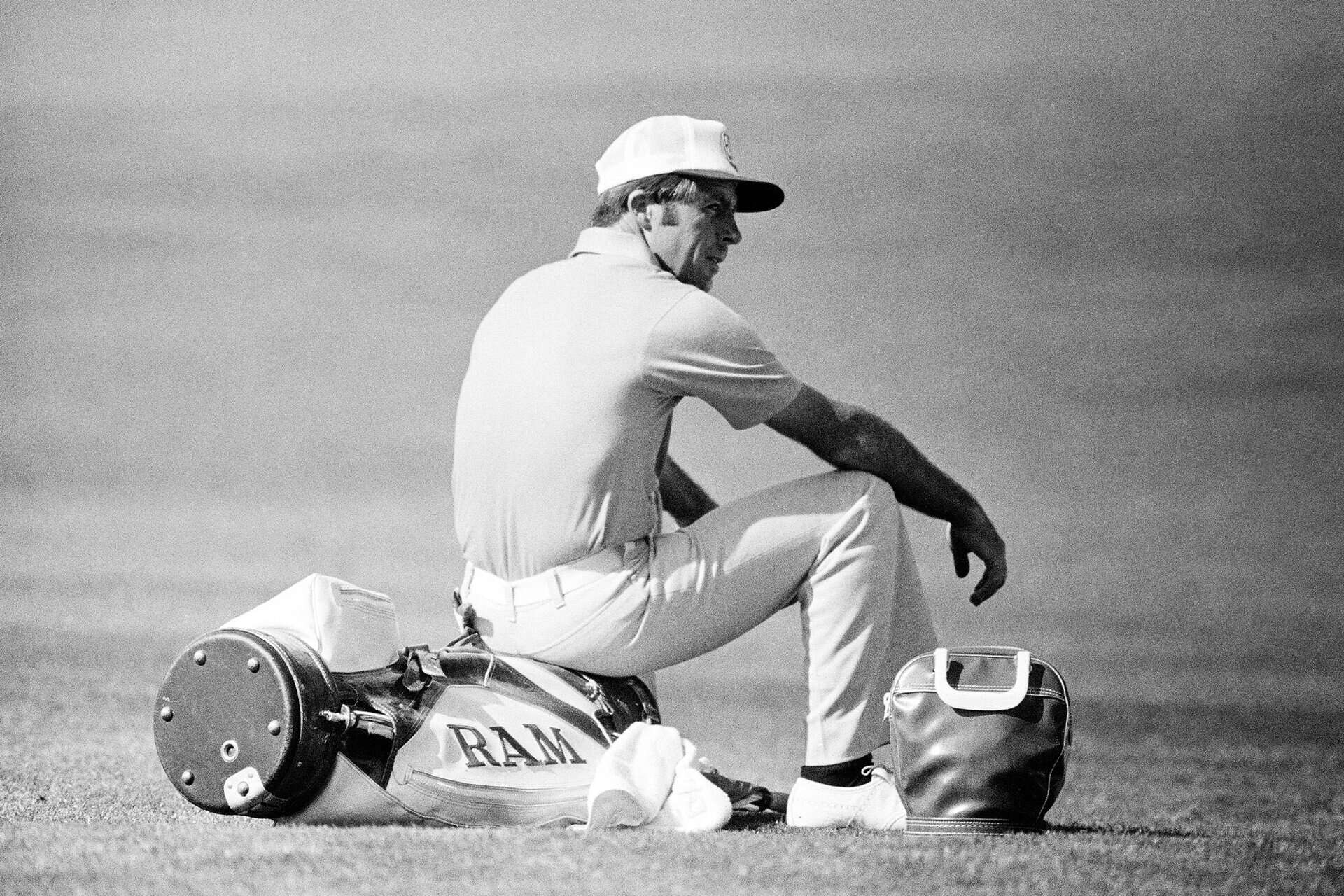



The five-time Open champion Peter Thomson has died at the age of 88.
Thomson had suffered from Parkinson’s disease for more than four years and he died at his home in Melbourne on Wednesday, according to Golf Australia.
He is survived by his wife, Mary, four children, 11 grandchildren, and four great-grandchildren.
I had the pleasure of speaking to Peter Thomson on the occasion of the 50th anniversary of his third-successive Open win at Royal Liverpool. That was in 2006 as the championship was about to return to the Wirral venue after a long absence.
Here is the full feature:
Remembering Peter Thomson
The only other golfer in the modern era with as many Claret Jugs to his name is Tom Watson. Only one man in the near century and a half since the Open Championship began has been more successful than he was Harry Vardon.
He became only the second Australian to win a major when he claimed the first of his five Open titles in 1954 and even now, more than 50 years after his most recent success, his personal tally of majors represents almost a third of the Australian nation’s collective total in the men’s game.
By anyone’s standards Peter Thomson is truly a giant of the game. So why is it that this five-time Open champion is so rarely mentioned in the same breath as the likes of Jack Nicklaus, Tom Watson, Lee Trevino, Gary Player, Walter Hagen, Ben Hogan and Tiger Woods?
The simple answer is that Thomson never quite achieved the same level of success in the United States as he did on this side of the Atlantic. Or at least not until he joined the American Seniors Tour almost 20 years later and in 1985 reeled off nine victories to win that year’s money list and confirm his enduring class.
Advertisement
As with most things, the reasons behind this apparent anomaly in his career are manifold, but one of the more significant is that The Open simply meant more to him. Indeed, it has always been his number one priority in professional golf – a life-long love affair for the Australian as strong now as it was when he grew up in Melbourne in the 1930s.
“I played a lot of golf on a local nine-hole municipal course as a youngster and there were photos on the wall of St Andrews,” said Thomson.
“It was always the ultimate thing to do to go and play in The Open.” Thomson’s dream became reality in 1951 when he travelled to Northern Ireland and qualified for the championship proper.
“When I played at Portrush I was euphoric. It lifted me. I was always lifted by the occasion whenever I played in The Open.
“It was very basic and primitive back in those days, nothing like it is now. There was only one official, believe it or not, the secretary of the R&A. But it worked brilliantly.”
Despite the excitement, Peter Thomson played well enough on his debut to finish sixth, the start of a quite brilliant Open record.
The next championship he missed would be in 1981, exactly 30 years later. During the seven years after 1951, Thomson’s record was, and is, the best in Open history. Between then and 1958, only two men finished above him: Bobby Locke in 1952 and 1957, and Ben Hogan in 1953 at Carnoustie.
In among this were four victories, including three in consecutive years, something nobody else managed in the 20th century and only Jamie Anderson and Bob Ferguson can match elsewhere (Tom Morris Jr won four in a row between 1868 and 1872 but there was no championship in 1871).

“The Open was the one big highlight for me every year,” he said.
“You can’t keep a high priority of interest for 52 weeks a year and you have to set a week to get to your pinnacle.
“It always happened that championship in July was the week I had to be ready for. Once you have won something I think that you have gone through the barrier and then it’s something you know you can do and believe you can do again.
“I did have an advantage. All the big names in those days were club pros. Guys like Dai Rees and Christy O’Connor. Even Henry Cotton had a club to go back to. Whereas I was a young player from Australia with no obligations. I didn’t have to go and open the shop first thing on a Saturday morning the day after The Open finished and sell tee pegs and balls to the members.”
Thomson also recognises a natural affinity with seaside golf served him well. It is said that he honed his keen eye for judging distances when walking along a street by estimating how far away a lamppost was then pacing it out to check his accuracy.
Attention to detail, calm thinking and a cool, strategic brain were said to be as key to Thomson’s consistency as much as his simple, repeating swing and sure putting touch.
“I just didn’t find it any mystery. It all looked very logical to me. I just felt this is it. I suppose I was unusual because so many players did and still do look at Open courses and feel uncomfortable. I was the opposite.
“Getting your clubs ready was the most important thing. It wasn’t like now when you can just walk into a shop and walk out with a brand-new set. Finding a driver that you liked and would last a good year or so was very difficult because in those days they certainly didn’t last forever.”
Advertisement
Interview continues on the next page, where Thomson recalls his battle with the up-and-coming Americans and calls for a Ryder Cup-style event involving Australia…
Throughout the 1950s, it is true to say that many Americans tended to stay at home rather than come to Britain for the Open. This is another reason why Peter Thomson’s record is sometimes played down.
“It’s always presented that way but I don’t think there was ever an event where there was not some strong contention from the American contingent,” he said. “It’s a myth there were never any Americans playing in that era.”
Remember that the likes of Hagen, Hogan, Denny Shute and Sam Snead all won The Open in this period.
“And Byron Nelson was at St Andrews in 1955 when I won. It just wasn’t easy for the Americans then because of the difficulties of travel and the problems finding reasonable accommodation and then there was the size of the ball.
“Some of their players made the mistake of changing to our small ball when it became apparent in later years that their ball was much more stable in the wind.
“And you shouldn’t forget Bobby Locke, either. He was always the man to beat when I started playing and I don’t think he gets much credit even though he won the Open four times.”

Peter Thomson is too modest to point out that even the record of Arthur d’Arcy Locke cannot compare to his own. By the mid-1960s, Arnold Palmer had arrived on the scene, along with Jack Nicklaus, and The Open resembled the global event it is today. And at Royal Birkdale in 1965, seven years after winning at Lytham – incidentally the course Thomson rates as the most challenging on the rota – he joined an elite group of players that comprises him, Watson, James Braid and JH Taylor by claiming his fifth title.
Advertisement
And this time there could be no reservations about the quality of the opposition, as Thomson prevailed at a windswept Birkdale for a two-shot victory.
Peter Thomson did travel to America in this period and played in several editions of the Masters and US Open. Though he came close to winning both on occasion, he was not destined to win the title that would undoubtedly have capped his extraordinary career.
And, largely because of that, when his achievements in the game have been scrutinised he has often been given rather less credit than he might have been.
“The opposition was a lot better in the US. If you look at the Ryder Cup results from around that time you’ll see it was pretty one-sided,” he said.
“It was around the 1950s that their club pros started competing against each other during the winter months and they called it the tour – that was the start of the professional touring golfer. It was really tough competition.
“I was a young man going into that scene against the likes of Ben Hogan, Byron Nelson and Cary Middlecoff – they were better than me when I was in my early 20s.
“And without being disrespectful to the British players of the time they were better than them as well.
“What you have to remember about tournament golf is that it’s about 50 per cent on you and 50 per cent on the other players.”
In those days Thomson was something of a trailblazer, setting an example that future generations of Australians have followed gleefully. His own inspiration was Norman von Nida, the fiery Queenslander known simply as ‘The Von’, who died in 2007.
Advertisement
“I wasn’t the first world player by any means,” he said. “I followed in [von Nida’s] footsteps. He was the pathfinder.
“He went to St Andrews in 1946 [to play in The Open] in a modified Lancaster Bomber that was Army surplus. I think it took him four or five days to get there.”

Thomson knew all about the journey from Down Under to St Andrews, because he had a home in the Auld Grey Toun and spent three months there every year, July through September. Naturally, this coincided with The Open and as an honorary member of the R&A, he attended the event each year.
At St Andrews in 2005 he was there to celebrate the 50th anniversary of his win on the Old Course, and he returned to Hoylake the following year when it was exactly half a century since he made history by winning the Claret Jug there for a third successive year.
Peter Thomson went on to be part of an internationally renowned course design business – Thomson, Perrett & Lobb. While Thomson and Ross Perrett, also president of the Society of Australian Golf Course Architects, concentrate mainly on the Australian and Asian markets, Tim Lobb is concerned with Europe. Thomson’s only design in Britain is The Duke’s course, at St Andrews, that was then purchased by American entrepreneur Herb Kohler.
One of his more recent projects, Moonah Links, has twice hosted the Australian Open. Thomson described it as his ‘Leviathan’ and designed as an antidote to the power of the modern player.
“They certainly don’t play like I did any more. They are too aggressive for me. That’s their downfall. When I played you were much more cautious – we all were, Ben Hogan was.
“We didn’t take risks. It was more a case of being sensible in those days.
“Now they always think their next iron shot will finish next to the pin. And it doesn’t always.”
Speaking of the current crop of Australian players, Thomson said: “Collectively, they’re a strong bunch. You’ve got a good nursery for them, good competition and good role models. They’ve got a great climate in which to prepare themselves.
“And of course we Aussies bow to no-one. There seems to be something about Australians and sport that makes them so competitive, whatever sport it may be.
“I would love to see – and I’ve been trying to arrange it for some time now – a Great Britain vs. Australia Ryder Cup-style match.
“Britain tends to make up about half the Ryder Cup team these days and there are plenty of good Aussies. I think it would be great fun.”
It’s an event that may never take place, but the Peter Thomson Cup undeniably has a certain ring.
It would also provide a fitting legacy to the career of a man born and bred in Australia but a part of whom will be forever British.
This interview originally appeared in the August 2006 edition of National Club Golfer magazine and has been updated for 2018.