

Thirty years on, the tournament where Sir Nick Faldo won his third Green Jacket remains one of the most compelling and dramatic occasions that Augusta National has ever staged.
The 1996 edition is remembered as much for Greg Norman’s collapse, but the result was a Faldo win following a gobsmacking 11-shot swing in the final round between the top two on the leaderboard, and an 18-hole stretch of the Englishman’s typical, clinical brilliance.
This was not just a case of Norman letting slip a six-shot advantage and seemingly letting the occasion swallow him whole, but it was also a masterclass in patience, discipline, and quite frankly immense quality from the man who became a six-time major champion in the process.
“I always add – that 67 was the low round of the weekend. The whole Saturday and Sunday, that was the lowest round,” Faldo told the NCG Golf Podcast of his final round of 5-under.
“That’s to give you some idea of how difficult the golf course was. It was firm, fast, very firm greens. (You) needed a lot of strategy – that gives you a clue as to how difficult it was.”
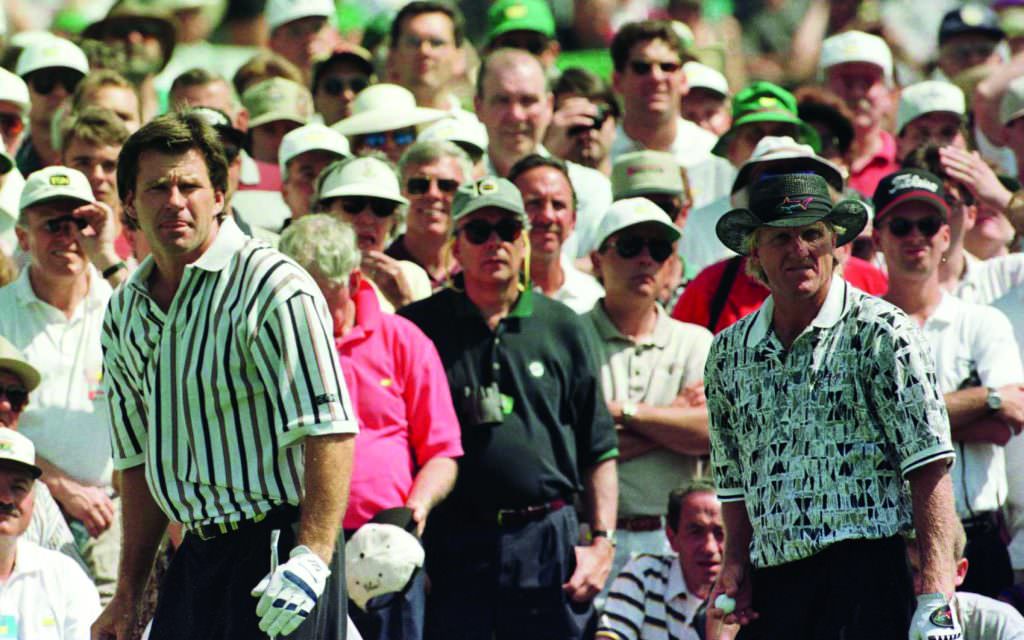
Going into Sunday, Faldo trailed Norman by six, having carded a 73 in the third round. The Australian, already a two-time major champion and donning that famous straw hat on top of that iconic baggy polo, was chasing the one title that had always eluded him.
What followed in the next 24 hours was brutal from the Shark’s point of view, but somewhat understandable and familiar given the tension and the angst that the back nine at Augusta National can cause.
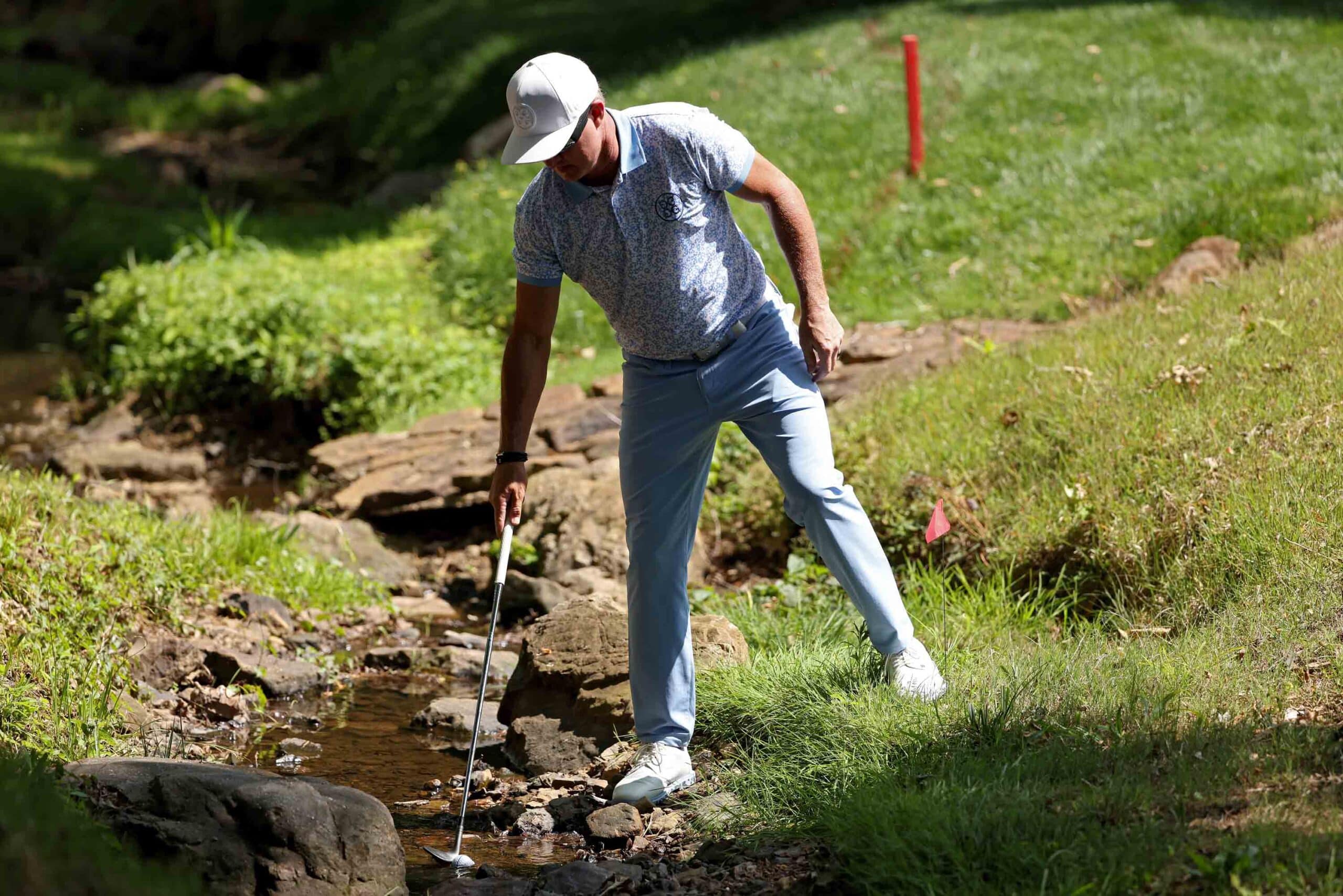
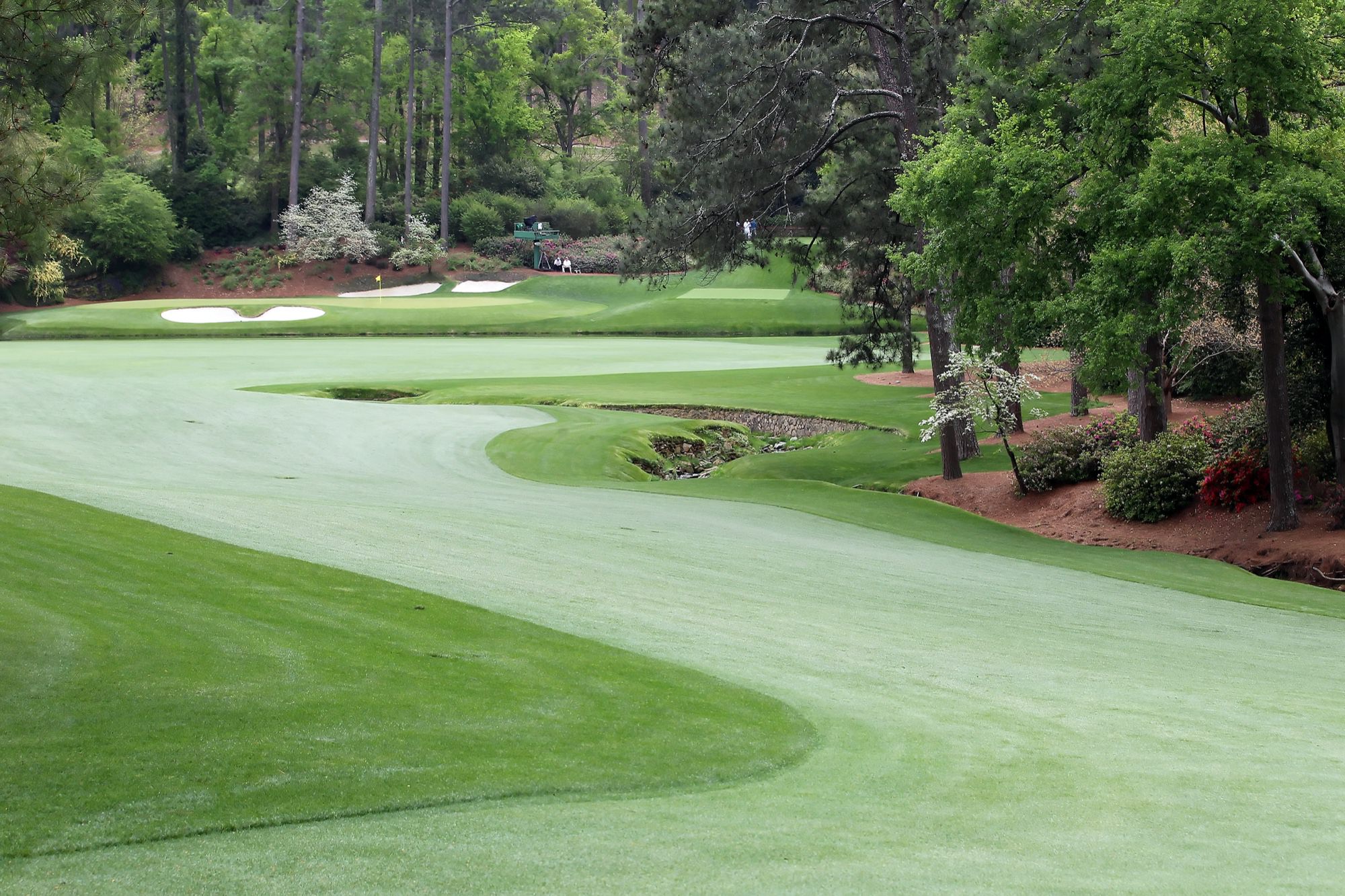
During the middle leg of the perilous trio of holes that make up Amen Corner, Norman found the water on the par-3 12th hole, but Jordan Spieth, Francesco Molinari, and Cameron Smith can tell you how easily that can happen when you might start envisaging yourself with one arm in the Green Jacket.
Advertisement
“The great thing about the Masters is – there’s history. People have seen, and people remember guys storming through the field like Jack (Nicklaus) did in 1986, and they’ve seen collapses when guys have bogeyed the last three holes.
“I just said to myself, three shots, that’s what it’s all about. If I’m within three, if I get within three after nine, anything can happen. That was my simple goal. I was nice and relaxed about that.”
A pretty simple insight, eh? Faldo didn’t chase six shots, so he says. He chased three by the turn. In doing so, he gave himself a target that felt achievable and left the door open for everything else. Remember one of the great clichés uttered in commentary booths around the Augusta complex every April, of course, ‘The Masters doesn’t start until the back nine on Sunday’.
Even Faldo’s preparation that morning of April 14 hinted at a calmness that would define the day.
“You’ve probably heard another story. I bowled up a bit late. Normally, I get there an hour and 20 minutes (before) – and Fanny’s standing there, her eyes like this big! ‘We’ve got 57 minutes!’
“I said, ‘We’re fine’, which was probably good, because I just got on with it.
“I was just getting on with it,” he added. “You did your own thing, and how you react to good shots or bad shots. But you can see how you have to be completely engrossed in what you’re doing, just me and Fanny, that’s it. No need to talk to anybody else, just completely engrossed in what you’re doing.”
Although Norman birdied the 2nd hole, a par 5 down the hill, he played the next seven holes in 3-over, and only led the prodigious Faldo by one stroke, even with the man from Welwyn Garden City making a bogey of his own on the awkward 5th hole.
“The best hole for me was the 6th hole. We both made four on the second. He bogeyed four. I bogeyed five. But then I made a really good two at 6, hit a 6 iron into about six feet right behind it. That made me feel really good.”
“I had a bad pitch on the 8th hole, and I was watching my reaction to that. But then I stood up, and then brushed a 20-odd footer in, but then Greg started making a mess down 9, 10, and 11.
“10 was when I really thought he was in trouble, because he had an 8 iron into the green, straightforward shot, pulled it left, bad chip. So that cost him a five. And I thought, Oh, now he’s really thinking about it. So he three-putted the 11th from nowhere, and I thought, wow.”
“Then 12, I really felt nervous on the 12th tee because it was like, wow, now we’re right in it. That was a chippy 7 iron back in those days, to that pin. I did exactly what you meant to do, hit it 15 feet left of the flag, and then he plonked it in the water, and I walked off two in the lead.”
From six behind, Faldo was now two ahead with six holes left.
“It’s mine to lose now. It was head down, blinkers on, and just keep churning out good shots. That was all I was trying to do.”
Advertisement
ALSO: What the patrons at Augusta really think about the Masters
This closing 67 remains one of the finest final rounds in Masters history, particularly given the conditions and the stakes. Norman toiled on the back nine, to say the least, and his anguish was no clearer than when he fell to his knees when he almost chipped in for eagle on the 15th hole. Hope was rekindled for half a second, then completely dashed when hitting another ball in the water on the par-3 16th hole.
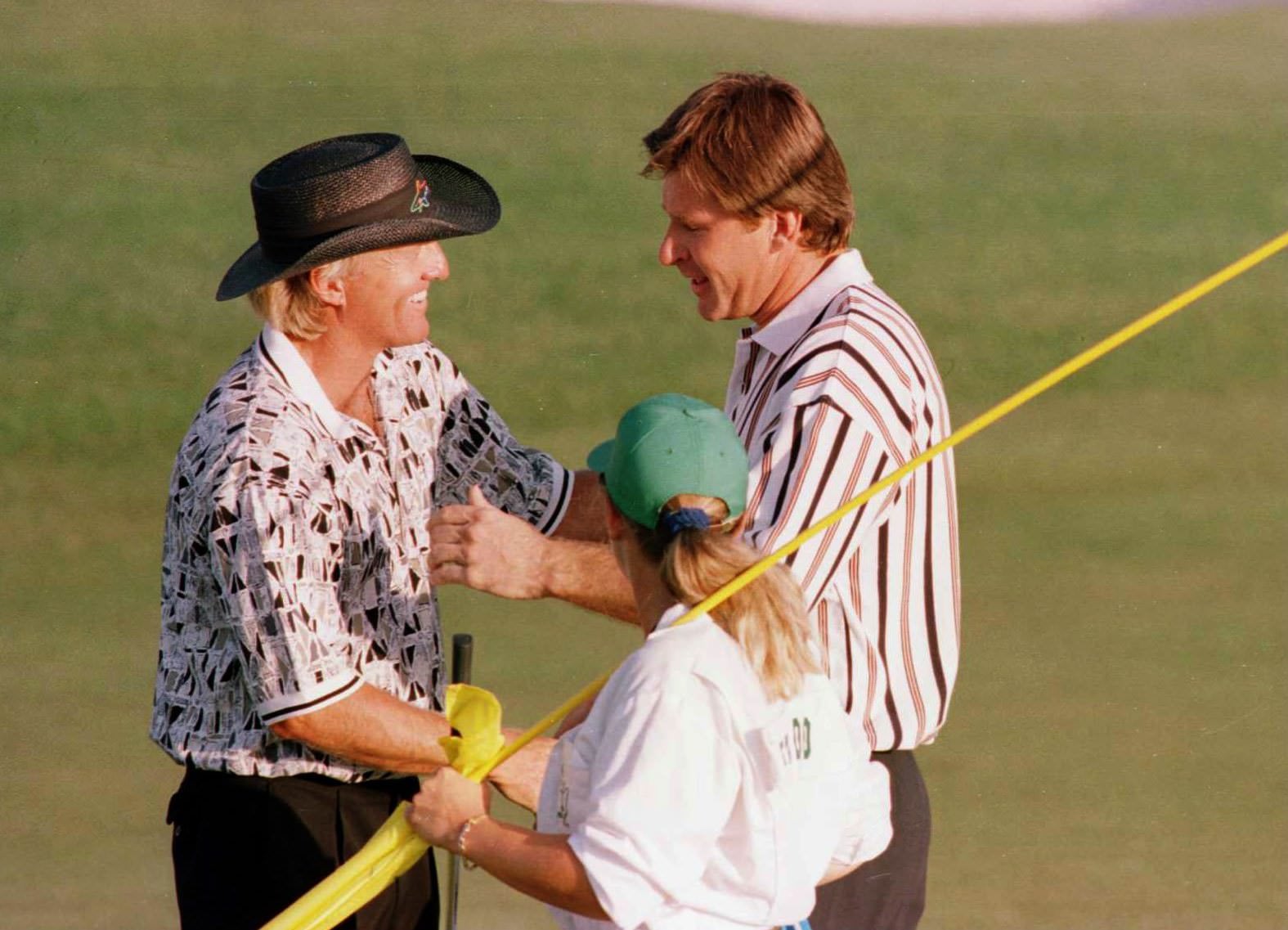
In what have become iconic pictures, Faldo and Norman embraced on the 18th green, exchanging words as the 60th Masters came to the most remarkable end. This was Norman’s third runner-up finish at Augusta, having come close in 1986 and lost in a playoff to Larry Mize in 1987.
The golden-haired icon from down under was a needle mover in his heyday, winning 88 times around the world and spending 331 weeks as World No.1. He has also caused a fair amount of needle in his post-playing career, too. Having tried to lead a breakaway world golf tour in 1994, seemingly his life’s mission became reality in 2022 when he ushered in the Saudi-backed LIV Golf League as its CEO.
He no longer has this role, but in comments to James Corrigan of the Telegraph in the week of the 90th Masters, 30 years after his famous collapse down Magnolia Lane, there certainly seems to be no love lost between him and his old rival, Sir Nick.
“What I got in those moments was a very narrow window into the other side of Nick Faldo,” Norman said. “There is something about Nick. It’s in him. There’s the public side of Nick.
“You know, he was the one who came up to me, he’s the one who hugged me. He’s the one who said, ‘don’t let those b******s get to you’. But it didn’t really mean much to me, because I knew he’d soon go back to being the way he was before. We never had any sort of relationship. We were chalk and cheese. He was a loner, I couldn’t be like him.
Advertisement
“Too right, I’ll bear a grudge, if somebody crosses paths with me, says something derogatory, tries to screw me over,” Norman added. “Nick said some things about me during my time at LIV, some really nasty things. I don’t have any respect for someone who gives their opinion on something in that sort of manner when they don’t know both sides.
“Come on, we have a history, he could have called me and asked for the other side of the story and I’d have gladly given it. And if he still hadn’t agreed then fine – his opinion and as he knows the facts, he would have been entitled to say anything he likes. Happy days. But just to sound off? Like I said, no respect for him. He still comes out with stuff that’s interestingly stupid, to be honest with you.”
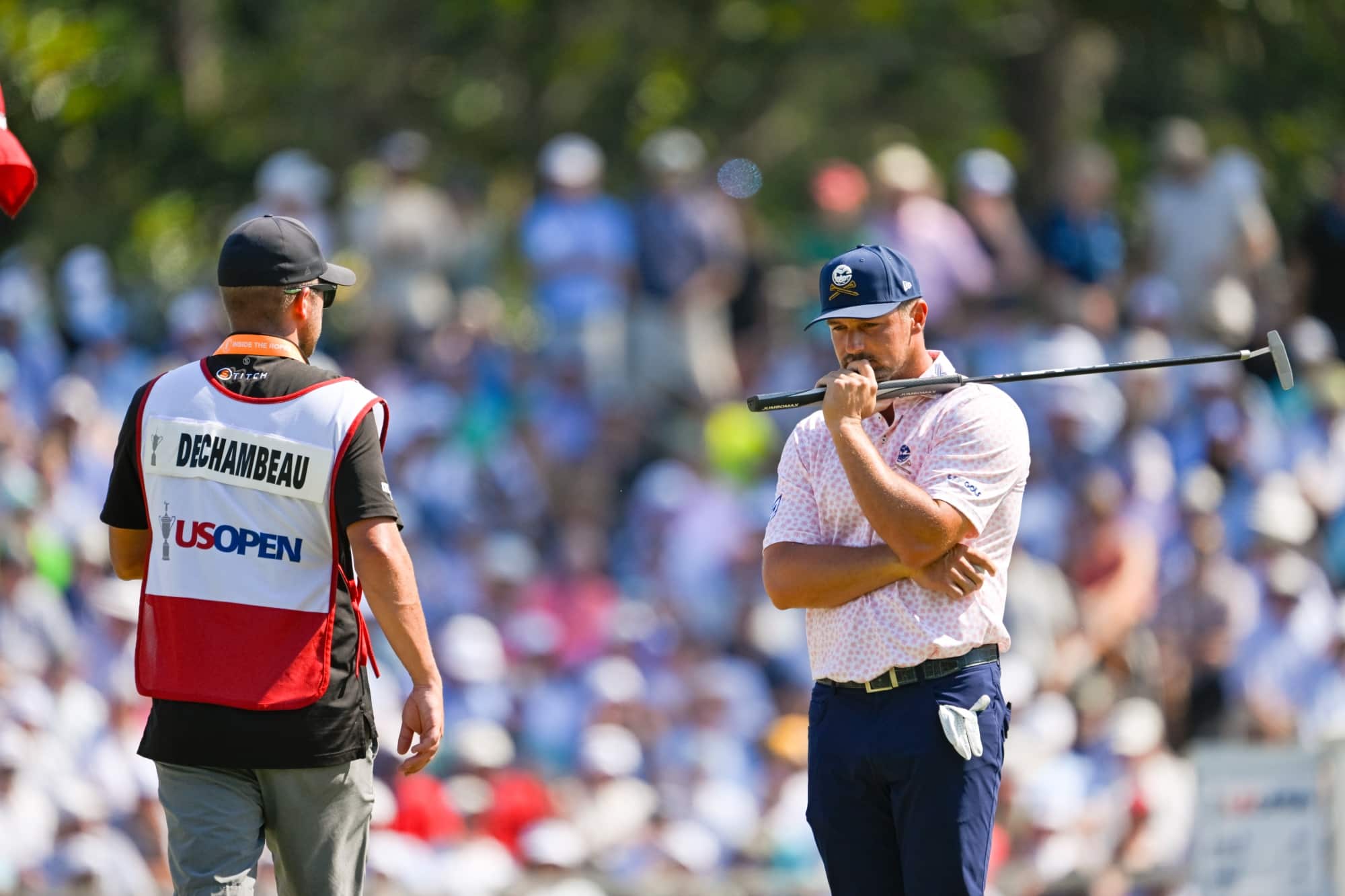
These remarks are not a direct response to Faldo’s recent reflections on the NCG Golf Podcast, and Faldo is one of many to express doubt over the perceived limitations of LIV, the league that is now in its fifth season and still retains the talent of Bryson DeChambeau, Jon Rahm, Cameron Smith and Dustin Johnson.
NOW READ: Sir Nick Faldo: Phil Mickelson makes the Masters Champions dinner awkward
NOW READ: Masters Friday tee times 2026: Pairings for the second round revealed
Advertisement