



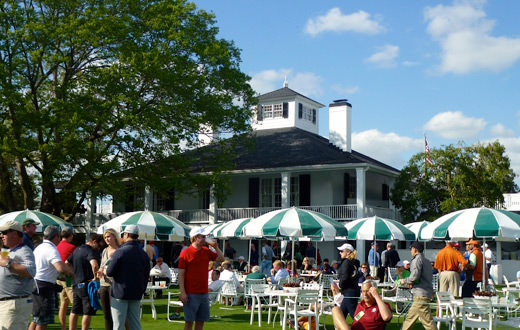
The outside walls of the Augusta National clubhouse look like they get painted every day.
The white and green umbrellas that stalk from the tables like lollipops at the front of the clubhouse look like they get washed every day.
It was a sunny scene synonymous with Masters week and the host venue. I didn’t tiptoe around as much as I expected when I finally walked under the dramatic tree inside the roped perimeter of the clubhouse belonging to the Green Jackets.
There’s Geoff Ogilvy. There’s Ludvig Aberg. There’s Jay Monahan sharing a laugh with Bob MacIntyre‘s manager. And there’s Patrick Cantlay walking between the Green Jackets after his Tuesday practice round, enjoying their favourite time of the year.
With my hands clenched behind my back, I timidly passed into another realm of this sacred landmark, which you’re convinced is a hologram. I pitter-pattered around the first room, the main room, like I was in a library. But unlike the library, I could’ve sat in it forever – a serene and peaceful rectangle of golfing heritage.
To my right, there is no less than the grand Masters trophy with every winner’s name on it, and every runner-up too. You couldn’t carry it either. It is colossal and evidently not the one presented to the Sunday winner. I slowly stepped around its circumference, scanning every name from Scottie Scheffler to Horton Smith, from Lee Westwood to Greg Norman.
When you reach the front door, there is a priceless painting of Augusta National and Masters co-founder Clifford Roberts to the left on the wall with an attached gold label that said: A picture of Cliff Roberts presented by artist to President Eisenhower in 1953 and given to Augusta National by Mrs Eisenhower in 1970.
In 1948, President Dwight D Eisenhower and his wife were invited to Augusta by Roberts. He became a member and hired Roberts as his financial advisor.
Advertisement
[object Object][object Object][object Object]
ALSO: The 2025 Masters field: Who’s headed to Augusta?
ALSO: Masters weather forecast 2025: Will there be rain or shine?
Augusta National clubhouse: A library, a living room and a museum all in one
I shifted my gaze from Roberts’ intimidating pupils to the un-intimidating sight of Magnolia Lane through the front door – the iconic tree-lined driveway where the Masters competitors roll in during tournament week.
Also sharing this hallway with the Roberts painting was a brown, longways rectangular panel that stated the names of the Original Planning pair of Roberts and Robert Tyre Jones (Bobby Jones). They founded Augusta National in 1932 on a 365-acre site of a former plantation called Fruitland.
Names of the Augusta National Organisation Committee were welded on in gold too, which included Roberts, Jones and Alfred Severin Bourne – a name that stood out to me.
Bourne was the heir to the Singer Sewing Machine Co. fortune and had the wealth to build Augusta National. He was the first figure that Roberts approached with regard to financing the club. The financial crash of 1929 that led to the Great Depression meant Bourne lived in regret that he couldn’t invest more than the $25,000 that helped kickstart the club’s birth. His father Frederick had left him $25 million.
In the club’s infancy, the membership was low, and finances were scarce because of the great depression. Plans for a ladies’ course and various other estates were parked. The first Masters was in 1934, and Roberts persuaded Jones to compete.
Forgive the tangents, but in this sport and in this place, it’s hard not to keep opening doors to see what’s in them. That could be said of the golf course.
I retreated towards the door from where I came in, the opposite direction of Magnolia Lane, and peered into a room smaller than a cupboard and thinner than a rake with a war-time sign on the door saying ‘Telephone’. Like Amen Corner from where I had just come, the Augusta clubhouse is somewhere you could never be bored despite its innocent simplicity.
Advertisement
I’m back in the room with the trophy now. I notice a book on the table by a brown leather sofa. It was Blasted Heath and Blessed Green: A Golfer’s Pilgrimage to the Courses of Scotland by James W. Finegan, published in 1996, which covers 60 courses across a thousand-mile loop starting in Edinburgh and ending in St Andrews.
Not only can you smell the history in the clubhouse, but it’s like you’ve become a part of it. Not only that, but you are welcomed into it. Above the fireplace, next to the table where this book sat, was a painting of the par-3 6th of Augusta National. It was more than perfect, and like the Roberts picture, there is not one sum of money you could attach to accurately round its worth.
This was the centrepiece of a smattering of paintings in each corner of the clubhouse, each of a different flower on the golf course: Azalea, Nandina, Chinese Fir, Golden Bell, White Dogwood, Camellia – all names of holes too. course.
A security guard told me I’d seen the bulk of the magic when I asked if I could continue exploring, away from the grill room and the like. I asked if I could go upstairs, but alas not as the Masters Champions Dinner was being prepared.
I understood.
NOW READ: The Masters betting 2025: Will Jon Rahm return to Augusta Glory?
NOW READ: The Masters Preview 2025
NOW READ: Who are the most famous Augusta National members?
Advertisement
Have you ever been inside the Augusta National clubhouse? What do you make of the Augusta National Golf Club clubhouse? Tell us on X!
Advertisement