



Protecting classic golf courses is why the distance debate really matters to the game’s traditionalists.
Length is crucial for amateurs and professionals to improve their scores, but many believe the longer a ball is airborne, the more it bypasses the turf that has been masterfully constructed over centuries.
St Andrews and Augusta National are usually sent over the top as examples in the distance battle. They are the most famous golf courses in the world, but the length of elite players causes concern that their charm is eliminated.
Sky Sports commentator Ewen Murray cites Sunningdale in Surrey as another cherished layout being turned to fodder by explosive drivers and missile-powered balls, speaking from a generation where the game was most challenging and least advanced in technology.
“I’ve been writing my book recently and reminiscing on some tournaments that I played in and one of them was with (Nick) Faldo at the European Open at Sunningdale,” Murray said to NCG. “I remember us hitting either a 2-iron or a 4-wood to the 1st hole and when I was there recently, there was a couple of young guys taking a 3-wood off the tee at the 1st and staying short of the hillocks that are in the middle of the fairway.
“They were only in play when you missed the fairway off the tee. Now they’re playing short of them and hitting a 9-iron or a wedge, which is a great pity I think.”

ALSO: Sky Sports expert: Trump won’t be around forever at Turnberry
Ewen Murray: Roll back could increase gap between good drivers and great drivers
In January 2028, the testing conditions used for golf ball conformance under what is called the Overall Distance Standard will be updated to reduce how far the ball goes for tour professionals and club golfers.
The R&A and USGA have golf’s long-term sustainability in mind and scaling back the golf ball is the strategy they’ve chosen. The move has been largely rejected by equipment manufacturers and most players, some of which have blasted the concept of a rolled-back ball.
Advertisement
While the governing bodies took the heat, Rory McIlroy and Tiger Woods watered the flames by supporting a shorter ball. They were also proponents of bifurcation (one ball for the stars and one ball for me and you) but although this was their first proposal, the governing bodies opted for roll back for everyone.
Murray, a competitor on the European Tour in the ’70s and ’80s, said warnings were flagged by his contemporary Seve Ballesteros decades ago. ‘If the ball speeds up, the best drivers lose their advantage’ was the message, and the experienced Scottish commentator believes this is a reality.
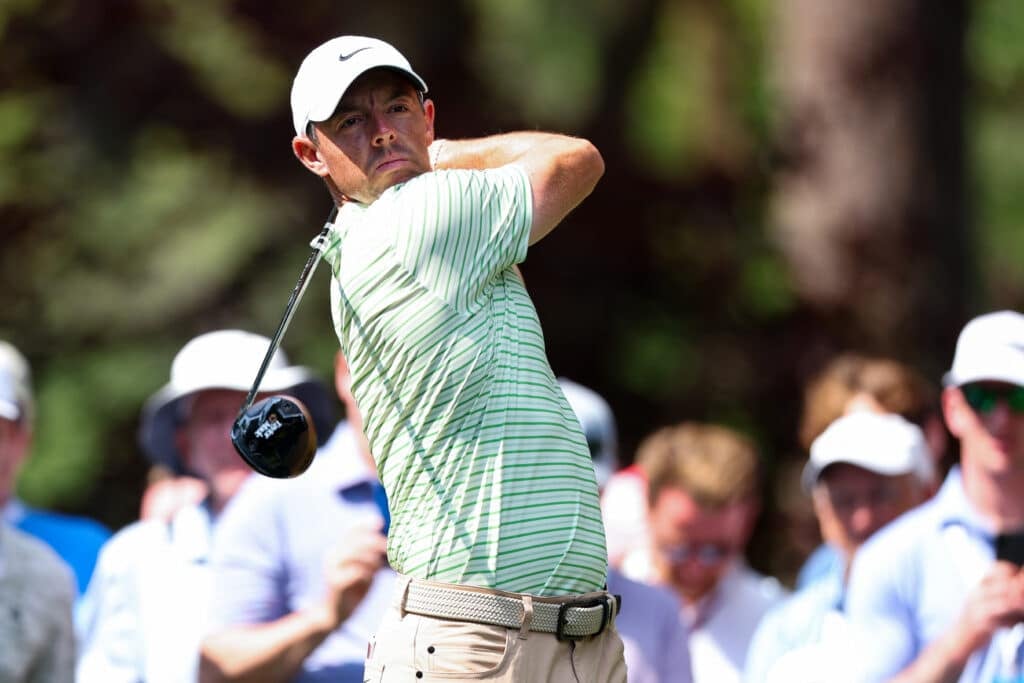
“The sweet spot is so much bigger than it would be if the head was smaller. But the other way of looking at that is that Rory being a great driver, and there are still two or three great drivers in the game, and Rory being one of them,” Murray said. “The ones that weren’t so good, if they slow the ball down, will have to hit 3 and 4 and 5-irons again, which you don’t often see.
“You see so many tournaments where even at par 5s, they’re using a 7-iron. If you slowed the ball down and reduced the head size, all of these players who aren’t at the very top bracket would be hitting longer irons, and Rory and company who are good drivers would be good long iron players.
“The gap would increase. It would go back to the way it was in the days of Greg Norman (who) was a great driver, Ian Woosnam, Nick Price, they were the best drivers of my time. The gap between them and the next edition, if you like, would be greater. I think that would help the game.”
Advertisement
ALSO: Ewen Murray: Keegan Bradley needs to line up his replacement Ryder Cup captain now
A bifurcated ball, essentially a tournament ball for elite male competitions, was the first proposal from the R&A and the USGA, but they went back to the drawing board after a consultation period. Achushnet, the holding company of Titleist, doesn’t support the plans and TaylorMade says they are “disappointing.”
Universal roll back could force these equipment behemoths into a new blueprint too, having extensively invested in golf balls that perform well for top players over several years. New testing conditions for ball conformance will require a new approach.
Murray outlined the somewhat tricky position manufacturers could find themselves in and, despite romanticising a period of yesteryear that was full of creativity, skill and old equipment, expressed caution for how far traditionalists would really take the ball back given the choice.
“If it was me, I would want a ball that was slower and a ball that spins more and the best player would always be the best player. But whether they can do that now with legal clashes, you know, with golf ball manufacturers, club manufacturers.
“They’ve spent millions in research and development in producing what we have today, so it might be a very difficult thing to do, but just as you mention these courses, I remember playing them 30 or 40 years ago, and the enjoyment you got out of them and how accurate you had to be and how inventive you had to be, rather than just tee it up two inches high and blasting away at it.
“The game is just different, and I think it was better. Many will have their arguments on how far you want to go back! Do you want to go back to the featherys? No not really, but the persimmon wood and the balata ball produced the best players in the game.”
Advertisement
NOW READ: Masters say they will support golf ball roll back plans
NOW READ: We wouldn’t need golf ball roll back if every event was on a links course
What do you make of this Ewen Murray roll back view? Read more of our Ewen Murray golf pieces on our website and find them on X!
Advertisement