



There is not a golfer on the planet who hasn’t hit a ball, then twitched in agony, and watched a splash as it landed slap in the middle of a load of water. Penalty areas aren’t always ponds – they don’t always even need to contain water – but they are one of the five areas of the golf course defined in the Rules of Golf and they affect everyone who plays.
You all know there are two types: red and yellow.
That isn’t a fashion choice; there is a material difference between the two colours – with red offering a lateral relief option (two-club lengths) as opposed to simply stroke-and-distance or back-on-the-line relief with yellow.
So which should it be? How does your club decide whether a penalty area is marked red or yellow? For anyone who has ever grappled with this question, the answer is found in the committee procedures in the Official Guide to the Rules of Golf.
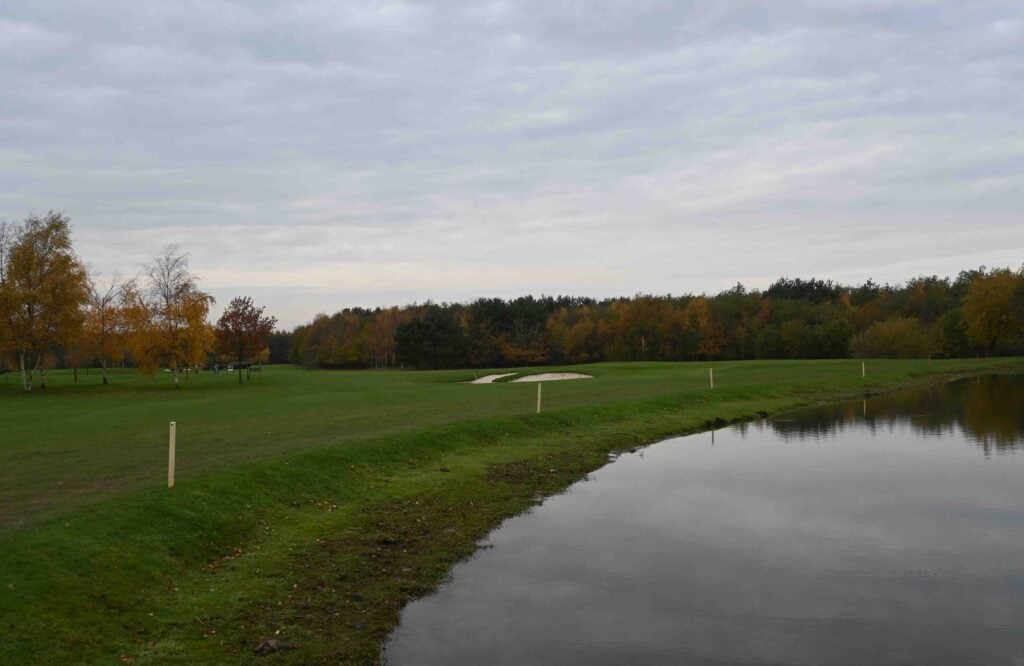
Yellow penalty area stakes in front of a pond | Source: NCG
Red or yellow – how are penalty areas marked?
The R&A and USGA’s position is that most penalty areas should be marked red. There are two reasons for this. The first is to give golfers that lateral relief option. The second is to remove confusion in the heat of a round.
Having penalty areas marked in the same way stops players potentially worrying about whether a relief option applies or not. If they are red, golfers can easily understand all options are available.
However, there are occasions where the character of the hole may give a competition committee pause for thought.
The course marking guidance around penalty areas in the Official Guide outlines a situation where part of the challenge is to carry the water.
An example it gives is where a stream “crosses the front of the putting green and there is a good chance that a ball that carries over the stream could fall back into it”.
Advertisement
If successfully executing that shot is important to the way the hole should be played, committees can choose to mark that penalty area yellow.
This means “a ball that lands on the far side of the penalty area before rolling back into the penalty area cannot be dropped on the far side under the lateral relief option”.
The Committee Procedures also ask that, where areas are marked yellow, competition organisers ensure there is an ability to drop back-on-the-line.
To do that, Rule 17.1d (2) says players must keep the estimated point where the ball last crossed the edge of the penalty area between the hole and the spot where it is dropped.
That can often mean going back in a different direction to what might be considered the usual line of play. If that isn’t possible, the only option a player would otherwise have in a yellow area would be to take stroke-and-distance relief.
Where this is likely, committees can think about adding a drop zone for that penalty area to give a second option.
Can a penalty area be both red and yellow?
They can and committees might look at doing this either with large penalty areas, or those that transition – think about a pond that moves into a beck.
The point you need to remember is your relief options are “based on where the ball last crossed the edge of the penalty area and not where the ball came to rest in it”.
If you’ve ever seen a red and yellow stake on top of each other, that’s because clubs are recommended to use the two colours to show where the penalty area changes.
It is even possible to define a penalty area differently depending upon the tees which are being used. They might be different colours depending on which tees are being played.
“But this is not recommended when multiple tees are being used for the same competition”.
- This piece also appears in the GCMA’s monthly Insights newsletter that is packed with expert opinion on matters relating to golf club management. Sign up to Insights for FREE here

Now have your say
What do you think of these rules? Does your golf club only have red areas? Have you ever been confused about which one is which? Let us know in the comments below, or get in touch on X.
Advertisement