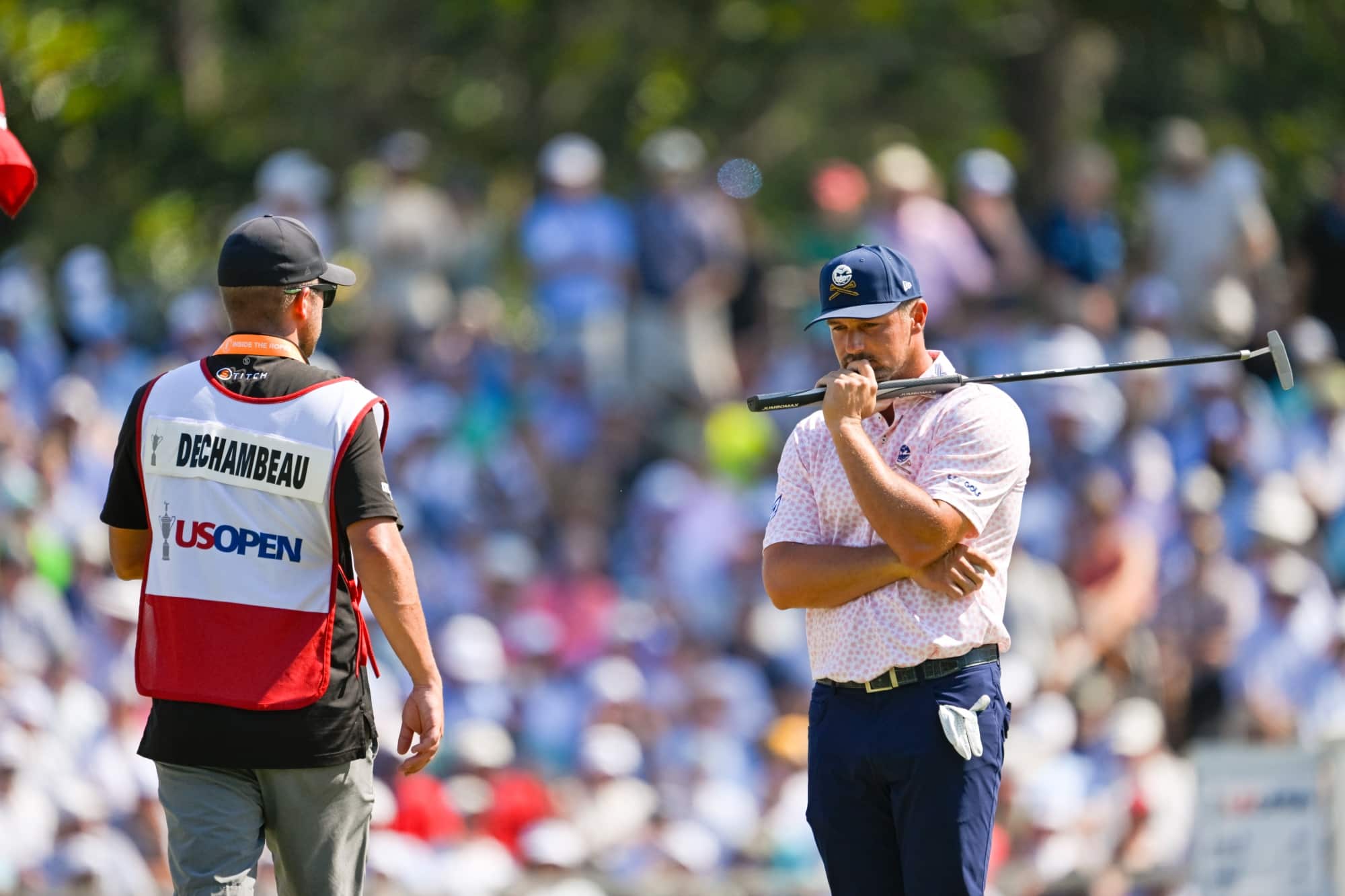




Come on, be honest? Who’s been guilty of taking more than a brief peek at their partner’s line when they’re trying to work out their next shot?
It used to be an old joke of Texas Scrambles that all four players would be rolled-up caterpillar-like all watching where the ball was going when one of them took a putt.
Well, if you and your partner like to watch each other’s putts – to get a view on what you will be facing next – then make sure to read the next few paragraphs carefully.
Standing behind partner when they’re putting: What do the rules say?
While it may always have been implied in Rule 10.2b (4) that you couldn’t crowd your partner’s line to get a read on where your next putt or shot might go, it is explicitly written into the rules on foursomes (Rule 22.6) and fourball (Rule 23.8) in the 2023 Rules of Golf.
Restriction on Player Standing Behind Partner when Stroke Made states that, in addition to the limitations in Rule 10, a player “must not stand on or close to an extension of the line of play behind the ball while their partner is making a stroke to gain information for their (the player’s) next stroke”.
If you’re caught doing this, you’ll get hit with the general penalty, which is two shots in stroke play or loss of hole in match play. In foursomes, that penalty applies to the side. In fourball, there are even examples where it could apply to both players.
Indeed, there’s a fuller explanation for fourball play in a new clarification, which reveals that how a penalty will be applied depends “on the reason the player stood there” and, if there’s a breach, “whether either the player or their partner was helped by the breach”.
The most relevant example talks about a player standing on, or close, to an extension of the line of play to “learn information about how their upcoming putt might break based on how their partner’s ball breaks on the putting green”.
Advertisement
Now have your say
What do you think of this rule? Did you learn something new and have you fallen foul of it in the past? Let me know with a comment on X.