



Who among us hasn’t had that moment when a playing partner has looked at us a bit askew, motioned down to our teed-up ball in the teeing area, and indicated that it might be a bit further forward than the rules allow? The answer is… none.
Don’t think I’m putting a downer on this, by the way. The penalty for playing a ball from outside the teeing area is pretty severe.
In stroke play, it’s two shots and if you don’t correct the mistake before teeing off on your next hole, it’s disqualification.
But how careful do we really need to be? What happens the next time someone thinks you might be ‘pinching an inch’?
What I’m trying to say is this: Does all of your ball have to be in the teeing area? Let’s dig into some teeing area rules.
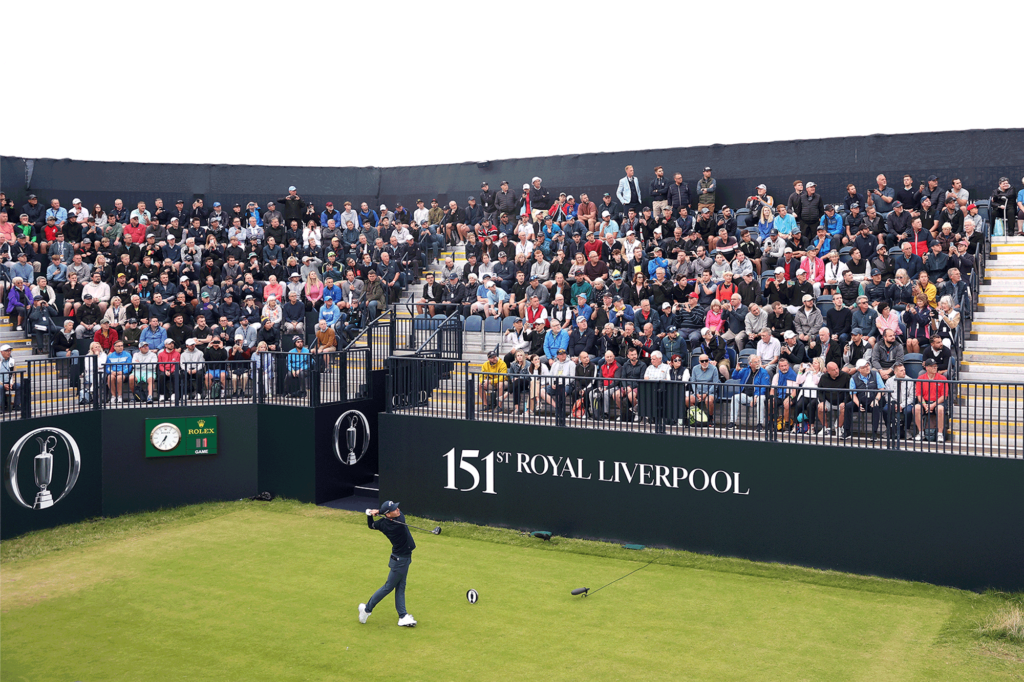
Teeing area rules
No, it doesn’t. Rule 6.2b (1) says that a ball is in teeing area when “any part of the ball touches or is above any part of the teeing area”.
Again, for those not paying attention, it’s “any part of the ball”. It could be a few dimples – though I wouldn’t advise you go this far. If any part it is in, it’s in.
That doesn’t simply apply to the most forward points, either. It’s anywhere within the rectangle that defines the teeing area. That’s two club lengths deep and also includes the outside edges as well.
If you’re finding this hard to visualise, the Rules of Golf that you can view on the R&A website – or in the app – has a very easy to follow diagram.
Got a question for our expert?
Despite the changes to the Rules of Golf in 2019 and 2023, there are still some that leave us scratching our heads. I’ll try to help by featuring the best of your queries in this column.
Advertisement
What do you think about these golf divot rules and golf divots in general? Let me know by leaving a comment on X.