



It wasn’t Calamity Corner that brought the chaos. Instead, two thin lines of white stakes flanking the opening hole at Royal Portrush threatened to dominate The Open in 2019 – before Shane Lowry’s heroics washed those fears away in a wave of Irish pride.
Rory McIlroy, shouldering a nation’s hopes, pulled his opening tee shot on Thursday. It clipped a couple of spectators, and landed just past the out of bounds line.
One swing and it had all fallen apart. A quadruple bogey eight led to a 79. His second-round 65 came too late. He missed the cut by one. Even his first tee shot six years later at the 153rd Open did its best to flirt with the dreaded white stakes.
It’s gone but not forgotten. The danger that wrecked McIlroy’s Claret Jug dreams then remains, waiting to once more threaten catastrophe in County Antrim this week.
But what if his disaster wasn’t simply nerves – what if it was a rule that perhaps shouldn’t even be in place?
Some things in golf are a consequence of playing a game across a vast arena. When you hit a ball with a stick, you are always governed to an extent by variance and luck.
But internal out of bounds feels self-inflicted – especially at Royal Portrush.
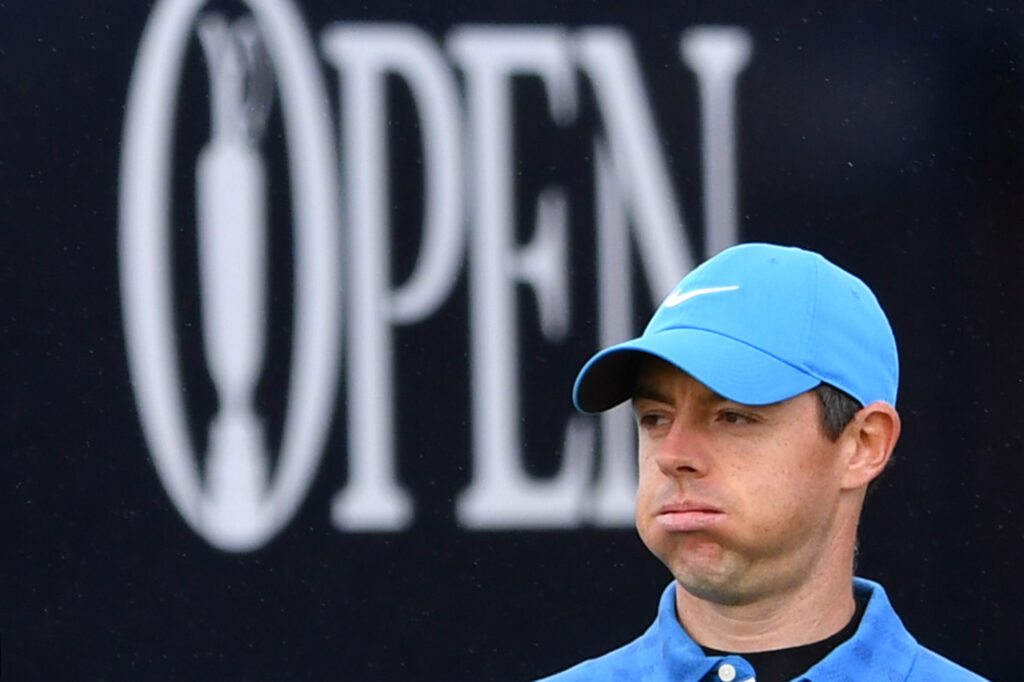
Royal Portrush internal out of bounds: Should it be removed?
Out of bounds defines the boundaries of the course. Usually, it marks where land ends, and trespassing onto someone else’s begins.
Sometimes it’s marked by a wall or a fence, other times by stakes or posts – also known as boundary objects – or painted lines.
As Kenneth Chapman writes in The Rules of The Green, out of bounds wasn’t a major part of early golf because playing areas weren’t nearly so well-defined.
The R&A then codified it in 1899 as “any place outside the defined or recognised boundaries of the course”.
Advertisement
But internal out of bounds has always been more controversial. In the Committee Procedures, the weightiest part of the Official Guide to The Rules of Golf, there’s a small section on marking internal boundaries and it even has its own Local Rule (A-4).
“To maintain the character of a hole or to protect players on adjacent holes, the Committee may establish boundaries between two holes,” it says.
Mostly, they’re used where clubs fear players might cut across holes to get better angles for approaches or avoid hazards. In today’s safety conscious world, no one wants shots flying over players’ heads – or, worse, lawsuits.
Much of what is deemed dangerous is open to debate. I’ve spent lots of time on course walks as a referee at championships reviewing internal out of bounds to judge whether it’s appropriate.
What’s flanking both sides of the opener at Portrush isn’t about safety. It’s about historical boundaries that have transcended an ownership issue.
“If you go back in history the club did not own that land,” said then R&A chief executive Martin Slumbers at his annual Open press conference in 2019. “So it was somebody else’s land in years gone by.”
The land was used for grazing horses and fenced off when The Open visited Royal Portrush in 1951. It’s also why there is a similar, less heralded, boundary running down the left side of the 18th.
It’s all part of the same triangle and it was acquired by the club in the late 1970s. So why does internal OB remain?
Tradition seems to keep those white stakes in place. The boundary is there for daily club play and The R&A have traditionally retained club boundaries for The Open.
“As the course has developed they’ve always kept that historically as out of bounds,” added Slumbers in 2019.
“We felt that was highly appropriate to do so this year as we’ve rebuilt the course. We try to stay true to how the course is played.”
This context might solve the conundrum for some of the players who aren’t sure why this internal nightmare exists, including Justin Rose when NCG asked him about it after round one of the 2025 Open:
“I actually didn’t even know there was out-of-bounds until I watched the television this morning, swear to God.
“I knew there was out-of-bounds right, I had no idea there was out-of-bounds left. I was like – there’s some things you don’t want to see, right?
“It is what it is. I don’t really know why it’s there, if I’m honest. I feel like one side is enough.”
It’s certainly played a part in Open folklore. In 1951, Max Faulkner produced a remarkable cut shot into the then 16th green (now the 18th) after his drive was impeded by a fence.
And you might argue the case for leaving it alone is strengthened now its legacy also includes McIlroy’s downfall.
Interestingly, though, course changes have happened in the past at Open venues when it was felt they were required.
Look at Royal Liverpool, where the routing is substantially, and some might say crucially, altered to cater for the logistics of hosting the championship.
The 1st hole for the members, with its own internal out of bounds down the right, is a completely different – and much diminished – prospect when the Open competitors arrive at the tee to start their 3rd hole rather than to hit their opening shot.
That change was considered, but not implemented, for The Open won by Roberto de Vicenzo in 1967. It was resurrected when the tournament returned to the venue 39 years later in 2006.
Advertisement
“Getting a strong finishing hole with enough space for grandstands was our priority, the 18th and the 72nd hole,” said then chief executive Peter Dawson. “On balance we’ve done exactly the right thing.”
While the boundaries remained intact, the character of the course undeniably shifted.
In 2017 at Royal Birkdale, players were prevented by a Local Rule issued during tournament week of hitting from the 9th onto or beyond the 10th fairway – with that classed as out of bounds and spectator safety the main concern.
So if course layouts can be changed, if new rules can – sensibly – be brought in to head off potential safety issues, why can’t we look at something that’s arguably only about aesthetics?
Golf already deals in randomness. Bad lies, bounces, and breaks are part of the game. But the internal out of bounds at Royal Portrush isn’t about architectural intent or even the unfair wrath of nature. It’s an administrative hangover.
Should major dreams end on the 1st tee because of a rule rooted in old land deeds? When a hole forces players into survival mode from the first swing, is that good strategy or golfing Russian roulette?
Once a necessary evil, is it now merely a trap? If we really want to give greatness its due, maybe it’s time to redraw the boundaries.
Main picture courtesy of The R&A
Now have your say
What do you think about Royal Portrush Internal Out of Bounds? Is it a necessary part of the test or an historical anomaly that needs review? Let me know by emailing me at s.carroll@nationalclubgolfer.com or by leaving us a comment on X.
Advertisement
Advertisement