


If you’re taking relief from an abnormal course condition, from a No Play Zone, a wrong green, or a dangerous animal condition – along with some Local Rules – you will need to first find the nearest point of complete relief to establish a reference point for your relief area.
Nearest point of complete relief. It’s designed to do ‘what it says on the tin’ but there can be traps for the unwary and I’ve seen plenty of club golfers fall foul of it and have to add penalty strokes to their score.
So what is it? How can you avoid getting tripped up? And what if you are in a spot on the golf course where it is difficult – or impossible – to get to the nearest point? Don’t worry, we’ve got you covered. Let’s get into it…
What is the nearest point of complete relief?
If you’re hunting through the 25 Rules of Golf to get the lowdown on this then look away. For this isn’t a rule, it’s a definition and you can find it at the back of your rule book or in the relevant section of the app.
Here’s the obvious bit. The nearest point of the complete relief is the “estimated point where the ball would lie” that is nearest to its original spot, but not nearer the hole.
You all know that bit. Your ball is in ground under repair. You lift it and take it out of the GUR and drop it.
Here are the two parts some golfers struggle with. The first is that point needs to be in the “required area of the course”. If you’re taking relief from an abnormal course condition in a bunker, the ball has to stay within that bunker.
And that nearest point also has to be “where there is no interference (under the Rule being used) from the condition from which relief is being taken for the stroke the player would have made from the original spot if the condition were not there”.
Advertisement
Let me spell out precisely what that can mean using the example of an abnormal course condition. When you take relief from, say, GUR, complete relief means not just the lie of the ball but area of intended swing and stance. If your ball is out of GUR, but you’re standing in it to take your shot, you haven’t found the nearest point of complete relief.
You must do this. Take a shot under the circumstances I’ve just described and you’ll get the general penalty – two shots or loss of hole in match play – for playing from the wrong place.
This is how strict it is. If, again, you were taking relief from GUR and your club touched the white paint that marked out the area during a stroke you would get penalised.
It’s a chunky sanction for simply taking a little bit of care.
It’s nearest not nicest
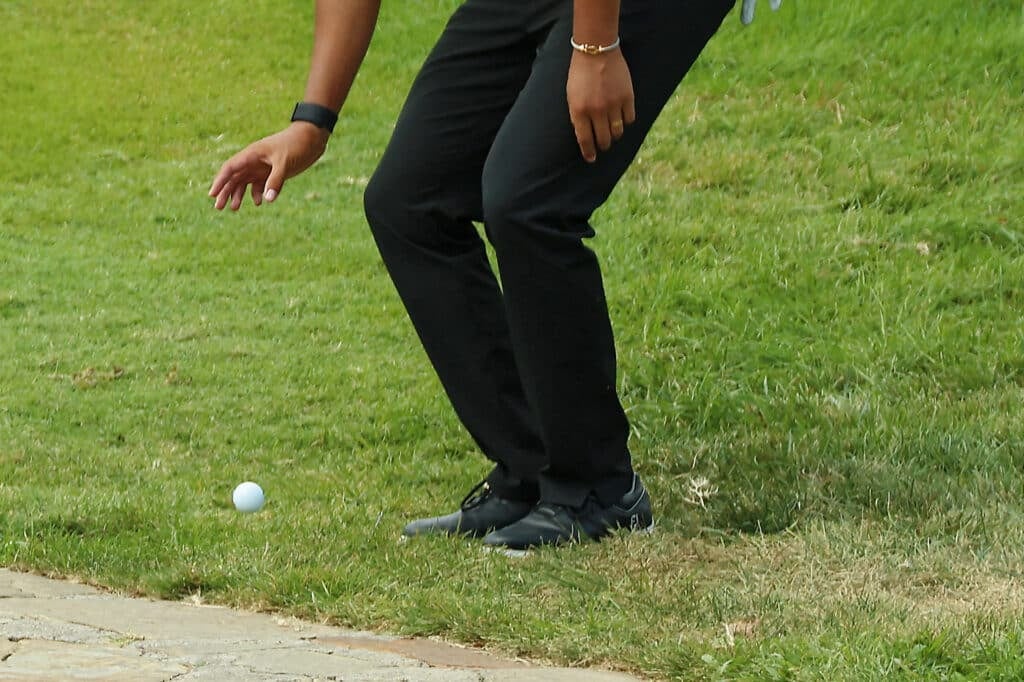
We’ve all seen this happen. A player picks up their ball and just walks over to whether there is a perfect piece of turf and drops it.
But nearest does not mean nicest. It means nearest! That might be in a place where there is interference by something else.
Not only that but taking relief doesn’t guarantee you a good lie. There is a clarification to Rule 16.1 which makes this very clear.
It’s why you should always suss out where your nearest point of complete relief might be before you pick up your ball to take relief.
If you don’t do that and subsequently find that point is in the middle of a bush, then that is where you are dropping. Be careful.
Advertisement
What if you can’t find the nearest point of complete relief?
You guess. If you can’t physically determine the nearest point of complete relief, a clarification to the definition says you must estimate it. Your relief area is “then based on that estimated point”.
It gives the example of a boundary fence that stops a player from getting into the required stance. In that case, you should estimate the nearest point and drop the ball in that relief area.
But if it is not “physically possible” to do that, then you can’t take relief under Rule 16.1.
What if you find your point but you can’t take a shot?
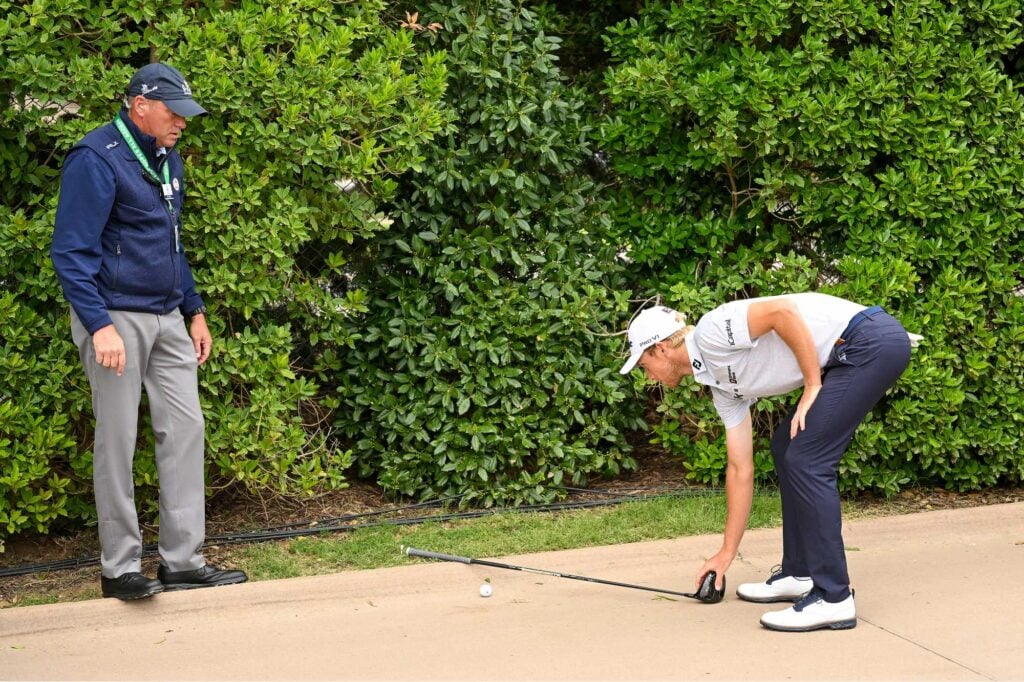
Let’s get into that last point a bit more. You’ve found your nearest point of complete relief, but you can’t take the shot. What do you do?
There is another clarification here to explain. You might not like the answer, but it is instructive if you find yourselves in this position.
The example it gives is that a player’s direction of play is blocked by a tree, or they can’t take a backswing because of a bush.
Knowing that you’re not guaranteed a good, or even “playable”, lie when establishing the nearest point of complete relief, you’ve just go to decide what type of shot you can make.
“This stroke, which includes the choice of club, may be different than the one that would have been made from the ball’s original spot had the condition not been there,” it says.
“If it is not physically possible to drop the ball in any part of the identified relief area, the player is not allowed relief from the condition.”
Now have your say
What do you think of these rules about the nearest point of complete relief? Have you ever come a cropper in some of the ways outlined above? Let us know with a comment on X.
Advertisement
Advertisement