


Coldplay did not have penalty areas in mind when they sang that everything was “all yellow”.
But when you’re standing in front of a load of yellow posts it’s hard not to get the feeling that no other colours exist.
Red might mean stop at a traffic light, but when it comes to colours around golf hazards it is yellow that often strikes fear into the heart of club golfers.
So what happens if you’re looking at yellow stakes and how do they differ from red penalty areas?
Golf rules for yellow stakes
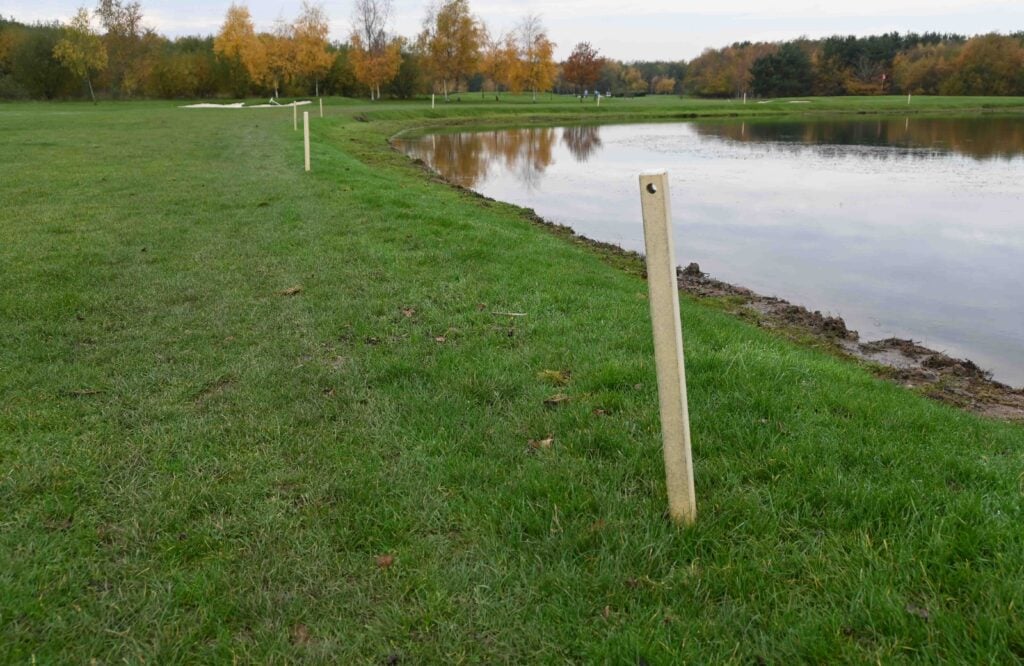
What can you do when your ball ends up in a yellow penalty area?
If you’re brave enough, you can always wade in there and try and play it as it lies. Don’t blame me if you get splattered.
If taking relief is your only option – let’s say you’ve struck it right into the middle of a pond – you have two choices. Each will mean adding a penalty stroke to your score.
The first is stroke-and-distance. That means going back and playing again from where the previous stroke was made.
The second is back-on-the-line relief. That one is a bit more complicated.
You need to keep the “estimated point where your ball last crossed the edge of the penalty area between the hole and the spot where the ball is dropped (with no limit on how far back the ball may be dropped).”
LISTEN TO THE NCG GOLF PODCAST
ALSO AVAILABLE ON:
Apple Podcasts: Listen Now
Spotify: Listen Now
Amazon Music: Listen Now
Let’s break that down into language that doesn’t sound like it comes straight from the courtroom.
You find the spot where the ball last crossed the pond, line it up with the flag, and then go backwards on that line as far as you like.
Make sure you drop the ball on that line and it then creates a circular relief area that is one-club length in any direction.
Advertisement
It’s important to remember that last section as it means with back-on-the-line relief the ball can go forward up to a club-length.
You’ll feel an overwhelming urge to pick it up and re-drop – as this is the only time the ball can go forward when taking relief – but resist it.
You’ll pick up a silly penalty if you do.
And what you also can’t do with yellow penalty areas is take lateral relief. That option, dropping into a two-club length relief area, is only available for red penalty areas. If you mistakenly do that, correct the error before taking a shot.
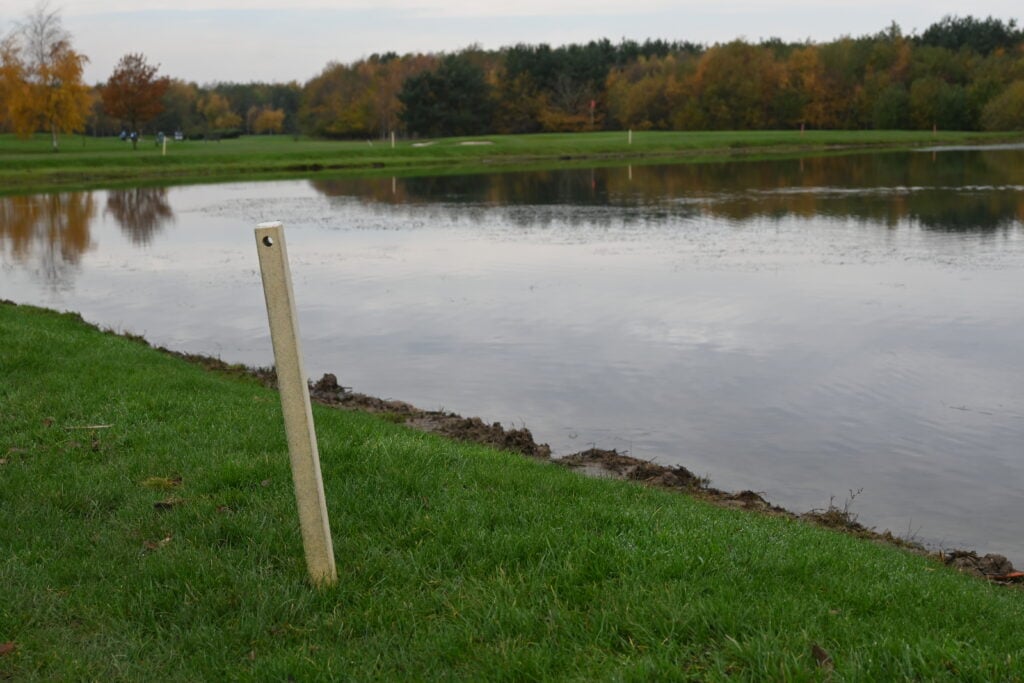
Why are some penalty areas yellow?
I’ve hunted back through the Rules of Golf archives and the first reference I can see to yellow stakes or lines comes into the definitions to the 1980 Rules of Golf where, as a final note to the section on hazards, it is written: “Water hazards should be defined by yellow stakes or lines and lateral water hazards by red stakes or lines”.
They’re part of a series of colours generally used on the golf course to denote certain conditions, such as white for boundaries or blue for no play zones.
So why aren’t penalty areas all just red? There are some who would recommend they should be and there is nothing to stop competition organisers doing just that. It would remove any confusion about what you can do.
There are occasions, though, where clubs might want to remove the option to take lateral relief. Say you’ve got a par 3 that makes players hit over a pond to the green.
They may feel successfully negotiating the water was part of the challenge of the hole and didn’t want people to hit it in and then be able to just clear the H2O out of the way when they drop by using a lateral relief option.
Advertisement
In that case, yellow stakes would be the way to go.
Got a question for our expert?
Despite the changes to the Rules of Golf in 2019 and 2023, there are still some that leave us scratching our heads. I’ll try to help by featuring the best of your queries in this column.
What do you think of these yellow stakes golf rules? Let me you what you think, and send me your own rules questions, by emailing me at s.carroll@nationalclubgolfer.com or by leaving us a comment below, or on X.
Pictures taken at Sandburn Hall
Advertisement