



David Leadbetter’s ‘A’ Swing simplifies the backswing; here, he explains how you can execute the A Swing.
David Leadbetter A Swing Backswing
There are so many ideas out there on how to take the club to the top of the backswing it’s hardly surprising so much confusion exists.
When do you cock the wrists? Should the left wrist be flat or cupped at the top? Does the right elbow stay ‘tucked’ or should it float…? The list goes on.
My primary goal was to simplify the backswing. And when you look at this initial sequence of images from this angle, down the line, you’ll see there’s a bit of a baseball-look here, too.
I’ve always been fascinated by this aspect of the golf swing: watch a baseball player and you’ll see the bat is cocked, pointing up at the sky in readiness for the strike – and the player uses his body to shallow the plane for impact. You step into the shot, and everything starts to move.
It’s not far away from what I’ve always believed in – i.e. steep to shallow. Nick Faldo played his best golf that way, as did Nick Price. And you have to go a long way to find better strikers of the ball. (More on this steepening and shallowing of the shaft angle a little later…)
So, the most notable element the backswing you see here is the accentuation of the steepness of the plane as the hands reach waist high. I refer to this phenomenon as the ‘V Plane’, created if we highlight the plane going back and the plane coming down.

As per the baseball analogy, when a player uses his body to step into the downswing the plane shallows automatically. That’s the reason so many who have tried the ‘A’ Swing find they strike the ball more solidly and more consistently, swinging from the inside and creating a nice draw.
Advertisement
The other key to point out here is there is no clubface rotation going back – at least no conscious rotation. (There is a little adjustment in the grip to facilitate this, which is explained overleaf).
The vertical nature of the shaft plane is Jack Nicklaus-like, Montylike. Johnny Miller, one of the great iron players in history had the same look to his swing.
And you achieve this by working the arms and hands in close to the body during the takeaway – the hands almost brush the right knee. So it’s an ‘in-then-up’ move which gets the shaft up into this vertical position at halfway back and, as you then complete the wind up of the torso, the clubshaft points across the line at the top, which I like.
A Swing Step-by-Step
So, let me take you through the backswing step-by-step. Pick up a club and follow my lead:
- Hands in, club is out: use your core/belly muscles to get the hands and the club moving a short distance, to where grip of club travels just past your right thigh. Your left arm should feel linked to your chest, and your hands should be close to your body.
- The clubhead stays outside the line of the hands, while the clubface looks at the ball.
- As the club is moving away, with the weak right hand grip, the right hand works inside, and you should feel that you are starting to ‘load’ the club now, at this point I’m about half of the way back. My right arm is above my left arm. Again, no forearm or clubface rotation.
- Now, complete the backswing motion with an upward spiral coiling of the body. The left arm stays nicely linked to your chest, while the right bicep pinches your right pec here. Then just wind it all up.
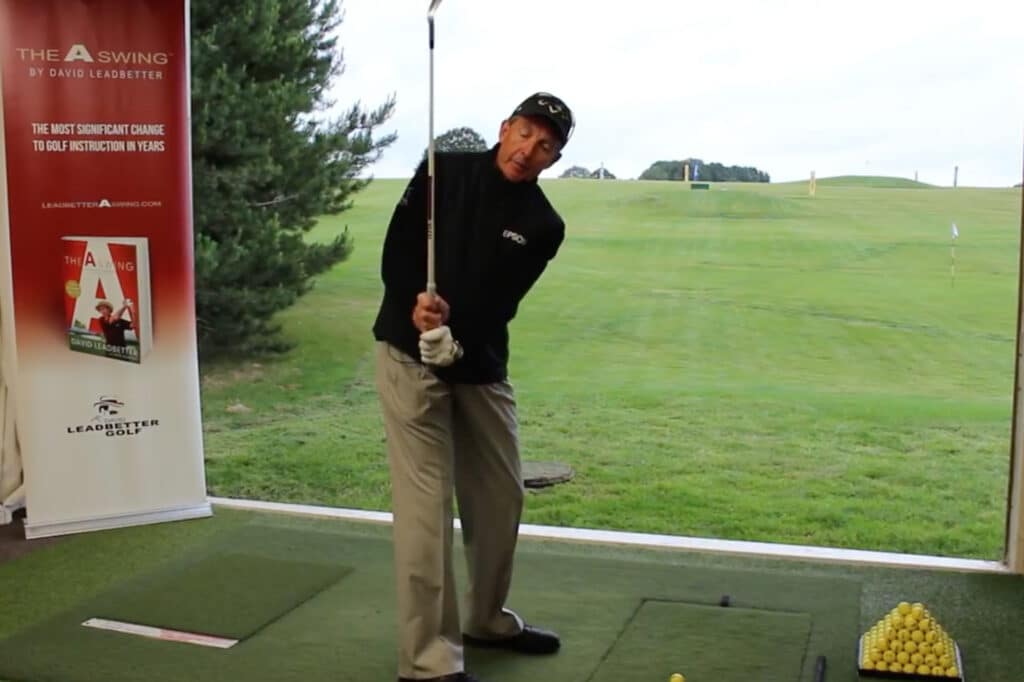
- Maintain the connection between your left arm and chest all the way to the top. The result will be a fully loaded backswing, with a short arm swing, while the club appears slightly across the line. The left arm lies under the shoulder plane.
- Starting the transition, the lower body moves towards the target just as the upper body and club are completing the backswing. This dynamic movement gets the hands and club working on tandem with the movement of the right shoulder and elbow.
- Halfway down the plane is on the same matching plane as the shaft at address, in sync with the body. This is the key benefit; shallowing the plane is a pre-requisite to syncing the arms and the body on the way down to impact.
- Swinging down in the proper sequence gives you the best chance of releasing the club and rotating your body in sync through the point of impact. With the shaft leaning towards the target you get compression and a solid ball-turf strike.
The point I want to stress, working through the backswing is that, you want to feel that your left arm is really under the sternum – in other words the left arm plane is underneath the shoulder plane.
The more you connect this, the shorter the distance the butt-end of the club travels and the more efficient you will be. One of the real facets here is the arm-swing, short and across the body, which again I have always liked.
It’s a compact move and one in which the hands and arms travel less distance to reach the top. The more ‘in’ you can get it at the start of your swing, the better. Just look at the distance the butt end of the club has to travel. By that alone it is easier to control.
Advertisement
The gearing is better – as JJ has proved. The key is really getting a feel for the backswing; it’s all about making a more efficient backswing in order to make a more efficient, easier, downswing.
Most teachers and biomechanics experts would agree on what happens in the transition, but for most amateurs, that sequence in the change of direction never takes place because they are so consumed with making a decent backswing.
Well, this simplifies that problem for you.
Have you given the David Leadbetter A Swing a go? Let us know how you got on on twitter.
Advertisement