



A tough new pace of play policy which can hand out stiff penalties to groups which aren’t quick enough launched without a hitch.
The English Senior Women’s Amateur Championship, at York Golf Club, saw the start of England Golf’s checkpoints – which aim to keep the game moving.
Groups at the governing body’s big events are now timed after completing the 4th, 9th and 14th holes of their rounds as the responsibility for pace of play shifts from rules officials back to players.
Enforced through a Local Rule, the first group – and any group after a starter’s gap – will be “considered to have missed a checkpoint, if upon arriving at a Pace of Play Checkpoint, the group’s cumulative time exceeds the time allowed for the number of holes completed”.
The policy also says that: “Any following group will be considered to have missed a checkpoint if it is more than 12 minutes (10 minutes in 2 balls) behind the group in front and exceeds the time allowed for the number of holes completed”.
A first missed checkpoint sees all players in a group given a warning by a referee and told to get back into position. A second missed checkpoint brings a one-stroke penalty, while a third missed checkpoint sees every player given an additional two stroke sanction.
At York, volunteers could see how players were doing on a tablet, which gave them a countdown of how long a group had to get through the checkpoint, while referees could also view every group on the course – and how they were doing against time.
On the opening day of the championship, groups of threeballs had four hours and 22 minutes to complete rounds and the times they had to be at their checkpoints were stated on their scorecards.
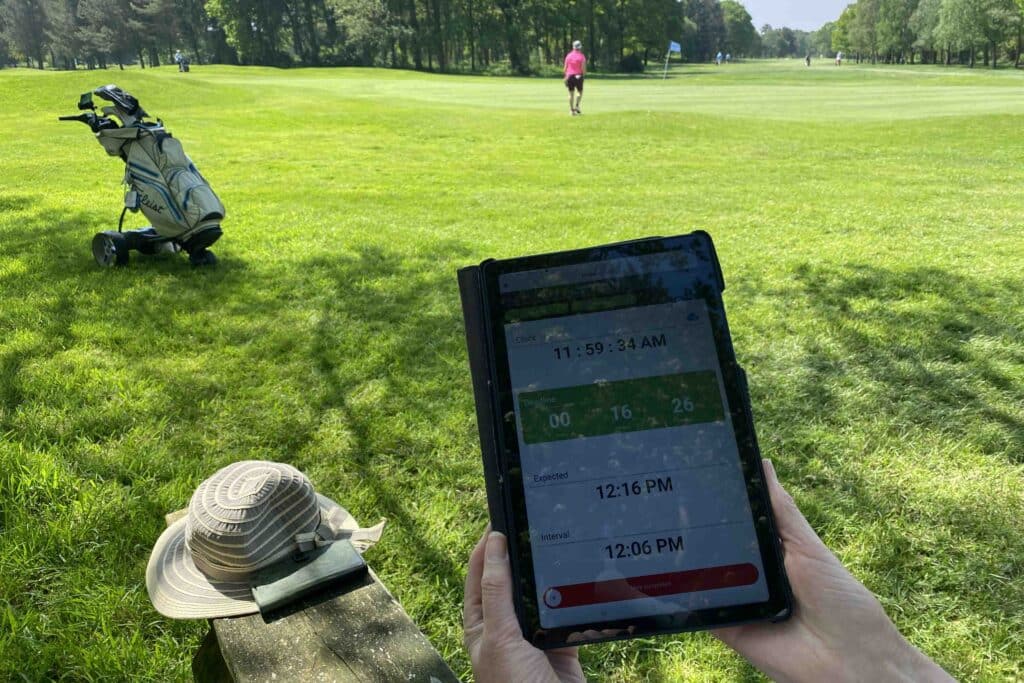
Pace of Play: Did England Golf’s new policy get off to a good start?
Almost every group successfully made it through their three checkpoints or had an extenuating circumstance – such as a ruling from an official.
Advertisement
The policy aims at encouraging golfers to play at an appropriate speed and, on site, England Golf’s championship manager Scott Allison said: “It’s created a bit of conversation among the players today about pace of play and perhaps it’s made them think about how quickly, or slowly, they play a round.
“The starter has been giving players a small briefing on the 1st tee and, on the scorecard, a label instantly shows you how quickly you should get to the 4th, 9th and 14th.
“The players have quite a clear message that we’re looking at pace of play. They get clocked in with a volunteer at the first checkpoint, which is on the 5th tee, and that volunteer will get a message to say whether the group is on time or not.
“It’s worked really well and it gives referees a live view of what’s happening on the golf course.
“Each referee has a tablet and they can see the minute a group gets through the 4th, 9th, 14th, and finally finish their round. Under the old system, they were constantly looking at every hole through the 2nd.
“We’ve been asking them to look at more refereeing and the checkpoints. It gives us some good data and some good insights.”
Now have your say
What do you think of England Golf’s new Pace of Play policy? Could it work in big tournaments at your club? Why not let me know your thoughts by leaving a comment on X.
Advertisement