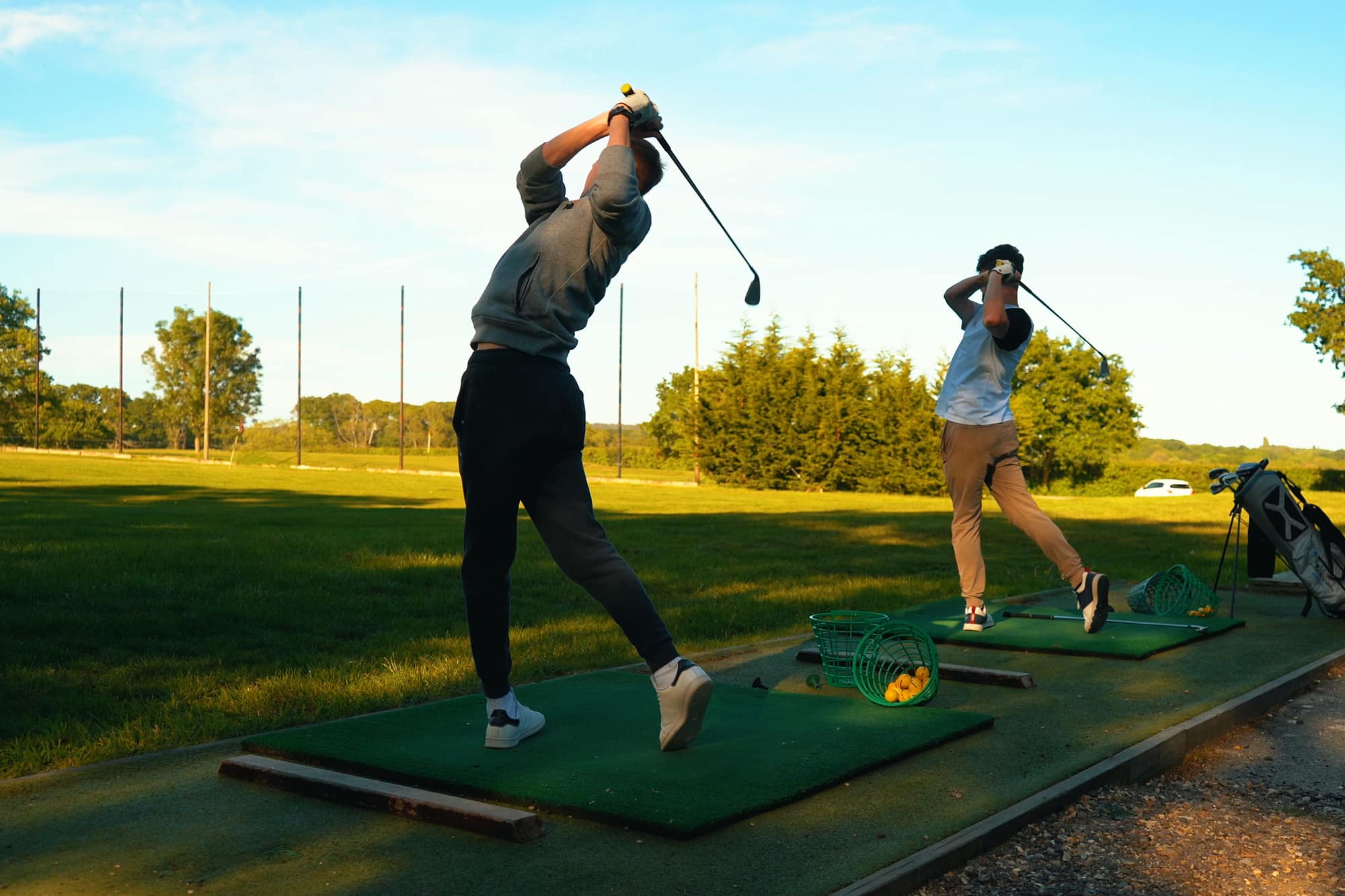


The point of our experiment was to see whether it was possible for players to actually hit within the timings allowed in the European Tour pace of play policy. To recap, should a group be on the clock, Player 1 has 50 seconds to hit and Player 2 and Player 3 have 40 seconds thereafter.
- European Tour pace of play experiment: What we set out to do
European Tour pace of play experiment 1: 2nd tee
When does the clock start?
Our understanding is that clock should start when all the bags and players are in position so all yardage checks, throwing bits of grass in the air and practice swings are included.
Group 1
Player 1: 33 seconds (-17)
Player 2: 33 seconds (-7)
Player 3: 25 seconds (-15)
Given there was hardly any wind early in the day this helped as did the group ahead still being on the green which meant the first player was ready to go straightaway.
Group 2
Player 1: 63 seconds (+13)
Player 2: 33 seconds (-7)
Player 3: 18 seconds (-22)
The first player, who is quite deliberate anyway, wasn’t helped by the green being clear by the time they arrived on the tee. Player 3 was helped by his caddie doing all the yardages and wind checks while the others were still putting on the 1st. Even so it does prove gently quite how long 40 seconds is to hit a ball.
Group 3
Player 1: 70 seconds (+20)
Player 2: 17 seconds (-23)
Player 3: 18 seconds (-22)
Again the green was clear which meant there was no leeway and the players and caddies arrived on the tee en masse.
Group 4
Player 1: 56 seconds (+6)
Player 2: 23 seconds (-17)
Player 3: 16 seconds (-24)
The easily-distracted first player half-stopped twice which was either bad luck, a personality thing, or just something to buy himself some more time. The third player, who I had always assumed to be quite slow, hit in the blink of an eye.
Group 5
Player 1: 69 seconds (+19)
Player 2: 39 seconds (-1)
Player 3: 25 seconds (-15)
The first player again backed off the shot, for no obvious reason, while the second player didn’t have a club out when it was his turn.