


With the benefit of hindsight, it would have been smart to have started a year earlier, when Jack Nicklaus won his sixth and final Green Jacket at the age of 46.
But I wasn’t to know that at the time, and so the Masters began for me with Larry Mize, Seve Ballesteros and Greg Norman heading down the 10th for their play-off in 1987.
I may not have appreciated the skill of the shot or the scale of the upset when Mize holed his long chip at the 11th, but it was enough to kindle a lifelong love affair with the game of golf in general and this tournament specifically.
I was there – in spirit – when Sandy Lyle continued the logic-defying period of European dominance the year after, followed by Nick Faldo, twice, then Ian Woosnam, Bernhard Langer and Jose Maria Olazabal, rudely interrupted only by Freddie Couples in 1992.
I have seen the Tiger Woods and Phil Mickelson eras – and still can’t quite believe that Ernie Els, Retief Goosen and David Duval failed to win a Green Jacket between them.
If I have missed an hour of live coverage since 1987, I can’t remember when or how or why.
I have written professionally about golf for fast-approaching a quarter of a century, much of that time editing a magazine that invariably featured a 32-page preview of the Masters each March as well as countless other pieces throughout the year. I reckon it adds up to over 1,000 pages devoted to this tournament.
I have been fortunate to interview many of the game’s greats and talk to them about Augusta – from Faldo to Jack Nicklaus, Tom Watson to Danny Willett and Arnold Palmer to Bubba Watson.
What is more, as a lover of golf course architecture, I have studied every nuance and read every piece of writing I could find on the golf course that Alister MacKenzie and Bobby Jones created on this former flower nursery in the east of Georgia.
Advertisement
I have also read more pieces like this, where first visits to the Masters are documented, than I would care to admit to.
So why should I bother writing this and, more to the point, why should you take your valuable time to read it?
Well, if I have a hook, it is that not too many first-time visitors to Augusta National can possibly have put quite as much research into this particular assignment.
I can recite every winner and describe each hole in intimate detail. I know my Hootie Johnson from my Clifford Roberts and my Ike’s Pond from my Rae’s Creek (or tributaries thereof).
Let’s be honest, if I had applied even half the diligence to my academic studies then I probably wouldn’t be a journalist.
Not that I would have it any other way, you understand: they used to say in Fleet Street that being assigned to the sports section was the equivalent of working in the toy shop.
If you take that a step further and extend it to me ‘working’ on things like the Open Championship, Ping’s new fairway woods and getting to play at Turnberry then you could say that it was a bit like being given exclusive access to Hamley’s as an eight-year-old after they have taken delivery of a new range of Subbuteo.
I am showing my age now – but then the justification for this trip was a present to myself having turned 50 last year (on the exact same day as Tiger Woods, if you can believe that).
ALSO: What the Masters’ no-mobile-phones policy actually means for the patrons
We are incredibly grateful at National Club Golfer to have been accredited for a press badge at Augusta in recent years. Accompanied by my long-time friend and business partner, Tom, we had the privilege of attending not just a day of the Masters but the entire tournament.
And so it came to pass that we drove down Washington Road with ‘Augusta National Golf Club’ rather surreally plumbed into the sat nav in the dark last Wednesday morning.
I would need to wait only another half an hour to see how the vivid mental map I had created over the years would compare to the actuality; how a million memories would collide with reality in 2026.
Accessing the golf course itself via the North Gate, my first view was overwhelming: there was the 1st fairway with Augusta’s verdant hills rolling into the distance, interrupted only by flashes of white bunker sand and those mellifluous, tall pines.
I knew the landmarks that I was looking for but I couldn’t quite find them as my brain attempted to compute the overwhelming visual data: if this was the 1st fairway then the 1st tee must be to the left: check. The 9th green should be close by – I saw a flag that corresponded. Which meant the 18th green should be just beyond that – sure enough, there was the very top of another yellow flag. I asked Tom, quite anxiously, if that was the 18th. He had been before, as a patron, back in 2013 for a couple of days. He wasn’t sure, but I was barely listening anyway.
It was still growing light and the fairways were damp. A gossamer of mist hovered over the ground.
But what about the turf below my feet – this was not what I had envisaged. I knew it would be cut tightly but nobody had ever prepared me for how firm it would be underfoot. This quintessential parkland course felt like a heathland – if not a links – back home. Combine that with the severity of the contours and the speed of the greens – and suddenly the ultimate challenge of Augusta made sense.
Advertisement
At this moment, as the sun came up on the final practice day of the 90th Masters Tournament, it would be untrue to say that the course was deserted. Equally, the patrons had had no longer than two minutes to explore the property, and the majority, led equally by gravity and the pull of history, had headed for the back nine and specifically Amen Corner.
By contrast, my intentions were clear: we would walk the whole course and we would walk it in the order it was designed. At the Masters and the Open, just as it should be, the course is played only from one to 18 and there is no such thing as a two-tee start. I would follow suit.
I took my first look down the opening fairway, and tried not to be distracted by the famous oak tree in front of the clubhouse. Or any one of the dozens of familiar landmarks within eyeshot that were now made physical. They could wait for later.
By the time we reached the 1st green, it was just us and the various Augusta staff and volunteers setting up for the day.
On the front nine, we saw no players and a single caddie – Marco Penge’s sidekick was rolling balls across the 8th green to test speed and contours.
There is almost no course furniture at Augusta during the tournament and very few stands. A rope separates patrons from players and the prepared turf.
Advertisement
On the practice days, you are free to stand behind every single tee – with the single exception of the 13th which no patron has ever been able to access – and we did.
You can also take a camera in with you on practice days and I snapped happily away – down every fairway and back from every green.
Because the TV camera positions here are fixed, it is remarkable that for every view that was instantly familiar, there were countless more that were new and startling.
If you want to read or listen to our hole-by-hole course notes, they are here, but let us stick to the overall experience for now.
The front nine broadly sits on the higher ground and works its way around the outside of the course. It is not quite as visually spectacular as the back nine. The only water hazard in play is the stream between the 2nd and 8th fairways. It is not where rounds culminate and is not where champions have been crowned. If Amen Corner is Augusta’s main theatre stage, then the front nine is up in the gods.
For all of these reasons, it is much quieter. I was struck all week that I was able to hear birdsong while on the course but it was especially the case in corners of the property like the 2nd, 5th and 9th tees.
It is official policy at the Masters that the staff engage with patrons and you quickly establish the habit of being ready with a cheery wave – not exactly hard to muster in the circumstances – and a friendly greeting. Staff and volunteers alike, you would not find a group of people happier to be working.
Walking the front nine for the first time before most patrons and competitors had even arrived on the property that morning is a memory I will treasure forever.
Advertisement
A feature of Augusta is that it is forever changing the mood music. It interchanges moments of solitude with knock-out reveals and stupendous increases to the excitement levels.
By the time we reached the 9th green and I had at least partially absorbed the severity of the angle at which the green sits relative to the fairway, the sun was up, the temperature was rising and the patrons continued to flood on to the course.
In some ways, I wished I was back on the front nine because I knew the back nine would be more hectic.
Then again, I was about to absorb my first view of the 10th fairway tumbling downhill, taking us to Amen Corner itself. What a thrill.
ALSO: Sir Nick Faldo: I knew when Greg Norman was in trouble during his 1996 Masters collapse
Short and left of the 10th green, in the pine straw and shaded by the enormous trees, quickly became one of my favourite vantage points. I took it in each and every day.
From there, you walk back to the championship 11th tee. To get the full benefit, I didn’t allow myself to take a glance over my shoulder until we reached our destination.
Only then did I fully appreciate that the drive is semi-blind, the players hitting over the crest of the hill.
You can’t yet survey Amen Corner from up here, but you can see the top of the famous scoreboard that has conveyed numerically so many moments of drama to players and patrons alike over the years. The sense of anticipation is profound.
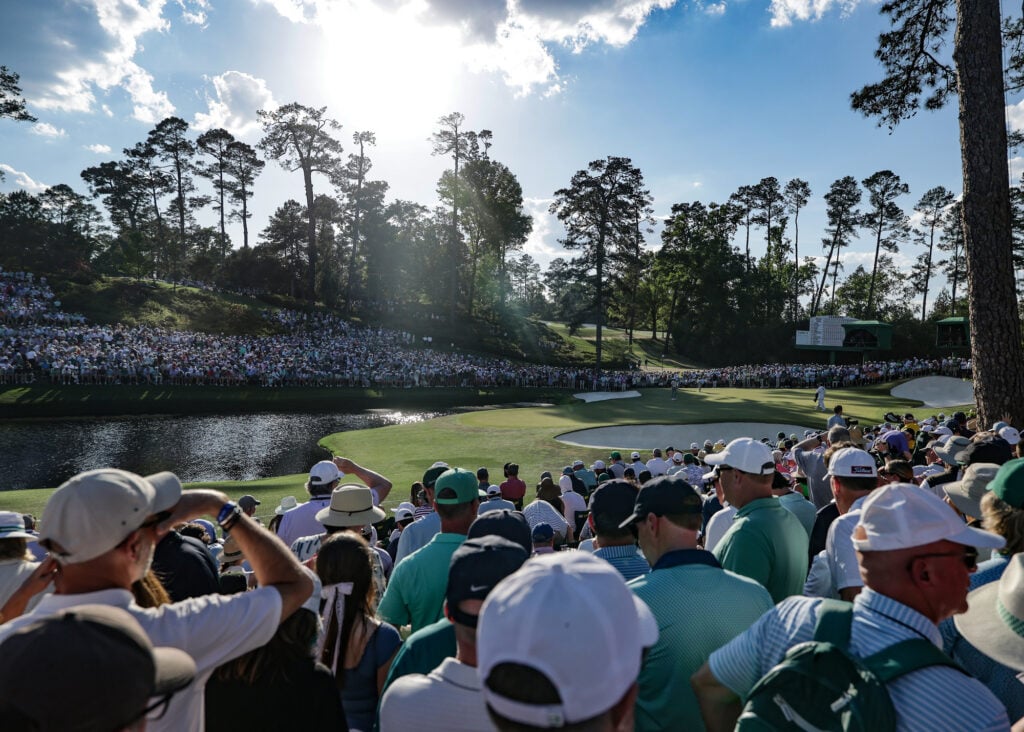
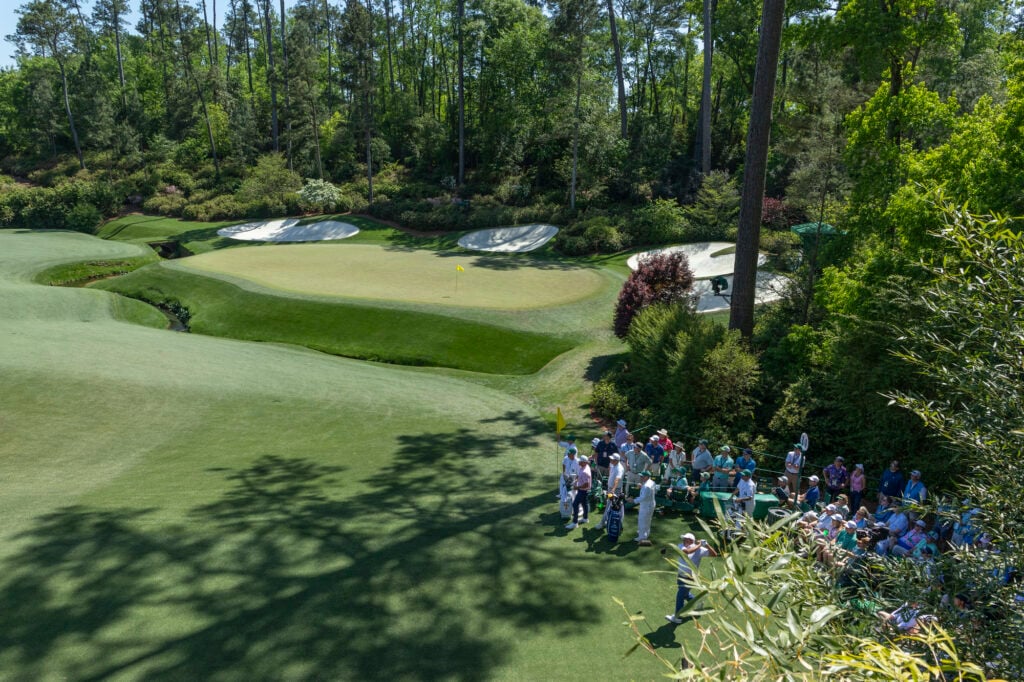
A few minutes later – there it was in all its glory. The water, the 11th green, the Hogan and Nelson Bridges and the 12th green in the distance. So very, very familiar and yet now brought to life.
It is always busy down here and to the right of the 13th fairway. All week, I experienced a slight sense of relief when moving on to the relative cool and calm of the 14th, now my favourite hole at Augusta.
It is like being back on the front nine and even on Saturday and Sunday afternoon, this is a pocket of the course that many patrons skip out, falling as it does between the two par 5s on the back nine where eagles and double bogeys abound. I am not sure I ever saw the small greenside grandstand completely full.
Despite having studied maps and aerial views of Augusta for decades, I simply could not appreciate until I got here how the 16th sits at the epicentre of the golf course, a natural amphitheatre.
From here, it is a significant and steady climb up the last two holes, the claustrophobia of the 18th tee shot breaking into a feeling of immense space when you pivot around the dogleg in classic Augusta fashion.
So much to take in. So much more to discover. So many details to double and triple check.
But from the exact spot where I knew the latest champion would be greeted by his nearest and dearest before being escorted up the hill to the Butler Cabin come Sunday evening, I had realised a lifetime ambition and seen almost every inch of Augusta National with my own eyes.
Now there was just the small matter of a golf tournament to watch unfold. And before that, the light relief of the par 3 competition.
I shook my head gently, drank in one last look down the 18th and tried to make sense of what I had just experienced.
NOW READ: The Masters’ gold standard for fan behaviour under scrutiny
NOW READ: Rory McIlroy wins the Masters again, and breaks Justin Rose’s heart again
Have you had an Augusta National first experience like me? Tell us on Facebook