


When Agustín Pizá was pinching triangles on a screen in the TGL labs, shaping a virtual course design for a new league created by Tiger Woods and Rory McIlroy, the tirade he got during his golf architecture degree felt distant.
At the start of his journey to becoming an award-winning golf architect, Pizá took his extravagant mind to Edinburgh to learn how the UK do golf courses to complement his Latin American roots.
He began in Palmilla, El Dorado and Querencia in Mexico which led to collaborating with Jack Nicklaus, Gary Player, Tom Fazio and Robert von Hagge on various projects. His portfolio is envied not only because of his star-studded contact book, but with his complete approach to architecture which was straightened out in Scotland.
“It was the down-to-earth approach on golf design,” Pizá said on his main takeaway from Edinburgh. “When I first started my career, I was working on the construction side of the industry, which was great because I had the opportunity to work from the ground up and know the inside-outs of golf and that’s one of our competitive advantages, knowing a lot of construction and project management.
“I learned across the pond where everything’s majestic, everything is a Big Mac, big shakes, bigger the better, the bolder, the big truck. So, I was used to, ‘Let’s move this mound and the hill and this mountain to the right, now let’s move it to the left’.
“Let’s get out there, let’s create character, let’s be bold, let’s do whatever we need to know’,” he added. “When I got to my masters degree in Edinburgh, it was the opposite completely. I was slapped on my first assignment because I was moving soil, I was doing creative plans on the first exercise, and I was called up front to be an example of what not to do! That was my first two or three weeks of assignment, I was going crazy, and they were like Augie Augie, what are you doing?”
Advertisement
To arrive in Edinburgh to learn about golf courses is to walk in the footsteps of Old Tom Morris, James Braid and Willie Park Jnr, a handful of the game’s most respected turf sorcerers that Scotland has produced.
Pizá asks for “nature’s permission” to begin construction now, and his Scottish education taught him that you can move landscapes and incorporate them as they are naturally found.
Having also temporarily lived in Chester, Pizá worked with Ken Moodie at courses like Moortown in Leeds, Vicars Cross in Chester, and Macclesfield, in Macclesfield. It is quite the contrast between Los Cabos and the lights and pixels of TGL, where he now finds himself working.
TGL presented by SoFi began in 2025 and has seen 24 players play in six teams, competing in a set of virtual golf matches by hitting balls into an interactive screen.
EXPLAINED: What is TGL Golf?
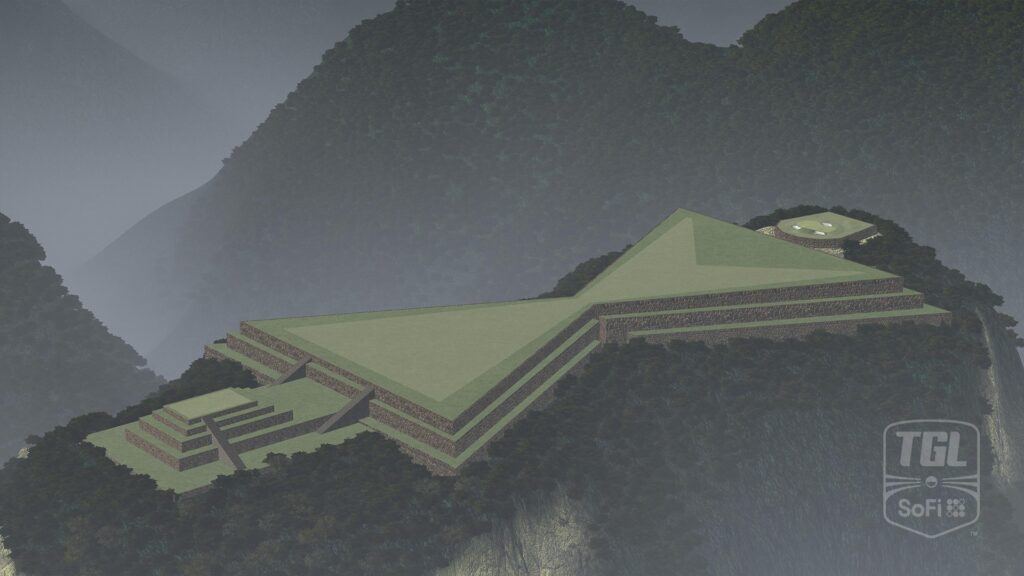
With the aforementioned triangles, Pizá initially designed three holes to appear on the TGL screen which some of the best PGA Tour players will play at the Sofi Centre in Florida starting in January – the Temple, the Serpent and the Plank. Without dismissing the rest, The Temple is quite the idea.
It is a 502-yard par 4 but the fairway narrows so much that you’d need to tiptoe through the middle, with cavernous drops on either side. Pizá mischievously chose the pinch-point based on how far players drive from the tee, creating jeopardy from the outset.
“I think it’s the hole that a lot of people engaged with, either bad or good, so I love that as it touched some buttons, it’s a little bit out there,” Pizá told NCG. “Funnily enough, I do think it’s one of my favourite holes because of the simplicity. One of the toughest things as a creative, you can talk to any sculptor or painter, is arriving to simplicity, arriving to that stroke of the brush and that’s it.
“Arriving to that takes years and years of practice, everything that you want to put on it – Architecture is about playing with forms, that’s what it is, geometric forms, and you’re playing with that. So when we had the opportunity to do TGL, this is the first time that we can create something and play with forms – and arrive to that simplicity.
“I grabbed a couple of triangles and with a little bit of time, creativity and playing around, I said, ‘Why don’t we pinch these two triangles? It’ll be a great risk and reward hole with just two figures, just two geometric figures, that’s all you need’. You don’t need to get fancy, you don’t need to do anything, pinch that thing to 15 yards and what’s the top players average drive? 286 yards?
“Let’s put it right there, 286, 15 yards wide, and then from there it starts growing and it starts encroaching to 15 yards and then it starts growing. If you hit it 15 more yards, you’re going to get 30 to 40 yards of territory. If you hit it 330, you can spray it about 60 yards – I’m really hopeful about that hole to grow on people and understand the simplicity of it and one of my objectives is to replicate it in the real world one day.”
About an hour with Augie Pizá is what we had, but it isn’t nearly long enough to explore his whole brain and golf architecture ethos. A writer or anyone not involved with the complex world of golf design wouldn’t know where to begin when arriving at a site with the task of building a golf course.
Advertisement
“I just see it,” Pizá said. He has seen much, from two Jack Nicklaus and one Gary Player signature designs to Querencia Private GC with Fazio and five different projects across America and Europe with von Hagge. He was the first Latin American to gain a masters degree in golf architecture from Edinburgh University and he is a Senior Member of the European Institute of Golf Course Architects.
A lot of graft has led to the point where Pizá has stepped into the future with TGL, but even that isn’t fully alien to him as in 2021, Pizá Golf created a hole for Golf+ which is a virtual-reality golf concept. He is a jack of all trades and, slowly becoming a master of all of them.
When I asked Augie how he would summarise his architecture ethos, I wasn’t disappointed with the answer:
“Our design philosophy is pretty clear in what we do, our routing plan has to be beautiful. And what I mean by that is we envision a routing plan like a treasure map, so you want to be there and explore the site, explore the land that we’re working on. We want our routing plan to be an adventure, a treasure map, you’re adventuring, you come down to the ocean, you come up to the mountain, you come down to the desert, you go into the marsh.
“That’s what we want to create, so the first thing that you do is study the whole atmosphere and the virtues of the site. If it’s a masterplan community, it gets more exciting because you want the routing to go through different products that you’re going to create or, a special point here or you see the hotel or the restaurants, or the restaurants want to see you. There’s also the other view from the outside in, all of that becomes a big puzzle that we call it the treasure map.
Advertisement
“We have a treasure map to create 6 holes, 12 holes, 18 holes, 24, with our Butterfly Golf concept, or whatever it is. That’s the first step, then from there, that’s in 2D. When we get to the third dimension, we call that our carousel of emotions. How are you going to feel? We want to give you these holes where you’re excited, it’s a challenge, that’s a mix of heroics, the risk and reward, and strategic and penal holes.
“All of that now, you start dressing up that treasure map with the carousel of emotions which is an emotional chart which now you can create different angles, different strategies, different categories of holes. Am I going to take a shot off you? Am I going to give you a shot, that’s where you really start creating this adventure of the golf course.
“With that said, the final element is what you’re asking for, and that has to do with the brief. Who are you catering for? Who is your end user? Where is it and what’s your objective? Not ours, but the clients and the situations. We have to adapt to that, that’s the secret, the secret of all of this is adapting to the end user.
“So when you get that then magic comes out because now we control the way we design and the way we design is, you can imagine an 18-chapter book, you can imagine a great piece of art, a good movie. You have your structure, you have your plot, you have your rising action, you have your climax, you have your surprising ending, you have all of that structure that lies within our philosophy of work.
Advertisement
“This is something we do, this is something that is very close to us and is a very original approach to design, and with that said now, what’s the brief? Are we designing a romantic comedy? Are we designing a thriller? Or a player’s course? Or a resort course where it’s like a romantic movie, and let’s all break 100 and be merry, and it was beautiful I shot 98.
“Or are we designing for TGL where we are designing for the best players in the world where instead of designing for a 270-yard tee shot, we’re designing for a 330. When we really want to challenge them, let’s go 330 because we know that Rory and the big boys can hit that, but we would never design that in real life, but the brief is design for the top and best players in the world that’s what we did for TGL, that’s that brief.”
Golf+ and the innovation involved with TGL are concepts on a long list of shape-shifting technologies adopted in other quarters by brands and golf coaches who want to take golf to the next level. The league uses a putting surface with 600 actuators underneath to change the slope, for example, as well as the 64 x 53-foot simulator screen.
Putting green technology is also the subject of Platform Golf’s ethos. Platform Golf uses cutting-edge technology to have players hit putts on a tilting green and hit approach shots from uneven lies.
The surfaces can be controlled by the user to recreate any situation encountered by any green. The practicality and value are of no end for coaches such as Claude Harmon III, one of the best coaches in the business, who has now become an ambassador for Platform Golf.
“These platforms allow us, as coaches, to teach situations that couldn’t usually be replicated away from the golf course – skills like putting on real greens and shooting from uneven lies. It’s a game changer no matter the ability level of golfer using it,” Harmon said.
NOW READ: When will Tiger Woods next play golf?
NOW READ: Tiger Woods’ 2024 fortune revealed: Has anyone else joined the billionaire club?
NOW READ: Does Tiger Woods deserve his own exemption category on the PGA Tour?
Follow NCG on X!