


It has always been to the embarrassment of club golfers when they need to remove a headcover to tee off on a par 3.
We’ve all lifted the 3-wood from our bags, knowing it’s the wrong club, to avoid the shame of needing a driver to reach what is meant to be a short hole.
When watching some pro golf tournaments, invariably the US Open or, in this week’s case, at the Genesis Invitational, said club golfers can sink into their sofas and snigger at the stars who experience the same awkwardness as they look to the meatier clubs to reach the green on a par 3.
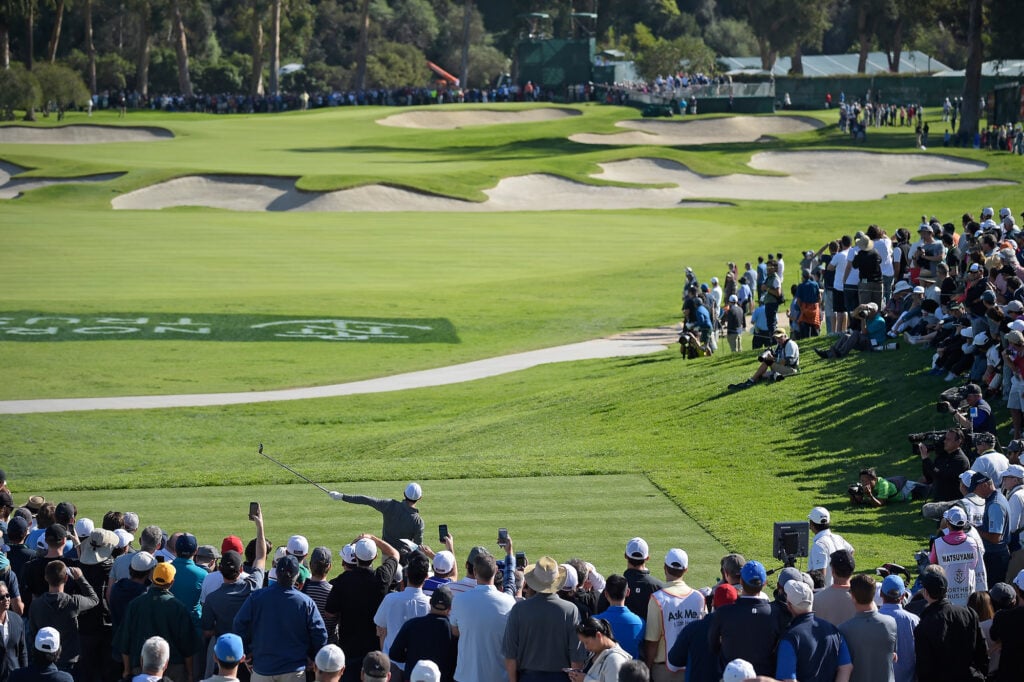
This year’s culprit is the 4th hole at Riviera Country Club. It is 273 yards, and the majority of the field will need to hit a wood, and some might need a driver. This has already sparked some debate as to what players and fans prefer: long par 3s or short par 3s.
Regular readers of NCG will know we love golf courses for one, and love talking about them even more. Dan Murphy and Matt Chivers throw their two-pence worth into the debate.
Tour stars never have a long iron in their hands, so why do we protest against monster par 3s?
A few years ago now, Dustin Johnson inadvertently revealed a shocking truth at the heart of professional golf, Dan Murphy recalls. At the season-ending FedEx Cup play-offs, he was asked about the difficulty of long par 4s. He matter-of-factly responded that the longest club he remembered hitting into a par 4 all season (my italics) was a 6-iron.
It is a cliché when discussing golf courses to say that the best ones call for you to use every club in the bag.
Given the difficulty of getting a long iron into the hands of a tour player, it is confusing that we routinely turn our noses up at any par 3 that is longer than 200 yards. But in an era where the average professional carries his 7-iron in the region of 185 yards, anything much less than that is a short iron.
Advertisement
It is therefore entirely reasonable for a par 3 at a major championship, or any event, to be played at 200 yards – and indeed well over that and nearer 300 yards.
As the chairman on NCG Top 100s course rankings, I prefer to think of a course’s par 3s not in isolation but as a collection. If together they have asked me to hit, say, a wedge, an 8-iron, a 6-iron and a 4-iron, and ideally play in multiple different directions of the compass, then that is a very promising start.
A good course provides the multi-skilled golfer with many and varied opportunities to prosper relative to his or her opponent(s). A diverse set of par 3s is a crucial part of that.
ALSO: Oakmont is a fearsome US Open venue – but it was designed to be brutal since day one
Shorter par 3s are so much more compelling and fun for the players and the fans
I am in no place to advise any golf course architect on how to design the perfect par 3, Matt Chivers modestly admits, but the wrinkles on my forehead bunch together when I look at a scorecard like Riviera, and see one that is 273 yards.
It’s clearer than ever that professional golf is about hitting it as hard as you can off the tee, then worrying later about where your ball finishes, in the knowledge that you’ll have a far shorter approach to the pin than if you didn’t wallop it.
Long par 3s, and especially the monstrous ones at pf recent times at Riviera and Oakmont, speak to this use of brawn and a lack of brains. This might be the romantic, idealistic side of the argument, but it’s where I fall.
Advertisement
Once we approach the 300-yard mark on a par 3, it becomes a significant achievement to find the perimeter of the putting surface, let alone the putting surface itself. Is the contentment of a player finishing in a vague proximity to the green what the course manager wants, what the fans want?
That applies to our level, as well as a professional level.
The Postage Stamp at Royal Troon, the 7th hole at Pebble Beach, the 15th hole at LACC, the 12th hole at Merion. Any golfer can tie themselves in knots on where to land the ball, what wedge to hit and judging the wind on these devilish shorties, and this is far more compelling than hitting woods on what are essentially short par 4s.
Skipping back to the pro sphere, I am happy for venues to adopt a monster par 3 or two. Reputations need to be upheld, and brands must be maintained. I will watch it regardless and will always be entertained by it.
However, this is a question of preference, and fans on the ground appreciate the viewing experience more when a player faces the agony of dancing his ball into a bottomless bunker, rather than rolling into the trap on its 20th bounce with a 3-wood.
“I just think all the best par 3s are under 200. You can maybe have it just over 200, but as soon as you start to take head covers off on par 3s, I just think it gets a little silly.” – the words of Viktor Hovland.
NOW READ: Does St Annes Old Links have the best collection of par 3s in Britain?
NOW READ: What is the best par 3 in England?
NOW READ: Play on a Par 3 golf course? You can put in a score for handicap
Advertisement
What do you make of the long par 3 debate? Tell us on X!
Advertisement