



Ben Hogan famously once said that the driver is the most important club in the bag because a good short game might save you a few shots, but bad driving will cost you plenty. With most penalty strokes happening because of shots with the driver, Hannah and Jack have 5 driving tips for mid-handicappers that are sure to help you out on the golf course.
- RELATED: Golf Swing Basics
- RELATED: This is why you keep topping your woods
Be Clever About Where You Tee Up
This can make a huge difference to how you visually see the hole and also how you feel stood over the ball. When you get onto the tee, instead of just teeing up your golf ball in the middle of the teeing area, have a look at the fairway and see if there are any hazards that you would like to avoid. If there is out-of-bounds left, then it’s a good idea to tee up on the left side of the tee box as you are then playing away from the danger and towards a safer part of the hole. You can’t always guarantee the ball goes away from the trouble but feeling like your aiming the big stick away from danger can help your ball stay away.
This might sound like a pretty straightforward piece of advice, but it is something that Tiger Woods and other PGA Tour professionals do week in and week out to get their tee shots closer to the middle of the fairway and away from trouble.
Understand What A Good Shot Looks Like
A lot of mid-to-high handicap golfers have too high expectations of what might happen when they hit the ball with the driver. Tour players do not hit every fairway, and neither will you. Golfers often get led into a false sense of security by hitting long straight shots at the driving range and are then shocked and disappointed at what they deliver hitting the driver on the golf course.
Advertisement
The purpose of the driver is to hit shots that land on grass in between the trees or hazards that line the hole. This can mean hitting the fairway or the semi-rough, or even the first cut of rough, and generally, this is okay. A good stat to keep track of to measure the performance of your driving is how many shots do you get ‘in play’. A shot is considered in play if you have a straight shot to the green where your swing isn’t impeded, you might not get the ball on the green every time from here but these shots won’t cost you double bogeys, which is what mid handicappers need to cut out from their card.
If you lower your expectations from hitting fairways to getting the ball in play, often you will hit more shots in the fairways as the targets just seem bigger.
Play With What You Have
The best strategy for getting around the golf course is not to fight your natural ball flight, but to play with the shot shape you have that day. If that means you have to aim up the left to play for your natural slice to finish in the right rough, then so be it. It is not advised that you try something you haven’t already practised plenty of times – golf is hard enough doing what you know; experimentation should be saved for the practice ground!
It is useful to know what your full swing shot tendencies are and what you can do to make them playable. For example, if you have a hook golf swing, then you have an issue with the face being too closed, so something that will allow you to play with this is moving the ball position back in your stance or simply just aiming more right. Do not keep aiming down the middle of the fairway and hoping it will go straight either, as this, too, is a terrible strategy.
Advertisement
Make Your Swing Flatter
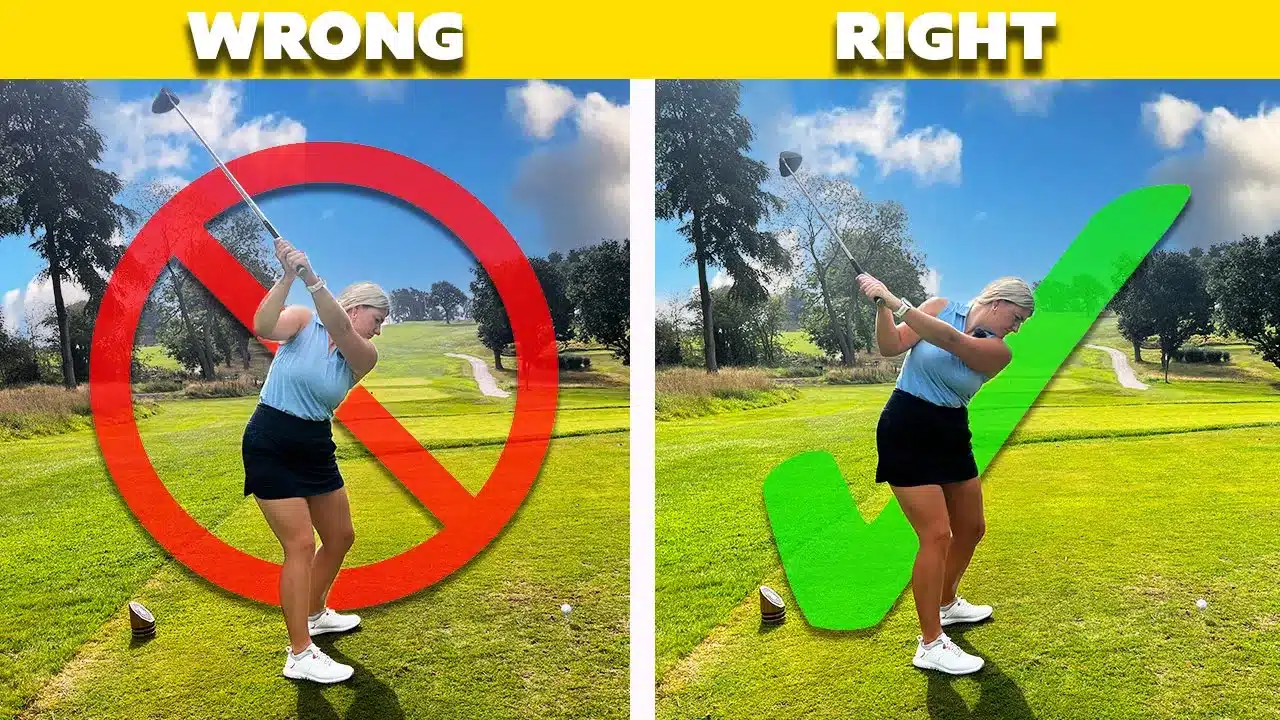
This is a common theme in our driver tips videos this year and is still great advice. There are so many advantages to making your driver swing flatter for mid-handicap golfers: More swing speed, more height on shots, more neutral swing path, shorter approach shots, less steep angle of attack and so on.
Rory Mcilroy, the best driver of the golf ball, maybe ever, has one of the flattest left arms on tour, and we should be learning from this! This is a great tip for beginner golfers too, and maybe all levels of golfers.
Ideally, your lead arm (left arm for a right-handed player) would be across your chest and level with the plane of your shoulders, as this could give the golf club enough depth to swing down on the inside in the downswing, creating a shallow, in to out swing path and a draw shot shape.
Know How Far You Carry The Ball… On AVERAGE
Your average shots do not go the same distance as your day’s best; it is obvious, but some people do seem to need reminding. Knowing your average is very important because this is what you should be looking at when deciding to either go over or lay up short of hazards. As a general rule, there should be at least 10 yards between the carry of the hazard and your AVERAGE driver carry distance to make sure you get over it safely.
To get your scores lower, you need to cut out unforced errors, and driving the ball into a hazard when trying to carry it definitely is an unforced error and can normally be avoided.
These tips aren’t that technical and can be taken to the course on your next outing; give them a go and let us know how you get on!
Advertisement
- RELATED: How to strike your irons properly
- RELATED: Can We Shoot Level Par with Hickories?
- RELATED: Are you using the right fairway wood for your game?
Advertisement