



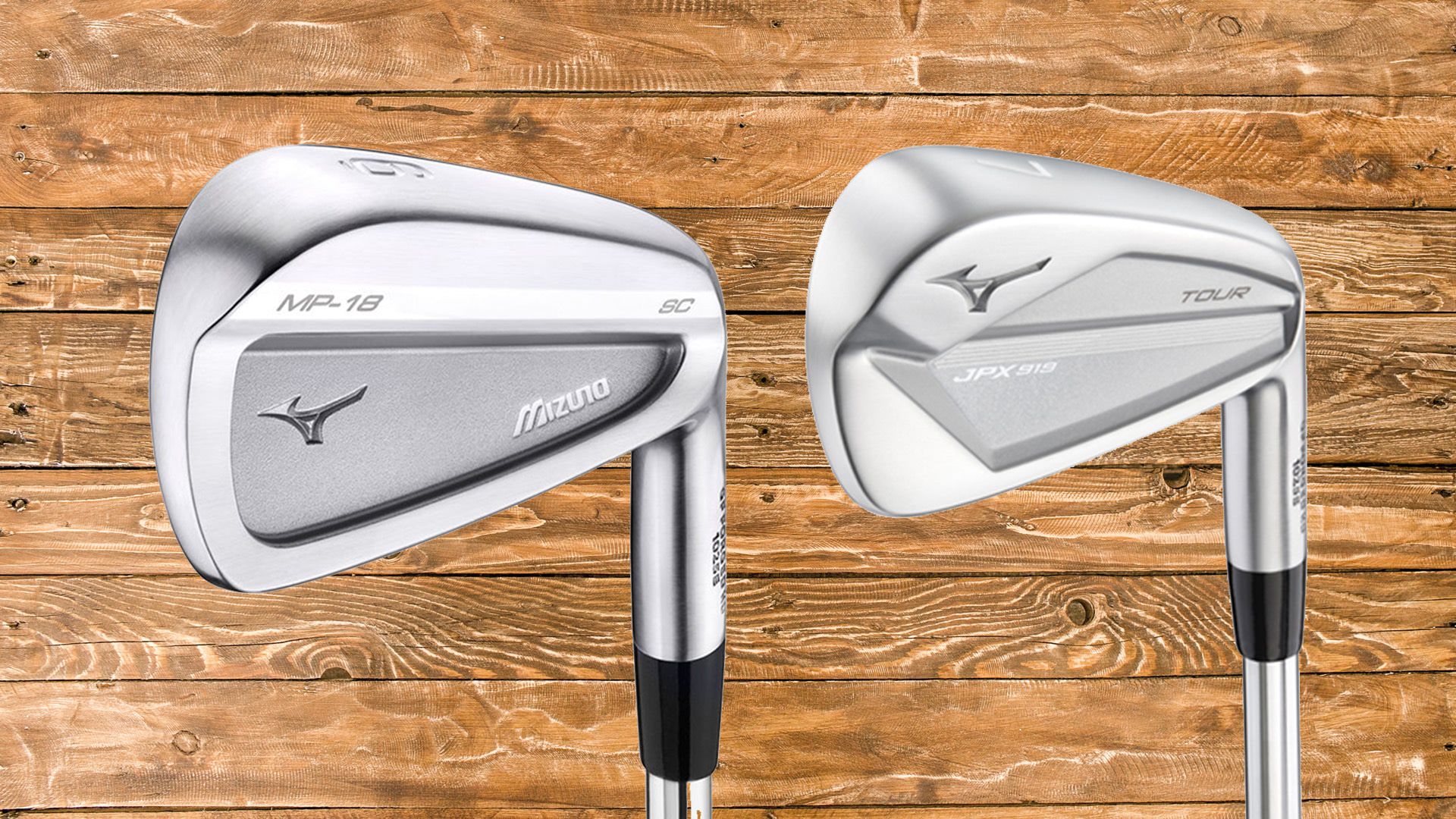
Our Mizuno JPX919 vs. MP-18 irons test took place at Rudding Park in North Yorkshire.
Data was gathered using a SkyTrak launch monitor and we used premium golf balls.
Mizuno JPX919 vs. MP-18: The methodology
So are you a JPX or an MP sort of golfer?
Traditionally, Mizuno always had their MP irons for ‘better players’ who want clean and classic, blade-like looks.

But with the introduction of the JPX900 Tour a couple of years ago there was then a JPX iron for the ‘better’ and tour players.
[skylab_video id=”150474″]Mizuno JPX919 Irons Review | Tour, Forged and Hot Metal[/skylab_video]
The JPX line and the MP line differ quite a bit. The former is more about cutting-edge technology, youthful and aggressive styling.
The MP line is all about that classic blade look and feel.
The JPX900 Tour were created with Brooks Koepka in mind – a young, athletic, aggressive player. He has since won three majors with them.
But some players will always gravitate towards the MP line. Paul Casey and Luke Donald are two who immediately spring to mind.
[skylab_video id=”124943″]First look: Mizuno MP-18 irons[/skylab_video]
So how could we put the JPX and the MP head-to-head?

Well, it has to be the new JPX919 Tour up against one of the new models from the MP-18 range.
We felt the JPX919 Tour and the MP-18 SC were about as similar as it got from a size and proportion point of view.

Both have almost exactly the same heel-to-toe blade length, top line, offset and sole width.
Mizuno JPX919 vs. MP-18: The technology
Both these irons are forged using Mizuno’s HD grain flow forging process. What the heck is that?
It’s basically the same forging process they’ve used in previous models – using a single billet of 1025 E pure select mild carbon steel – but they’ve made a tweak to the construction of the moulds.
Advertisement
It allows them to concentrate a higher density of metallic grains to really amplify the feel.

The JPX919 Tour is a touch more compact than it’s 900 predecessor but has a new stability frame which makes it more forgiving.
The MP-18 SC offers a touch more forgiveness than the MP-18 blade thanks to it’s split-cavity design.
So that’s the lowdown – but how did they perform? Find out the results of the testing and James’s verdict on the next page…
Mizuno JPX919 vs. MP-18: The results
So I’ve gathered some data on both irons after hitting a load of shots on the SkyTrak launch monitor.
And the results are very interesting.
Interesting in the fact there’s very little between them when it comes to the performance.

Maybe a touch more ball speed with the JPX919 but launch, spin, carry and total are all very similar.

My normal carry distance with a 7-iron would be 155 yards but we’ve got traditional lofts of 34˚ on each of these models.
So 7-irons in the JPX919 Tour and MP-18 SC are basically 8-irons when compared the the model of iron I would normally use.
That’s primarily why we see a carry of 145 and not 155.
Mizuno JPX919 vs. MP-18: NCG verdict
So, seeing as the performance of these irons are pretty much exactly the same – I wouldn’t say one is easier to use or more forgiving than the other – it’s all about looks.
It really comes back to the original question – are you a JPX or an MP player?

Are you all about the classic blade or are you a bit more ‘edgy’ and modern?

And that’s a question that only you yourself can answer.
Which model would I be leaning towards – if I was good enough to hit them consistently?
Advertisement
From a looks point of view, I’d be very much leaning towards the JPX919 Tour because, despite being in my mid 30s, I’m still down with the kids.
But after hitting both, I just seemed to enjoy using the MP-18 that little bit more – the look, sound and feel of them is simply sensational.
They’d excite me every time I went to play or practice with them.
So despite being young, athletic and aggressive just like Koepka, I’d be more than happy to settle in for a Netflix and chill night with the MP-18.
Mizuno JPX919 vs. MP-18 details
SRPs:
JPX919 Tour: £135 per iron
Available: 3-PW, right hand only.
MP-18 SC: £135 per iron
Available: 3-PW, left and right hand
More information can be found on the Mizuno website.

Slow play and what actually happens on the European Tour
Advertisement