

Attack wedge: An attack wedge is another name for a ‘gap wedge’. This fits between your pitching wedge and sand wedge in a set of clubs.
Bore-through: Bore-through refers to a golf club whose shaft goes into the club head and through to the bottom of the sole of the club, as opposed with a traditional hosel which only goes partially into the club head.
Coefficient of Restitution (COR): COR is a technical term describing the energy transfer between two objects. So when a golf club collides with a golf ball, energy is transferred from the club to the ball. The more energy transferred, the father the ball can travel.
Centre of Gravity (CG): Centre of Gravity, or CG as it’s most commonly referred to is the point within the head of a golf club at which it would be perfectly balanced. Having a low CG that is to the back of the club will result in a higher trajectory.
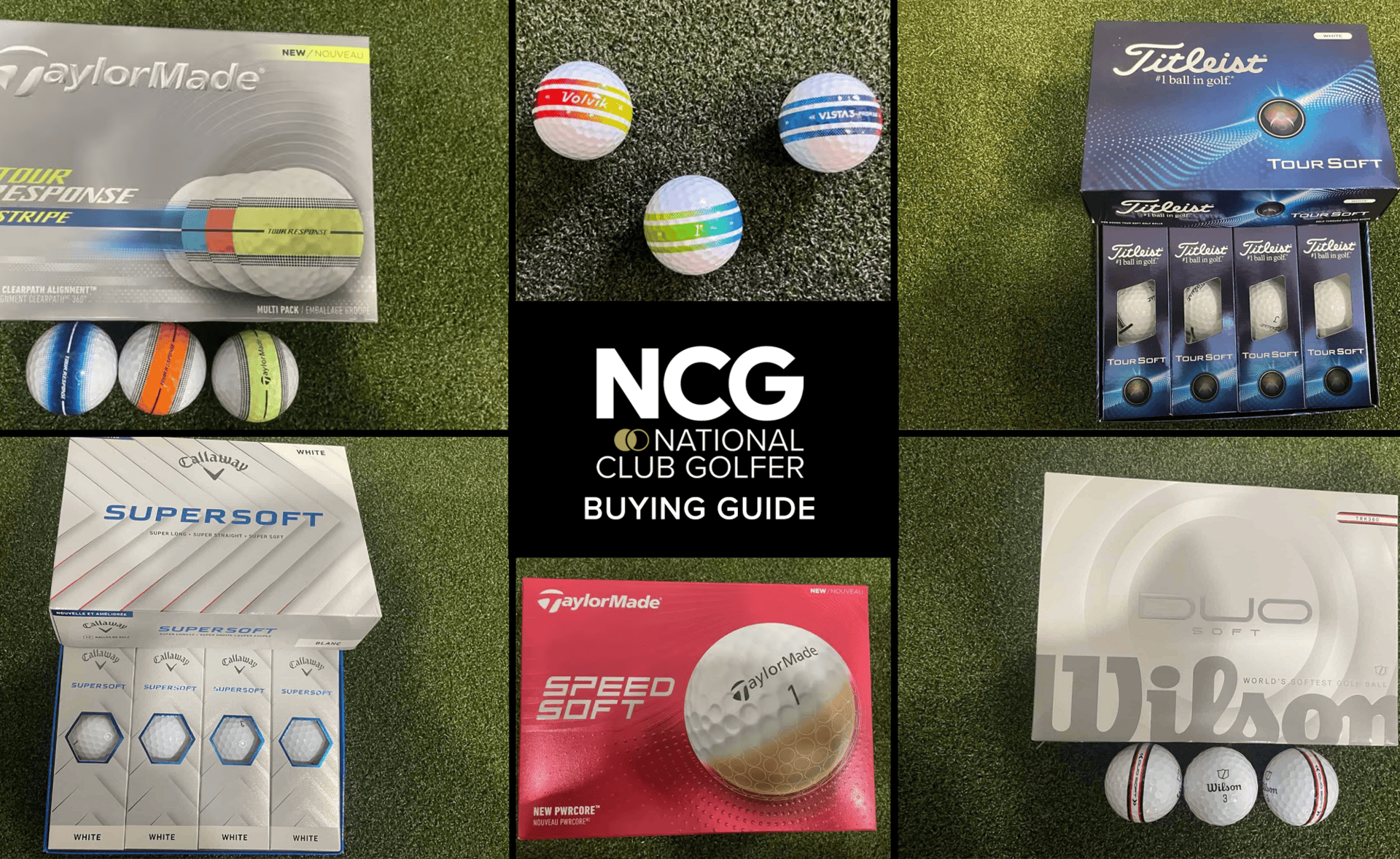
Dimples: Dimples are simply the indentations that cover a golf ball. Changing the shape and depth of individual dimples has an effect on the flight of the golf ball. Having deeper dimples on your golf ball will result in lower trajectory.
Forgivness: This refers to the construction and design elements in a golf club that help lessen the effects of bad swings and off-centre hits. If you hit the ball off the toe, or the heel of the club and still get good distance, that club will be known to be ‘very forgiving’ or offer a lot of ‘forgiveness’.
Grass club: This is the historical equivalent of the driver, back when clubs had real wooden shafts. A term most commonly used prior to the 20th century.
Hosel: The hosel is a part of the clubhead. It is the part where the shaft is fitted and secured, a lot like a socket. the entry point at the top of the hosel is often covered by plastic to hide the connection between the shaft and clubhead.
Advertisement
Launch angle: This is the initial angle the golf ball ascends immediately after impact with the club face.
Loft: The ‘loft’ is a measurement in degrees of the angle at which the club face lies relative to the shaft of the golf club. The lowest loft will be in your driver, more often between 9- 12.5 degrees. As you move through the set loft will increase, until your reach your wedges where the lofts are normally set between 48-64 degrees.
Moment of Inertia (MOI): The moment of inertia, which is commonly shortened to the MOI is simply the club heads ability to twist on impact. A club with a higher MOI will be more resistant to twisting in comparison to a club with a low MOI. This is why clubs with a high MOI are more forgiving, as off centre hits will result in the club head twisting to straighten the ball flight out.
Offset: Offset is a design in golf clubs where the leading edge of a club face is set back from the hosel or neck of the club. Offset originated in putters to help golfers get their hands in front of the ball. It is also good for players who slice the ball as it allows more time to square the club face up before impact.
Shaft: The shaft of a golf club is the long tapered tube that connects the golfers hands to the clubhead. Shafts come in various different designs in order to help different abilities to effectively strike the ball with force.
Torque: Torque is simply a measurement of how much a shaft is prone to twisting during the swing. A shaft with a low torque will resist twisting, whereas a shaft with a high torque will result in more twisting during the swing.
Advertisement