


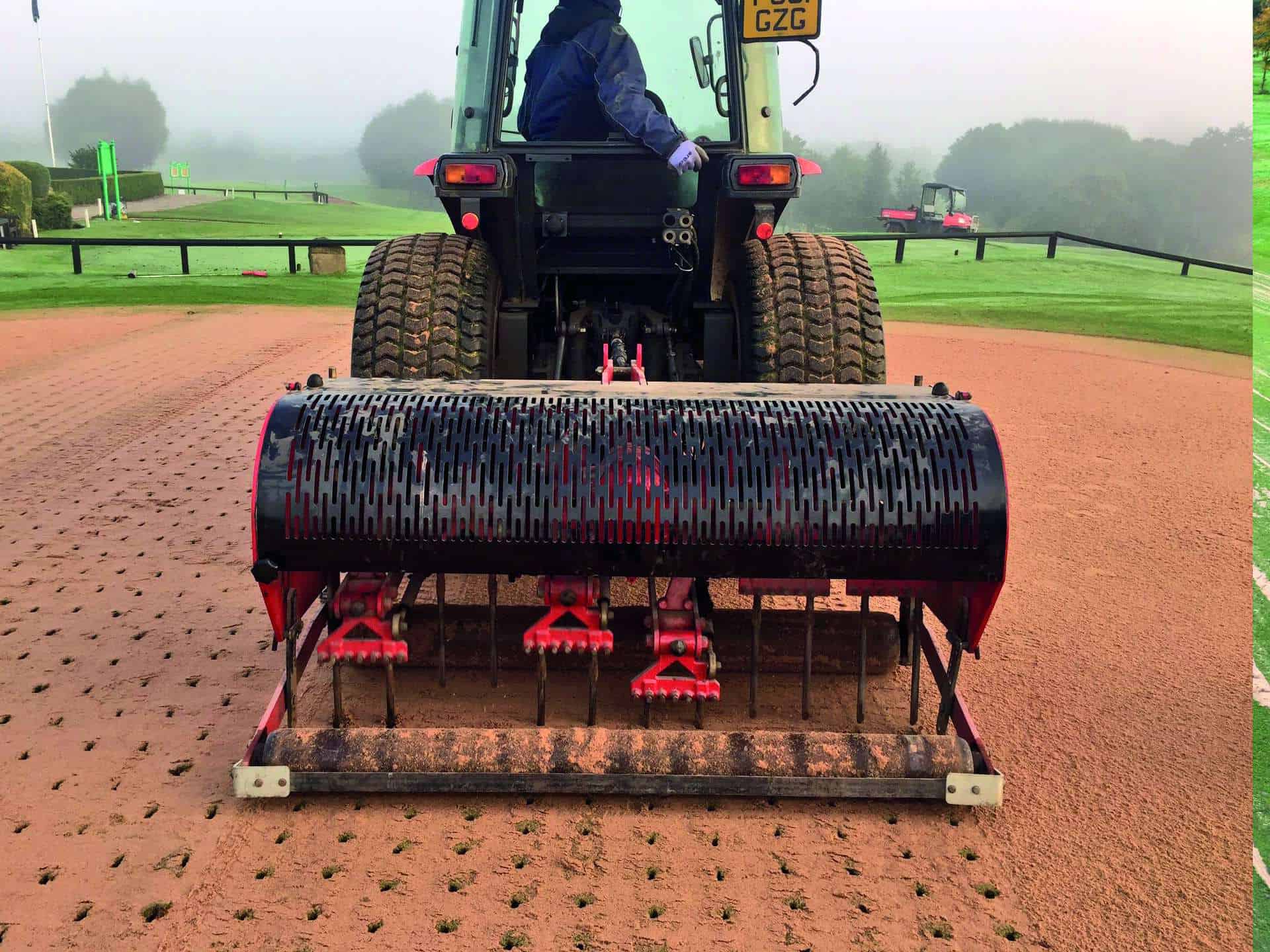
There is no point in beating around the bush. The sight of loads of holes punched into a green deflates the average golfer.
But do we really understand how necessary it is for the health of our putting surfaces? If our greenkeeping teams did not perform this vital maintenance, we’d soon know about it and we’d soon be complaining.
That’s because to keep our greens healthy and at their best you have to aerate.
What is aeration?
I once asked a turf expert this exact question and he replied with this: “It’s to replace anaerobic air in the soil with aerobic atmospheric air”. Any the wiser? No, I wasn’t either but then he knocked me out with a few facts that helped break it down.
Here’s the first: Grass roots do not grow in soil. But isn’t that soil below the ground? It is, but the roots grow in the air pockets between the particles of soil.
Aerating helps air and water better penetrate that soil. It helps relieve soil compaction and that means your greens play better, and it means you can use the surface longer – assisting in the demand for all-year round playability.
Soil structure is improved, along with rooting capacity, and any toxic gases that may be present in the soil can be released. It also allows greenkeepers to deliver nutrients and fertilisers right into the root zone of the plant.
So how do greenkeepers aerate? Well, they create holes. The aim on greens is to move water away from the surface as quickly as possible and that means aerating at all sorts of different depths.
Some of the methods used to achieve that include solid tining, star tining, air-injection and hollow tining.
What is solid tining?
A solid tine is piece of cylindrical metal that punches into the soil and makes a hole. It can be attached to various sorts of machines – you’ll probably have heard of a Verti Drain – and can then be adjusted to produce ‘heave’.
Advertisement
Tines can go straight in and out, and will provide minimal disruption to the surface, and they can also be moved to lift the soil. That fractures it and opens up the ground as it comes out.
You can have micro-tines, some of which are almost like needles and produce lots of holes, and you can also have tines that are much bigger, make sizeable holes, and usually go a lot deeper into the ground.

What is hollow tining?
It’s a round tube that penetrates into the ground. It collects a core of soil and when that tube penetrates again the core is pushed out through a hole.
That allows your greenkeeping teams to remove material such as thatch along with poor quality soil and means water and air can get into the root zone.
But when a core comes out, something needs to take its place. So when thatch is extracted, top dressing is applied behind to fill up those holes.
The easiest way to think of it is as an exchange of soil. Thatch is removed and good sand, or a mixture of sand and other materials, replaces it and helps move water through the surface and drainage.
That makes it easier for the plant to grow and healthier too.

What is top dressing?
It’s a layer of sand, or sand mixed with other materials, that is spread across the green. There are many different ways of doing that. You’ll might see greenkeepers produce a light sanding of greens on a regular basis, or they may do it more infrequently but heavier.
The point of top dressing is to dilute the thatch that sits between the surface and the soil, improve the quality of the soil and drainage and maintain a smooth and true putting surface.
Advertisement
It all helps promote a better grass plant and a better green.
Top dressing and aeration can take place at the same time, so if greens are hollow tined then whatever is in the top dress mix can be integrated into the soil through the holes in the surface.
- NOW READ: What is thatch on a golf course?
Advertisement