


Dirty balls, countless books and worn down putters – the treasure trove of memorabilia at Michael Herriot’s house runs deep.
His wife says he’s got too much of it but James Braid has fascinated him since he was a boy and it’s been a lifelong obsession.
“I’ve got examples of all the clubs he made – you name it, I’ve got it.”
If there’s anything worth knowing about the five-time Open champion then Herriot is the man to ask.
Did you know, for example, that Braid invented the mallet-headed putter?
“I have a couple of Braid Mills putters. There was a firm, Mills in Sunderland, who made them for him.
“That was so ahead of its time. We went through a phase of having wooden, mallet-headed putters but, in 1910, here he was inventing a club that really didn’t become popular in the UK until the 1950s.
“Each of the clubs were made to a specific weight for the individual concerned. He would make the club for a member and have the head specially made.
“You could have them light or heavy. These were things that nobody else was doing at the time.”
But Herriot’s love of Braid has gone much further than racks of old hickories and drawers full of Haskells.

A decade ago, the Henley member started the Association of James Braid Courses – and a members’ list that first numbered 30 now tops more than 300.
It’s a sheet that’s 36 pages long and includes St Enodoc, Southport & Ainsdale and Royal Blackheath, as well as Saltburn, Kedelston Park and Hockley.
The ethos of the association is simple. If you are a member of a Braid-designed club, you can go and play another one that’s tied to the association for a reduced green fee.
Advertisement
“It was Henley’s centenary in 2007 and we had round-robin matches with other clubs within 50 miles that were 100 years old at the same time,” Herriot explains of its humble beginnings.
“I thought it would be great for the members if they could go and see other Braid courses. I did a lot of research and got a list of all the clubs that I thought Braid had something to do with – either designing the original or redesigning bunkers or shapes of fairways and things like that.
“I started to email them and the first members’ list was in 2009.”
Of the more than 400 courses where Braid left his mark, Herriot has played 93 to date.
The first was as a 10-year-old boy when he set foot upon Cowglen, in Glasgow, and a club historian gave a talk and ignited the spark.
He’s been following Braid around Britain ever since and there are two layouts that hold a particular fondness.

“I don’t think there is an inland course, of that age, that can beat the King’s course at Gleneagles. As someone wiser than I said ‘if you are not playing well, just look at the views’. On the King’s course, you can play badly but still have had a great day.
“The other would be Brora, which is probably a typical Braid links course laid out on the land between the sea and the town. It’s a straight out nine and straight back nine.
“Other than where they have tried to gain a few yards, I suspect it is more or less as he wanted it laid out.
“It’s still has sheep on it, cows on it, and all the greens are protected by electric fences so it’s really what golf was all about 100 years ago.”
Advertisement
Turn the page to read Herriot’s memories of meeting Braid’s relatives and how he designed Henley in half a day…
The spirit of Braid lives on in the association and in the lengths some golfers will go to play his designs.
Herriot has been part of a group that has been “touring” for 30 years – “we’re now old men” – and never fail to take in at least one Braid course wherever they have travelled in the UK.
He also knows of players who keep their clubs permanently in their boot, waiting for the moment they can grab a half-day – or a spare evening in the summer – and nick off and play one of his courses at the special rate.
But for Herriot it is beyond a simple appreciation of the man’s ability to mould something special from the soil.
“He wasn’t just a golfer, he was a gentleman who, according to books written about him, played golf every day of his life.
“If he didn’t have a game at Walton Heath, he would stand on the first tee to wait for a singleton to come along and would even go out with a junior.

“I have a copy of a famous story of someone’s experience playing with Braid in such circumstances. He just happened to be out and there he was standing on the first tee.
“That, to me, is what golf is all about. It’s about friendship. You can play like a 50 handicapper but still have had a great day because you’ve got your mates with you and you’ve a bit of banter during and afterwards.
“When you think he got a day off from Walton Heath, which usually was him playing an exhibition match with Harry Vardon, JH Taylor or some of the amateurs and, in that day off, he designed golf courses.”
Advertisement
He put Henley together in just half a day, drawing on a lifetime of golfing knowledge and the visions in his head of hole designs.
“He didn’t believe in moving a lot of earth other than to make the tees and make the greens. He used one company in the main to do all that – Stutt’s. They knew how he worked and he knew how they worked.
“He would come to a place like Henley and put a peg in the ground where he wanted the first tee.
“He was a very tall man so his steps were virtually a yard long and he would walk the first hole and put a peg in the ground where he wanted the green. He would make a note that the first hole was, perhaps, a number 23 of the holes he carried in his head.
“Then he’d go onto the second and do the same thing, all the way round. He’d take his notes back to Walton Heath, get out the topographical plan and plot the holes onto it – putting in bunkers if he felt they were needed.
“He wasn’t a great user of bunkers. Berkhamsted has no bunkers, Chorley Wood has no bunkers, and then the draughtsmen at Walton Heath would draw it out on a topographical plan.

“He’d sent it to the golf club and say ‘This is what I want. I’ve sent it to Stutt’s and they will be in contact’. For £15 3 and tuppence ha’penny, he designed Henley.”
Herriot can tell you how Braid designed the dogleg, or how Seve Ballesteros once declared the 12th hole at Henley to be so fine he would happily put it on any golf course in the world.
Advertisement
But his favourite story is not one of heroics at the Open, or of how a spectacular course came into being.
It’s a much simpler scene that epitomises why Herriot holds the man in such high regard.
“I had the pleasure to sit next to one of his granddaughters at a dinner. I said, ‘So what was he really like?’
“She said, ‘Well, we used to go there on Sunday for tea and he’d say hello. And when we left, he’d say goodbye.’ To me, that tells you a lot about Scottish people, but it also tells me a lot about the man.
“He was very quiet. Vardon was probably the flashier, dare I say, of the Triumvirate whereas Braid was quiet and perhaps an in the background type of person.
“For me, that sums up the man more than anything.”
 Who was James Braid?
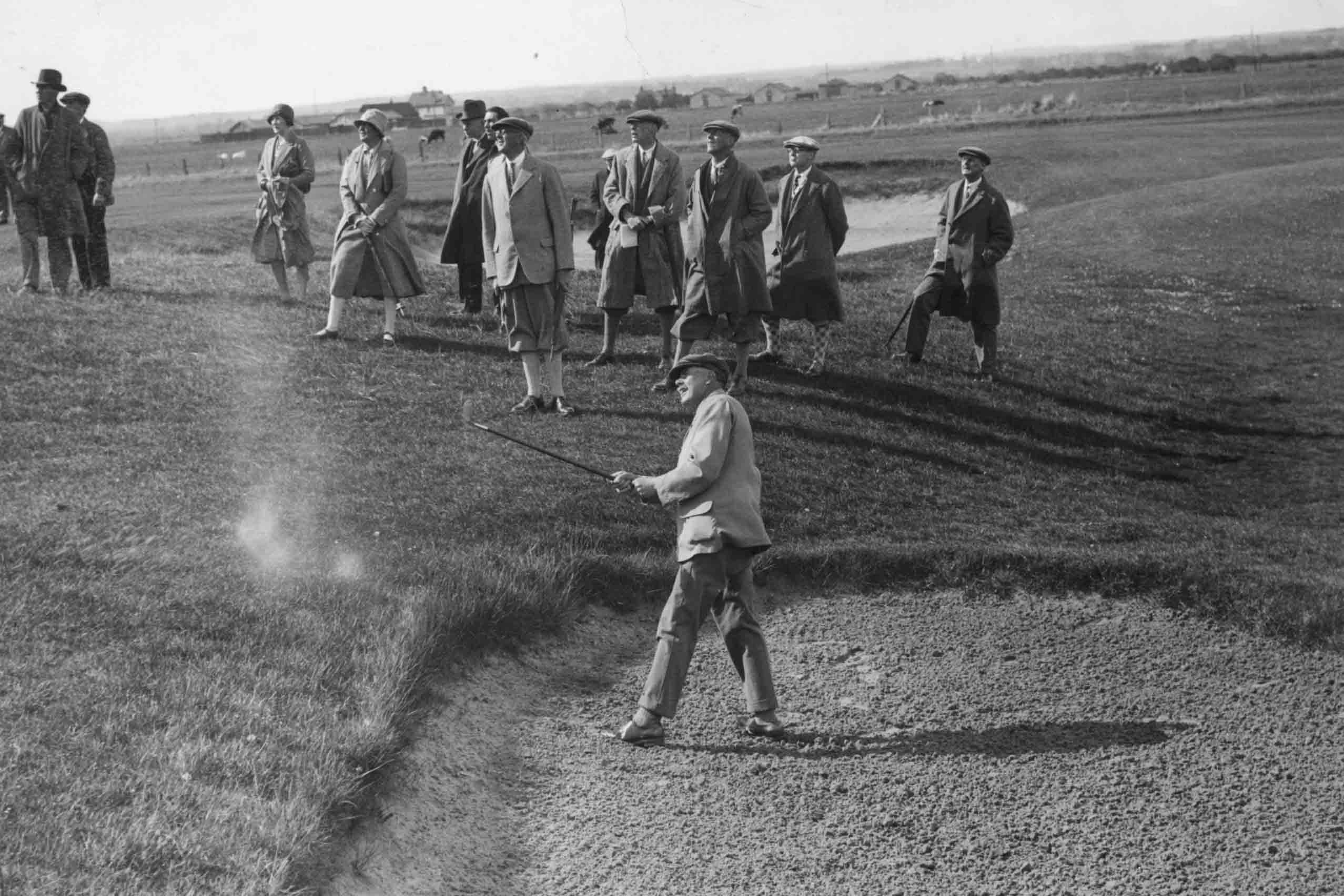
Part of the famed Great Triumvirate that dominated golf in the late 19th and early 20th century, which also included Harry Vardon and JH Taylor, James Braid won the Open Championship on five occasions between 1901 and 1910.
Born in Earlsferry, in Fife, he learned to play at an early age and worked as a club maker before turning professional.
He became the club professional at Walton Heath in 1912 and scaled back his competitive engagements – becoming more involved in course design.
Braid would go on to design or alter some 400 courses, including creating the King’s and Queen’s courses at Gleneagles while also remodelling Carnoustie.
‘Seve would have hit that 1-iron under the branch, over the trees, and taken a gamble’

Meet the man who walked off during a Masters practice round with Nicklaus
‘I had two heart attacks and played European Senior Tour qualifying 14 days later’
Advertisement